Organism · Dinosaurs
Secernosaurus koerneri
Source time context (not species duration) · ≈ 143–66 Ma
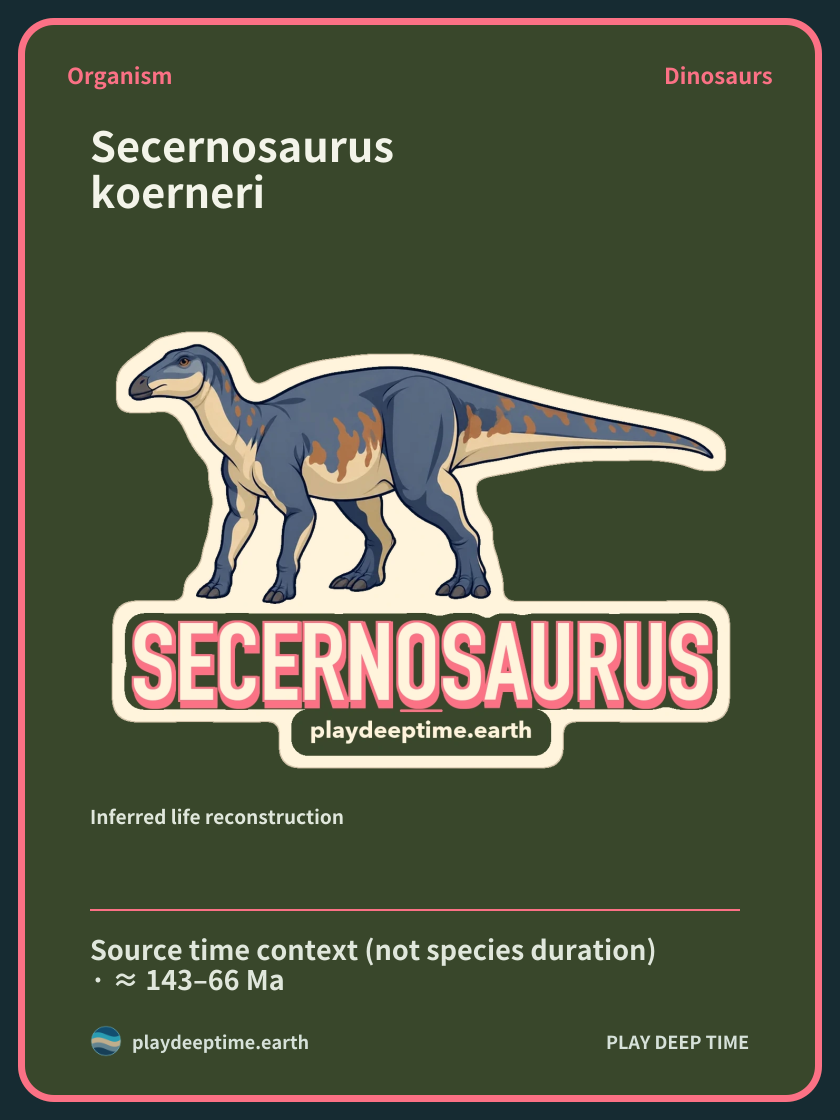
Inferred life reconstruction
Secernosaurus koerneri
Overview
Plant-eating dinosaurs with broad, duck-like mouths did not live only in North America. Secernosaurus koerneri was a hadrosaur from Patagonia in South America. It broadens our view of dinosaur distributions at the end of the Cretaceous.[1][2]
Loading illustration…
Key facts
The teeth in its jaws formed batteries of many teeth rather than working individually or in pairs. Such structures are compared as plant-processing apparatus. Behind the duck-like mouth lay complex tools for a plant-eating life.[1]
Time and place
It is known from Late Cretaceous Patagonia. Major specimens have been studied as coming from layers close to about 70 million years ago. Localities around the Chico River and Lake Colhué Huapi in present-day Chubut Province, Argentina, are important for comparisons.[1]
The time range describes source context, not the complete duration of this species.
Size, form and skeleton
Type specimen FMNH PP13423 includes fragments of dental batteries, the base of the skull, neck and back vertebrae, ribs, and parts of the shoulder and forelimbs. Several body regions can be compared with other hadrosaurs. Each fragment helps fill out the outline of this broad-mouthed dinosaur.[1]
The Natural History Museum in London gives a body length of about 3 m for the genus Secernosaurus.[3]
Loading illustration…
Habitat and reproduction
Hadrosaurs were a group of plant-eating dinosaurs. The many teeth forming their dental batteries processed vegetation. Comparing Patagonian specimens with relatives from other continents reveals how far dinosaurs with similar feeding apparatus spread.[1][2]
Fossil discovery
After Brett-Surman introduced it as a new species in 1979, research on South American hadrosaurs continued. In 2010, the relationship between this species and material of Kritosaurus australis was reexamined. New specimens and anatomical comparisons continue to refine the names and relationships of dinosaurs in this region.[1][2]
References
Research questions
How were South American duck-billed dinosaurs related to species on other continents? Analyzing features of the head and body together allows study of movement between continents and diversification within regions. This dinosaur encourages us to consider geography and evolution together.[1]
Observation
Move your gaze from the broad mouth to the jaws and trunk.[1]
Related organisms
 Corythosaurus casuariusDinosaursSource time context (not species duration) · ≈ 143–66 Ma
Different bodies among dinosaurs
Compare the bodies and backgrounds of Secernosaurus koerneri and Corythosaurus. Secernosaurus koerneri: plant-eating dinosaurs with broad, duck-like mouths did not live only in North America; this hadrosaur came from Patagonia in South America. Corythosaurus: Corythosaurus casuarius is known for its tall, helmet-shaped crest and long, narrow beak. Genus-level accounts also describe nasal passages extending into the crest.