Organism · Animals
Selkirkia columbia
Source time context (not species duration) · ≈ 510 Ma
Inferred life reconstruction
Selkirkia columbia
Overview
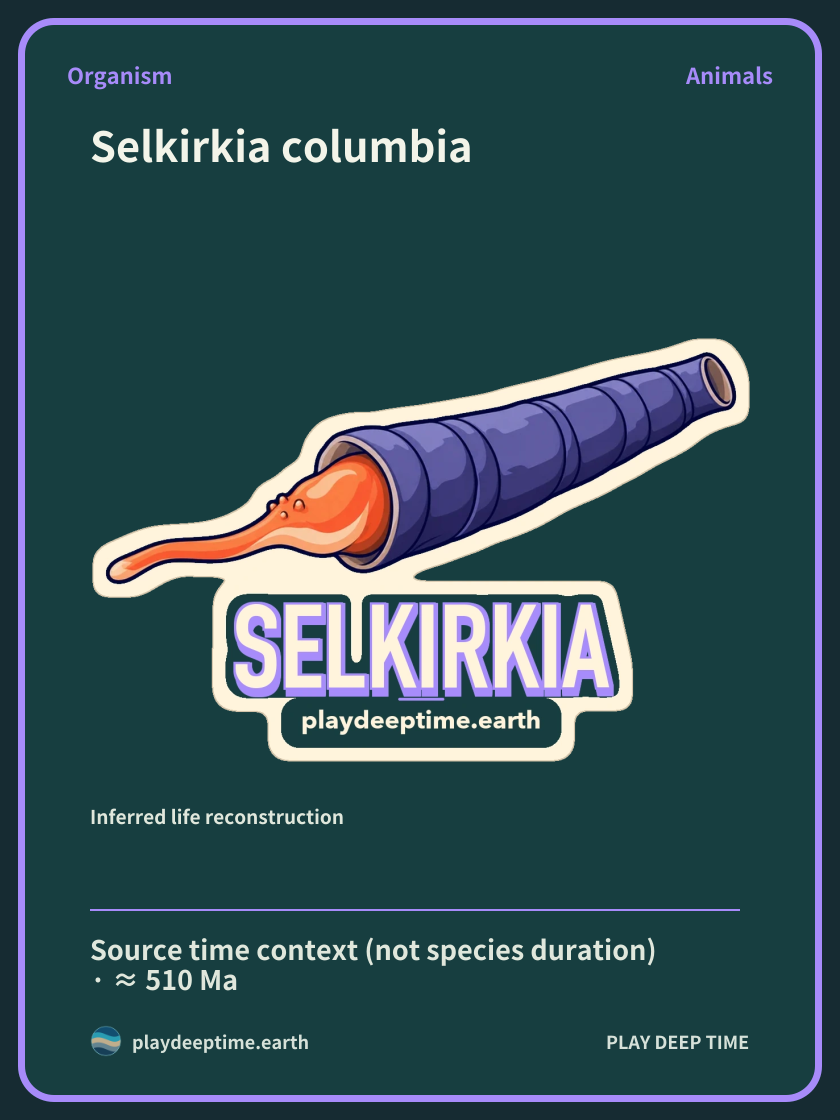
Selkirkia columbia is a Cambrian worm whose body lies inside a tube open at both ends. Its anterior region and proboscis extend toward the front opening. This arrangement invites consideration of both the outer tube and the organism inside.[1]
Loading illustration…
Key facts
The proboscis is described as capable of turning outward. The tube surrounding most of the body and the anterior region near its opening provide different information.[1]
Time and place
Selkirkia columbia specimens USNM 57624 and GSC 45330b come from the Walcott Quarry. This locality lies on Fossil Ridge in present-day British Columbia, Canada. The entire Cambrian spanned approximately 540–490 million years ago.[1][3][4][5]
The time range describes source context, not the complete duration of this species.
Size, form and skeleton
The tube is open at both ends and tapers gently in one direction. Most of the body lies inside, while small anterior projections and a single proboscis extend toward the opening. The long tube and its front region can be examined separately.[1]
The museum species account describes it as growing up to approximately 6 cm long.[6]
Loading illustration…
Habitat and reproduction
Which parts would an organism inside a tube expose? The account of Selkirkia’s form explains the connection between the tube opening, anterior region, and proboscis. This observation considers the surrounding structure and the organism itself together.[1]
Fossil discovery
The museum’s species account connects a tube open at both ends with the body inside. The scope of observation expands from the tube’s outer outline to small parts around its opening. One organism is understood through two kinds of structures.[1]
References
- Royal Ontario Museum — Selkirkia columbia
- Paleobiology Database — Age of fossil-bearing strata of Selkirkia
- Royal Ontario Museum — The Burgess Shale locality today
- Royal Ontario Museum — Waptia fieldensis
- International Commission on Stratigraphy (2024) — Geological time chart
- Royal Ontario Museum — Selkirkia columbia
- The Burgess Shale: Louisella pedunculata
- Conway Morris (1977) — A study of fossil priapulids
- Comparative study by Shi et al. — Trunk projections of Louisella
Research questions
How can a fossil tube be distinguished from the organism inside it? Examining the connection from the tube opening to the anterior region and proboscis helps distinguish the body from its surroundings. Small clues within a broad outline are important for this organism.[1]
Observation
First examine both ends of the gently tapering tube. Then locate the anterior body region and proboscis at the front opening to reveal the relationship between the outer tube and inner organism.[1]
Related organisms
 Louisella pedunculataAnimalsSource time context (not species duration) · ≈ 539–487 Ma
Tubes and proboscises of Cambrian worms
Explore the different records of bodies and time preserved by these two organisms. Selkirkia columbia is a Cambrian worm whose body lies inside a tube open at both ends. Its anterior region and proboscis extend toward the front opening. Its specimens USNM 57624 and GSC 45330b come from the Walcott Quarry on Fossil Ridge in present-day British Columbia, Canada. Louisella pedunculata is a Cambrian worm with an eversible proboscis in front of a ringed trunk. Rows of small projections are described on the trunk. It is known from the Walcott Quarry on Fossil Ridge, a Middle Cambrian locality in present-day British Columbia, Canada.