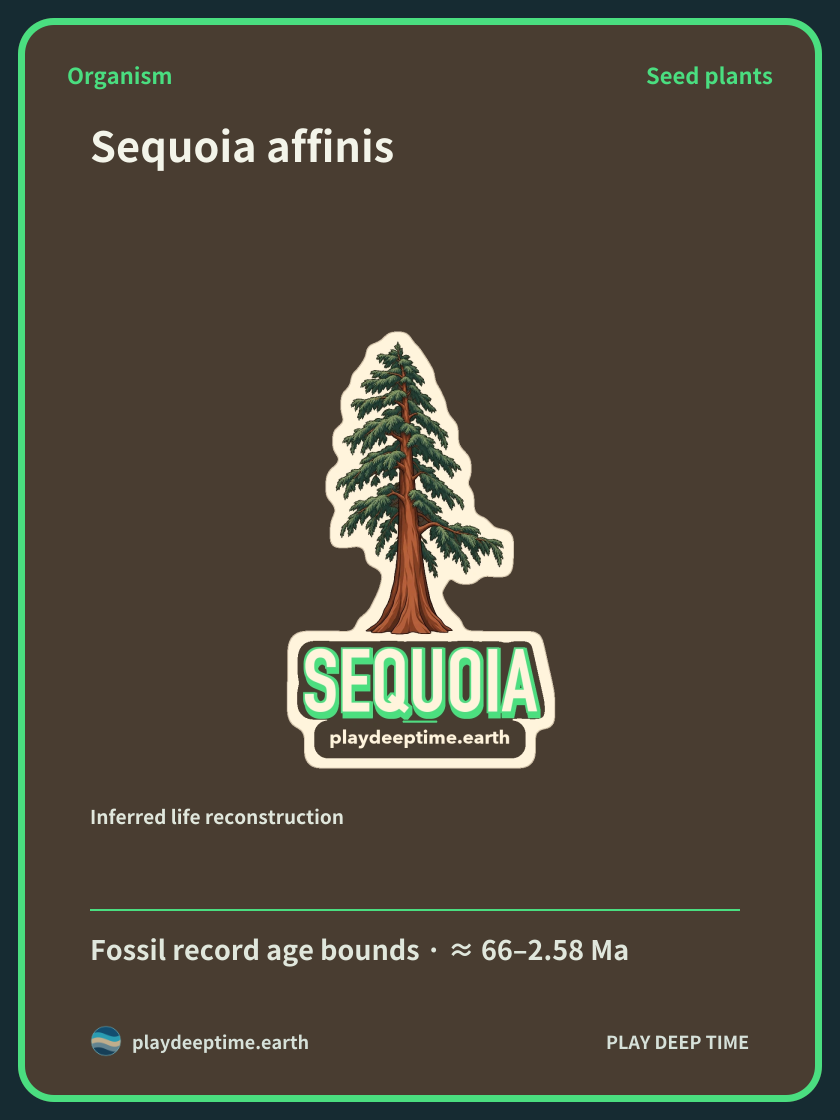
Organism · Seed plants
Sequoia affinis
Fossil record age bounds · ≈ 66–2.58 Ma
Inferred life reconstruction
Sequoia affinis
Overview
Sequoia affinis is a fossil redwood from Florissant. Slender fossil leaves and branches, as well as massive petrified trunks, convey the form of an ancient tree. The park introduces it as a fossil closely related to the living coast redwood.[1]
Loading illustration…
Key facts
The scale of observation changes dramatically from thick stumps to tiny pollen grains. The park explains the ancient redwood by presenting wood, leaves, male and female cones, and pollen separately.[1]
Time and place
This story follows fossils from Florissant in present-day Colorado, USA. The park account also presents the background of the genus Sequoia, which was widespread across the Northern Hemisphere during the Eocene.[1]
The time range describes source context, not the complete duration of this species.
Size, form and skeleton
The park explains that fossil redwood leaves were narrower than those of today’s coast redwood and often attached closer to the branch. Leafy branch fossil FLFO 3661 provides one clue. The cones are described as smaller than those of the living coast redwood.[1]
Sequoia affinis left enormous fossil stumps at Florissant in present-day Colorado, USA. Based on their thickness, the United States National Park Service explains that the trees’ average height may have exceeded 76 m.[7]
Loading illustration…
Habitat and reproduction
Even tiny pollen grains convey the tree’s life. The park describes how pollen from male cones traveled on the wind, settled into a lake, and survived in the sediments.[1]
Fossil discovery
At Florissant, thick trunks can be seen as petrified stumps. Shale also preserves traces of leaves and cones, allowing the tree to be understood through different kinds of fossils.[1]
References
- US National Park Service — Fossil redwoods of Florissant
- US National Park Service — Fossil redwoods of Florissant
- Palaeovespa — Morphology and discovery of fossil wasps from Florissant
- Paleobiology Database — Fossil-bearing strata of Palaeovespa
- NPS, Florissant fossil redwoods (Sequoia affinis)
- NPS, Fossil wasp (Palaeovespa sp.)
- US National Park Service — Ancient Sequoia of Florissant
Research questions
How might several trunks have grown from one stump? The park presents the possibility that shoots around the roots grew into several trunks as part of its reconstruction story.[1]
Observation
First find the leaf-bearing axis, then follow the directions of leaves on either side. Moving your gaze from the outline of a small branch to individual leaves makes observation more detailed.[1]
Related organisms
 Palaeovespa florissantiaInsectsSource time context (not species duration) · ≈ 37–34 Ma
A redwood and a small wasp from Florissant
Sequoia affinis and Palaeovespa florissantia connect through the Eocene record of Florissant in present-day Colorado, USA. Alternate between slender leaves on a branch and small compartments in an insect wing to find fine traces of different organisms preserved in one region.