Organism · Dinosaurs
Shuvuuia deserti
Source time context (not species duration) · ≈ 84–72 Ma
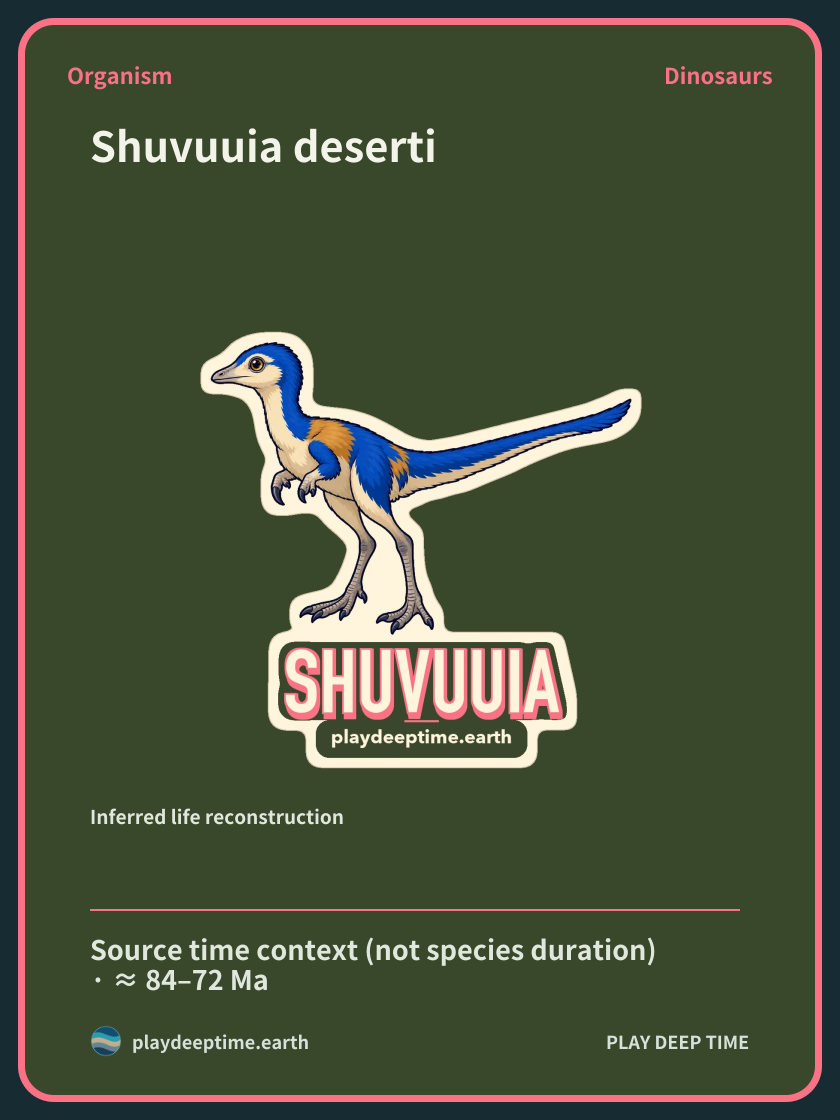
Inferred life reconstruction
Shuvuuia deserti
Overview
Shuvuuia deserti was an unusual dinosaur with small forelimbs and long hind limbs, known from Late Cretaceous fossils in Mongolia. From hand and foot bones to the interiors of the eyes and ears, its small body has raised big questions.[1]
Loading illustration…
Key facts
The contrast between long legs for running and short forelimbs is distinctive. A completely preserved hand confirmed the presence of reduced fingers. Even a seemingly simple hand retains small changes in dinosaur evolution.[1]
Time and place
It lived during the Campanian of the Late Cretaceous, roughly 80–70 million years ago. Fossils came from the Djadokhta Formation in the Gobi region of present-day southern Mongolia. Different specimens from Tögrögiin Shiree and Ukhaa Tolgod have been studied.[1]
The time range describes source context, not the complete duration of this species.
Size, form and skeleton
MPD100/120, examined in a 2002 study, was not yet fully grown. It preserves part of the head and jaws, many vertebrae, hands, hind limbs, and a long tail. This valuable skeleton allows comparisons down to the joints of small fingers and toes.[1]
The Natural History Museum in London gives a body length of about 0.6 m in its account of the genus Shuvuuia.[6]
Loading illustration…
Habitat and reproduction
Was this small dinosaur active at night? A 2021 study compared eye and ear structures and proposed the possibility of life in darkness. Spaces inside the skull, as well as visible running legs, provide evidence for exploring when it was active.[2][3]
Fossil discovery
A 2002 study of a new skeleton added details of the hands and feet. Research on sensory organs followed in 2021, and a 2025 study reexamined interpretations of its hearing. Different observations and comparisons enrich the story of one animal.[1][2][3]
References
- Suzuki et al. (2002), “A New Specimen of Shuvuuia deserti Chiappe et al., 1998 from the Mongolian Late Cretaceous, with a Discussion of the Relationships of Alvarezsaurids to Other Theropod Dinosaurs,” Contributions in Science 494; DOI 10.5962/p.226791.
- Choiniere et al.2021 — Evolution of vision and hearing modalities in theropod dinosaurs
- Manley & Köppl2025 — When dinosaurs hear like barn owls
- Suzuki et al. (2002), “A New Specimen of Shuvuuia deserti Chiappe et al., 1998 from the Mongolian Late Cretaceous, with a Discussion of the Relationships of Alvarezsaurids to Other Theropod Dinosaurs,” Contributions in Science 494; DOI 10.5962/p.226791.
- Xu et al.2011 — Linhevenator tani, a short-armed troodontid dinosaur
- Natural History Museum, London — Shuvuuia
Research questions
Did Shuvuuia really hear as well as an owl? A 2025 study challenged the method used to compare bony spaces inside the ear. How to compare living birds and fossil dinosaurs fairly is an intriguing issue in sensory research.[2][3]
Observation
Examine the head, short forelimbs, long hind limbs, and tail in sequence.[1]
Related organisms
 Linhevenator taniDinosaursSource time context (not species duration) · ≈ 143–66 Ma
Late Cretaceous dinosaurs of southern Mongolia and Inner Mongolia, China
Shuvuuia and Linhevenator were different dinosaurs of the Late Cretaceous Campanian. Follow material from separate formations in present-day southern Mongolia and Inner Mongolia, China, to examine Shuvuuia’s small forelimbs and long hind limbs and Linhevenator’s short, robust arms.