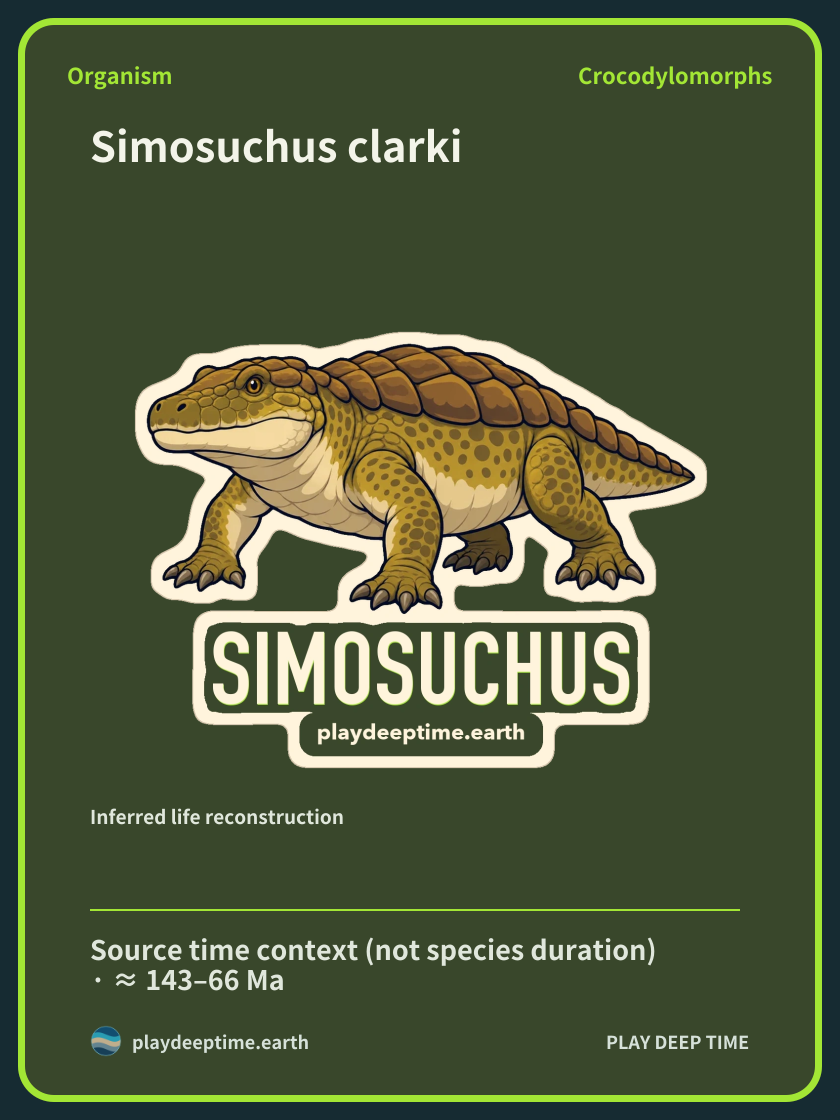
Organism · Crocodylomorphs
Simosuchus clarki
Source time context (not species duration) · ≈ 143–66 Ma
Inferred life reconstruction
Simosuchus clarki
Overview
Simosuchus clarki is a crocodyliform known for its blunt snout, short, broad body and short tail. Its body bears bony armour. Comparing it with a long-snouted crocodile reveals a different body configuration.[1]
Loading illustration…
Key facts
Its teeth are described as leaf-shaped. Researchers interpreted it as a plant-eater on the basis of this and other features. These clues invite us to consider the diverse ways of life among crocodile relatives.[1]
Time and place
It is known from latest Cretaceous material in present-day Madagascar. The researchers' account places it around 66 million years ago. Its distinctive head and body have been studied among crocodyliforms near the end of the Cretaceous.[1][2]
The time range describes source context, not the complete duration of this species.
Size, form and skeleton
Leaf-shaped teeth are described in its blunt snout. The short, broad body carries bony armour and ends in a short tail. Examine the combination of short and broad proportions in the head, trunk and tail.[1]
Scott Hartman's skeletal reconstruction of Simosuchus clarki gives a body length of about 75 cm. It illustrates the size of this small crocodile relative with its short snout and armoured body.[8]
Loading illustration…
Habitat and reproduction
Could crocodile relatives also have eaten plants? Researchers proposed a terrestrial, plant-eating way of life based on Simosuchus's teeth and body structure. Their work explored possibilities broader than the familiar image of a crocodile.[1]
Fossil discovery
A university research team's 2010 account introduced Simosuchus's blunt snout, leaf-shaped teeth and bony armour. Several body features were discussed alongside interpretations of terrestrial life and plant-eating. It is an example of discoveries about appearance leading to questions about lifestyle.[1]
References
- Stony Brook University (2010) — Simosuchus researchers’ explanation
- International Commission on Stratigraphy (2024) — Geological time chart
- Stony Brook University (2010) — Simosuchus researchers’ explanation
- International Commission on Stratigraphy (2024) — Geological time chart
- Buckley, G. A. & Brochu, C. A. (1999), “An enigmatic new crocodile from the Upper Cretaceous of Madagascar,” Special Papers in Palaeontology 60, pp. 149–175.
- Turner, A. H. & Buckley, G. A. (2008), “Mahajangasuchus insignis (Crocodyliformes: Mesoeucrocodylia) Cranial Anatomy and New Data on the Origin of the Eusuchian-Style Palate,” Journal of Vertebrate Paleontology 28(2), 382–408.
- Pochat-Cottilloux2025 — Non-semiaquatic adaptations of extinct crocodylomorphs
- Scott Hartman — Skeletal reconstruction of Simosuchus clarki
Research questions
What clues do leaf-shaped teeth offer when interpreting an animal's life? Rather than examining the head alone, compare its short, broad body and tail as well. Multiple features together reveal crocodyliform diversity.[1]
Observation
Move your gaze from the blunt snout and leaf-shaped teeth to the short, broad body. Examining the bony armour and short tail together reveals a configuration different from a familiar crocodile's.[1]
Related organisms
 Mahajangasuchus insignisCrocodylomorphsSource time context (not species duration) · ≈ 143–66 Ma
Different faces of Madagascar's ancient crocodyliforms
Simosuchus and Mahajangasuchus are represented by latest Cretaceous material from present-day Madagascar. Examine the blunt snout and leaf-shaped teeth of one and the broad, rounded front of the lower jaw of the other to compare diverse crocodyliform faces.