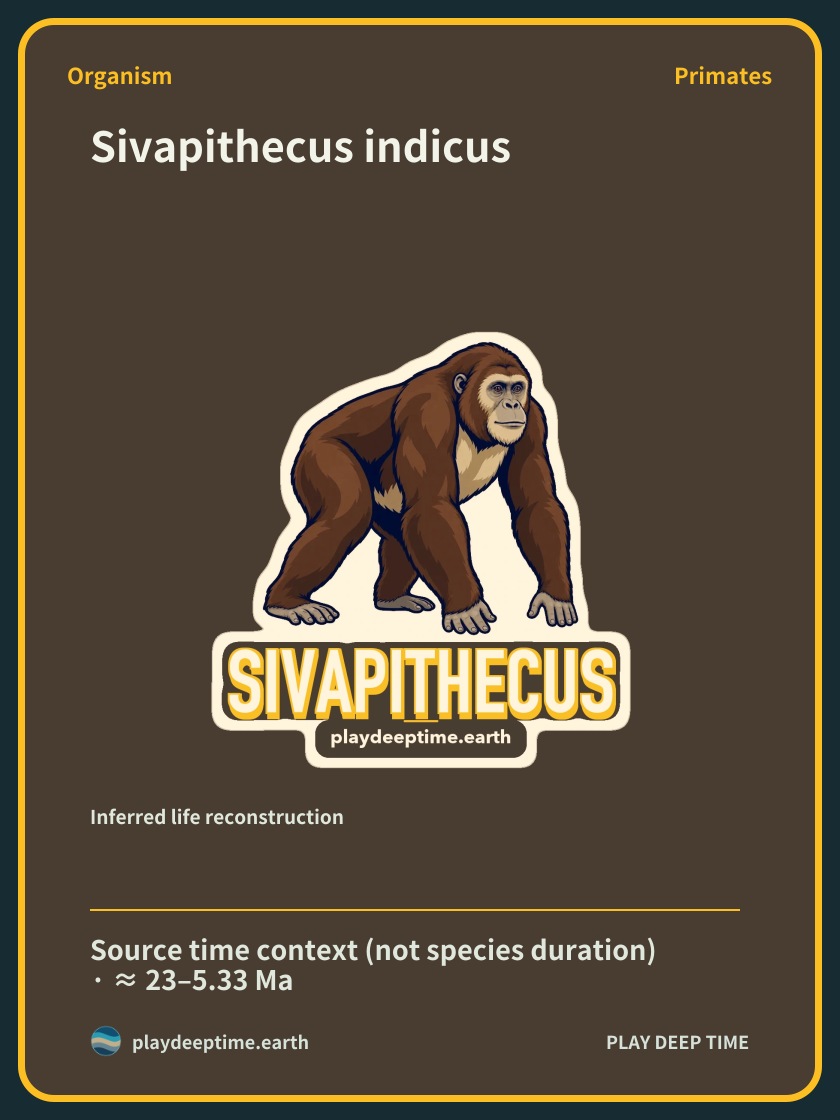
Organism · Primates
Sivapithecus indicus
Source time context (not species duration) · ≈ 23–5.33 Ma
Inferred life reconstruction
Sivapithecus indicus
Overview
Sivapithecus indicus is a fossil primate known from a humerus, partial pelvis, and partial palate. Specimens from different body regions can be compared side by side. Several pieces of material provide clues to the head, limbs, and their connections with the trunk.[1]
Loading illustration…
Key facts
YGSP30730 appears in the research as a humerus and YGSP41216 as a partial pelvis. Instead of one individual's complete skeleton, there are specimens documenting different regions of the body.[1]
Time and place
It is known from literature on Miocene primates of the Siwaliks. The Miocene spans roughly 23–5.3 million years ago. This material allows comparisons between partial specimens assigned to the species and body structure discussed at the genus level.[1][2]
The time range describes source context, not the complete duration of this species.
Size, form and skeleton
Material assigned to the species includes a humerus, partial pelvis, and partial palate. Genus-level sources address a posture in which the limbs support the body, along with grasping hands and feet. Species-level bones and the body structure suggested by related material can be examined at their different scopes.[1]
The pelvic fossil YGSP 41216 of Sivapithecus indicus is estimated to belong to an individual weighing about 20–25 kg. Researchers gauged its size by comparing the pelvis with those of living proboscis monkeys and baboons, and considered the individual likely to be female.[3]
Loading illustration…
Habitat and reproduction
What can an arm and pelvis tell us about body posture? Comparing bones from different regions raises several questions about the arrangement that supported the body. Sivapithecus material offers an example of reading partial bones alongside genus-level interpretations.[1]
Fossil discovery
The literature on Siwalik primates describes humerus, pelvis, and palate material assigned to indicus. The same chapter also compares material from other Sivapithecus species. This research gathers information about the body by distinguishing between several species and body regions.[1]
References
Research questions
How can the facial and limb material of several species in one genus be connected? Both the species assignment and the region documented by each specimen need to be examined. Reading the names attached to cranial and postcranial bones together provides a basis for comparing form.[1]
Observation
Move your observations from the arm to the pelvis and then to the palate material from the head. Remembering that each region conveys different information helps when comparing several partial fossils.[1]
Related organisms
 Victoriapithecus macinnesiPrimatesSource time context (not species duration) · ≈ 23–5.33 Ma
Different bodies among primates
Examine the bodies of Sivapithecus indicus and Victoriapithecus macinnesi together. Sivapithecus indicus: Sivapithecus indicus is a fossil primate known from a humerus, partial pelvis, and partial palate. Victoriapithecus macinnesi: Victoriapithecus macinnesi is a Miocene primate known from several specimens of heads, jaws, and limbs.