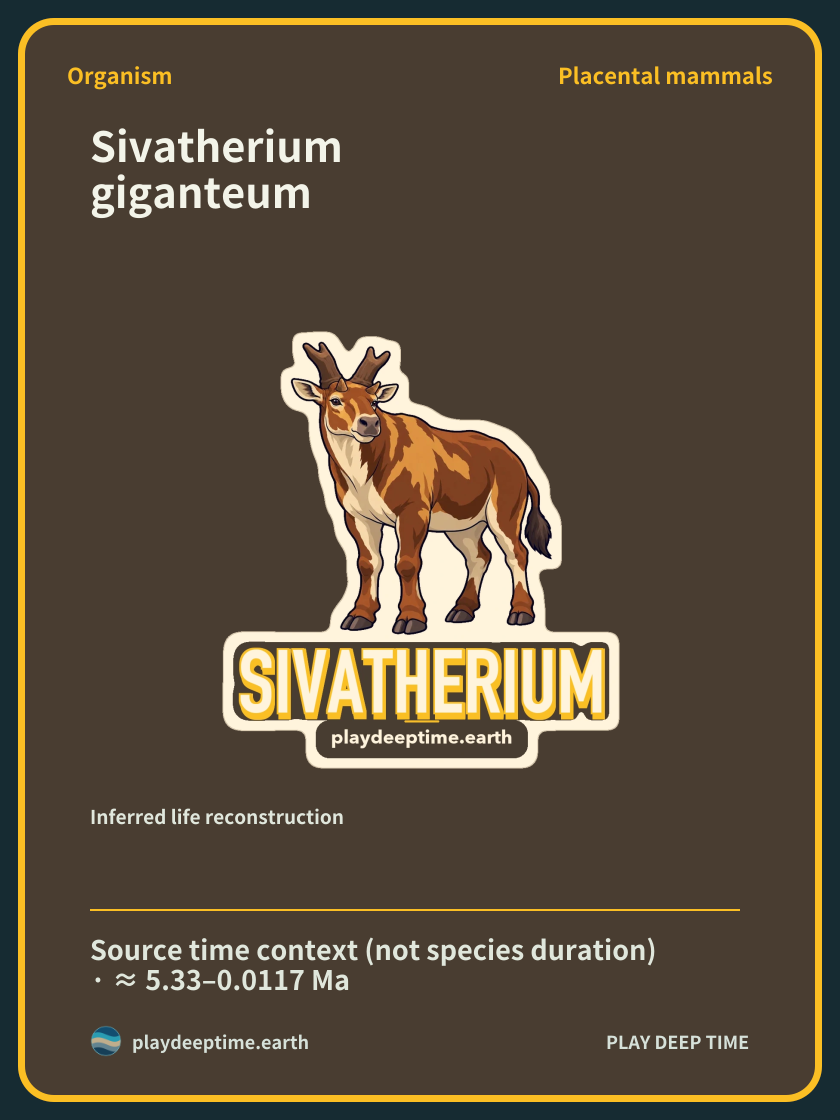
Organism · Placental mammals
Sivatherium giganteum
Source time context (not species duration) · ≈ 5.33–0.0117 Ma
Inferred life reconstruction
Sivatherium giganteum
Overview
Sivatherium giganteum is an enormous giraffe relative with a short neck and thick limbs. Its head carried one pair of projections at the front and another at the back, differing in size. Its proportions contrast with those of living giraffes.[1][3]
Loading illustration…
Key facts
A body-size reconstruction used twenty-six bones. Material from at least three adults was combined, with missing parts reconstructed through comparison, to assemble a whole body. It is an intriguing example of several fossils contributing to one body model.[1]
Time and place
It is studied through material from near the Pliocene–Pleistocene boundary, around 2.6 million years ago. Fossils of this group also appear in studies of the Siwalik region in present-day South Asia. They allow comparisons of varied bodies among ancient giraffe relatives.[1][4][5]
The time range describes source context, not the complete duration of this species.
Size, form and skeleton
The neck is short, and the bones of the lower limbs are thick and relatively short. A small pair of front projections and a larger pair of rear projections are distinguished on the head. The widening ends of the metatarsal bones are another feature studied in relation to its large body.[1][2][3]
A three-dimensional skeletal model assembled from several fossils yielded a calculated body mass of approximately 1.25 tonnes. The study’s 95% prediction interval is 857–1,812 kg; this is not a range representing the smallest and largest actual individuals.[6]
Loading illustration…
Habitat and reproduction
This giraffe relative is studied to understand how thick limbs supported a large body. Researchers compare the shapes and joint ends of the metatarsals together with the short neck. Its head ornaments and size raise questions about the lives of differently built members of the giraffe family.[1][2][3]
Fossil discovery
A 2016 study reconstructed the whole body using twenty-six bones from the Natural History Museum. It combined head and limb material with a model filling missing parts. Digitally connecting museum specimens reveals the body of a large mammal.[1]
References
- Basu et al. (2016) — Reconstructing the body size of Sivatherium
- Comparative study of giraffid metatarsals
- Study of giraffid morphology and relationships
- Study of Sivatherium fossils from the Siwaliks
- International Commission on Stratigraphy (2024) — Geological time chart
- Basu et al. (2016) — Skeletal reconstruction and body-mass estimation of Sivatherium
- Basu et al. (2016) — Skeletal reconstruction and body-mass estimation of Sivatherium
- Harrison (1985) — Large camels of Cenozoic North America
- Smits (2017), Remodeling the Fossil Record: Analysis of Emergent Evolutionary and Ecological Patterns
Research questions
How can whole-body size be estimated from partial skeletons? Researchers compare the relative sizes of bones and missing areas of the model with other giraffids. The study examines the relationship between a calculated body model and the bones actually preserved.[1][2]
Observation
Distinguish the small front projections from the large rear projections on the head. Then picture the short neck, thick legs, and widening metatarsal ends to see proportions unlike those of living giraffes.[1][3][2]
Related organisms
 Aepycamelus giraffinusPlacental mammalsSource time context (not species duration) · ≈ 23–5.33 Ma
A giraffe relative and a long-necked camelid
Explore different records of bodies and time in these two animals. Sivatherium: Sivatherium giganteum is an enormous giraffe relative with a short neck, thick limbs, and a pair of projections at the front of its head and another pair at the back, differing in size. It is studied through material near the Pliocene–Pleistocene boundary, around 2.6 million years ago; fossils of its group also appear in research from the Siwalik region of present-day South Asia. Aepycamelus giraffinus: a camelid known for very long, slender limbs and neck vertebrae, treated as the type species of Aepycamelus. It lived in the Miocene, a period roughly 23–5.3 million years ago.