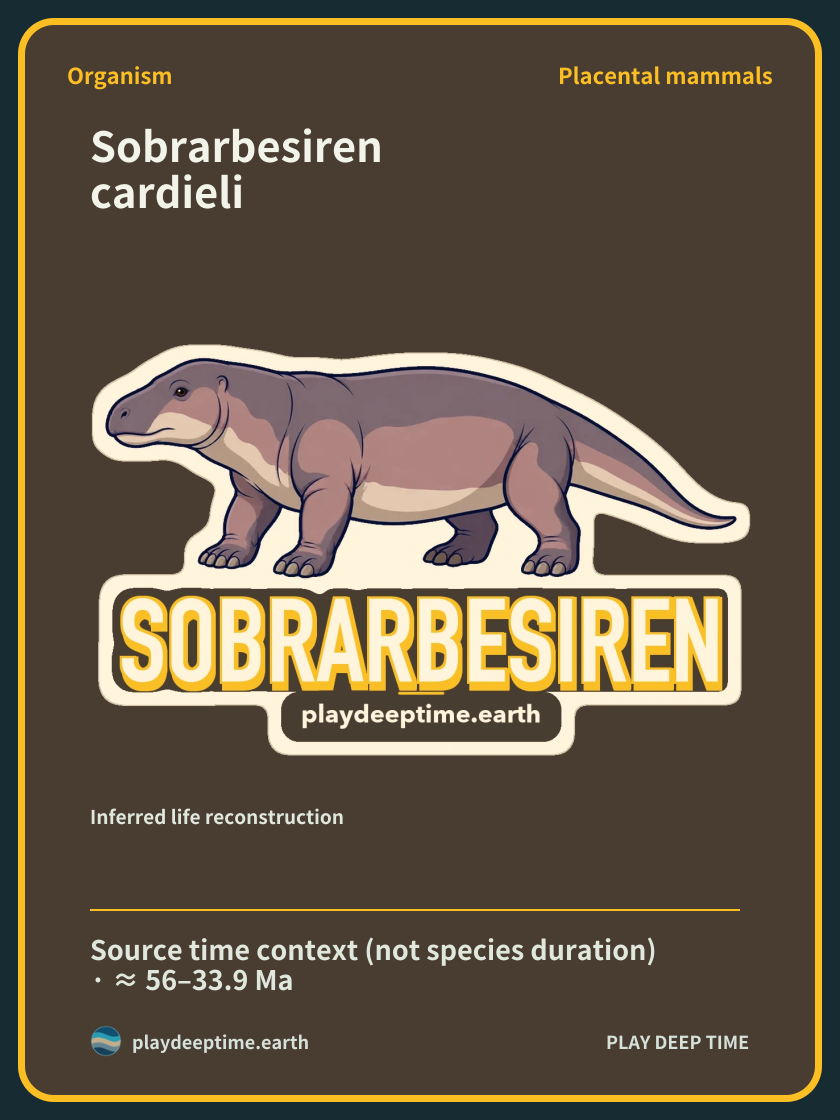
Organism · Placental mammals
Sobrarbesiren cardieli
Source time context (not species duration) · ≈ 56–33.9 Ma
Inferred life reconstruction
Sobrarbesiren cardieli
Overview
Sobrarbesiren cardieli is an early sirenian that retained four legs. After picturing living dugongs and manatees, encounter an ancient relative with hind limbs. The adaptation of a terrestrial body to aquatic life begins to emerge.[1][2]
Loading illustration…
Key facts
Fossils of different ages also reveal growth. The first study used material from at least six individuals, and a later cranial study used eight. Comparisons from small individuals to young adults examined changes in the head.[1][2]
Time and place
This animal lived around 42 million years ago during the middle Eocene. It was discovered at Castejón de Sobrarbe in Huesca, present-day northeastern Spain, south of the Pyrenees. A modern mountainous region preserves the story of ancient sea cows.[1][4]
The time range describes source context, not the complete duration of this species.
Size, form and skeleton
The head, vertebrae, ribs, shoulders, pelvis, and forelimbs and hind limbs are known. A 2018 study estimated a total length of approximately 2.7 m from a reconstruction connecting several bones. The body transitioning toward aquatic life can thus be compared alongside the head.[1]
Loading illustration…
Habitat and reproduction
Later cranial research interpreted it as feeding selectively, mainly on seagrasses in shallow coastal seas. Possible feeding on floating vegetation was also discussed. The ear region retained features from before complete specialization for aquatic life.[2]
Fossil discovery
A 2018 study introduced a new genus and species from the Sobrarbe region. Its name honors the region and discoverer Jesús Cardiel Lalueza. Subsequent comparisons of more cranial material broadened the story of sirenian evolution.[1][4]
References
- First adequately-known quadrupedal sirenian from Eurasia (Eocene, Bay of Biscay, Huesca, northeastern Spain)
- Díaz-Berenguer et al.2022 — The skull of Sobrarbesiren and sea cow evolution
- Pérez-Ramos et al.2026 — Virtual reconstruction and morphometric analysis of the vertebral column of Pezosiren portelli
- NOVA FCT2018 — An early sirenian discovered in the Pyrenees
Research questions
How did the hind limbs of sea cows diminish? Comparing pelvic, limb, and cranial function with other early sirenians reveals different adaptive processes. It raises the possibility that mammals entering the water followed more than one path.[1][2]
Observation
Move your gaze from the head to the trunk, pelvis, and hind limbs. Comparison with living sea cows makes ancient bodily changes toward aquatic life clearer.[1][2]
Related organisms
 Pezosiren portelliPlacental mammalsSource time context (not species duration) · ≈ 56–33.9 Ma
Early four-legged sea-cow relatives
Sobrarbesiren and Pezosiren provide evidence for comparing limbs and vertebrae of Eocene sirenians. Placing different fossils from Spain and Jamaica side by side reveals several forms of transition from terrestrial bodies to aquatic life.