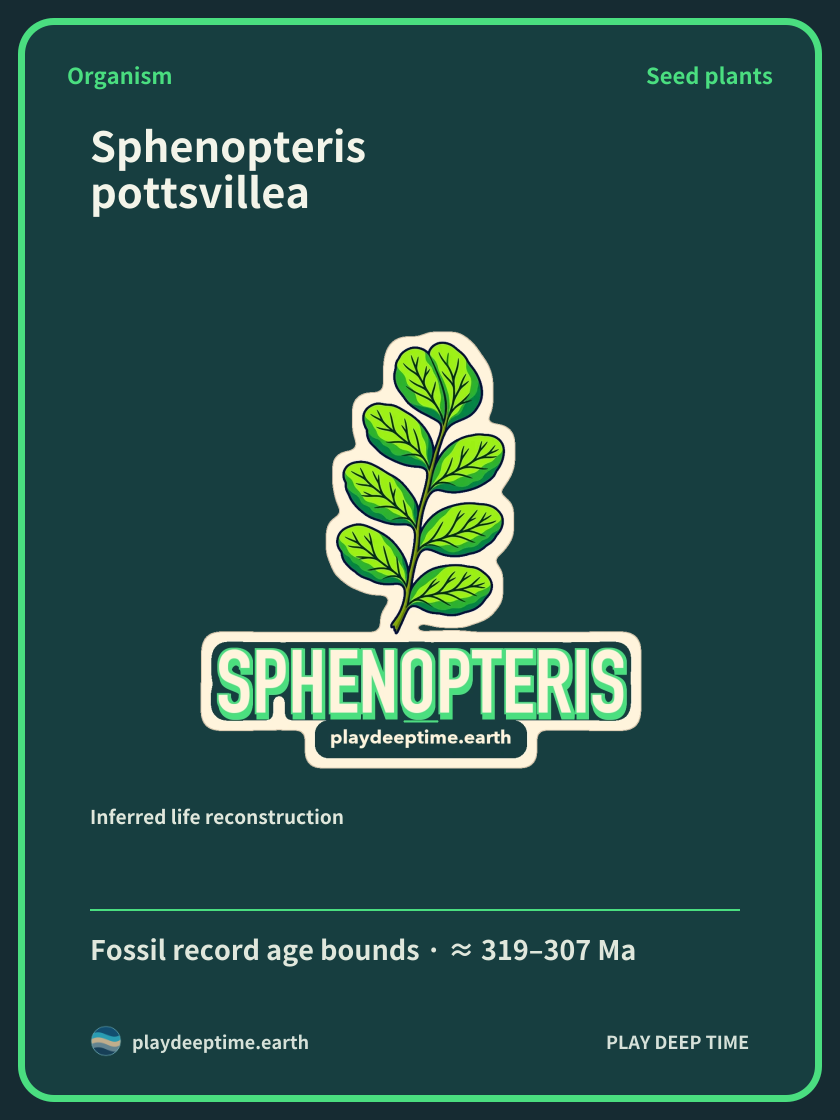
Organism · Seed plants
Sphenopteris pottsvillea
Fossil record age bounds · ≈ 319–307 Ma
Inferred life reconstruction
Sphenopteris pottsvillea
Overview
Sphenopteris pottsvillea is a fossil plant studied through fragments of feather-like divided leaves. The shapes of the small leaf divisions and the veins within them provide clues to its identity.[1]
Loading illustration…
Key facts
The branching of the veins deserves as much attention as the leaf silhouette. The description records veins starting near the base and branching as they extend straight or curve.[1]
Time and place
The specimens studied were collected from the Pottsville Formation at Union Chapel Mine in present-day Alabama, USA. They date to the Early Pennsylvanian, the early part of the later Carboniferous.[1]
The time range describes source context, not the complete duration of this species.
Size, form and skeleton
The small leaf divisions are arranged alternately and have an oval outline with blunt tips. The description also records small divisions joining one another near the tips of the larger leaf divisions.[1]
Sphenopteris pottsvillea is a plant whose single leaf spreads widely into two branches. A study analyzing fossils from Alabama, USA, reconstructed a total leaf length of about 2 m. This figure is the length of one large leaf bearing small leaf divisions, rather than the height of the plant.[9]
Loading illustration…
Habitat and reproduction
The researchers examined the Union Chapel flora found alongside fossil footprints. Using the preservation of the plants as a clue, they discussed the possibility that this area included an environment influenced by tides.[1]
Fossil discovery
The plant fossils in this study were collected at the mine and donated by amateur fossil researchers. A specimen examined as this species bears the number UF 18902-34033.[1]
References
- Dilcher·Lott·Axsmith — Plant fossils from the Union Chapel coal mine, Alabama
- Dilcher·Lott·Axsmith — Plant fossils from the Union Chapel coal mine, Alabama
- Study of Lepidodendron stems in a Socorro coal-bed forest
- Sam Noble Museum — Fossil lycophytes and Lepidodendron
- Senckenberg — Lepidodendron aculeatum fossils
- Lepidodendron aculeatum with attached leaves
- Rothwell (1991) — A small fern living attached to tree trunks
- Dilcher·Lott·Axsmith — Plant fossils from the Union Chapel coal mine, Alabama
- Gastaldo (1988) — Leaf structure of Sphenopteris
Research questions
Separate parts of a plant sometimes receive different names. The paper explains this research practice and also summarizes the history of the name for this species' leaves changing from Mariopteris to Sphenopteris.[1]
Observation
Look for the small divisions arranged alternately along the leaf. Alternating between their outer outlines and the veins inside reveals several features even in a single fragment.[1]
Related organisms
 Lepidodendron aculeatumLand plantsFossil record age bounds · ≈ 330–299 Ma
Two kinds of traces for reading Carboniferous plants
The feather-like divided leaves of Sphenopteris pottsvillea and the diamond-shaped leaf cushions of Lepidodendron aculeatum are different traces of Carboniferous plants. Examine leaf divisions and trunk surfaces in material from different localities and times, and compare how the clues used to identify plants differ from one organ to another.
 Botryopteris forensisVascular plantsFossil record age bounds · ≈ 359–299 Ma
Different clues preserving Carboniferous plants
Sphenopteris from Alabama was studied from the Pottsville Formation of the early Pennsylvanian, while Botryopteris from Ohio was studied from the later Duquesne coal bed. Comparing feather-like divided leaf fragments with stems entangled among roots shows how the questions used to understand a plant change with the parts preserved in its fossils.