Organism · Flowering plants
Spirematospermum wetzleri
Source time context (not species duration) · ≈ 23–5.33 Ma
Inferred life reconstruction
Spirematospermum wetzleri
Overview
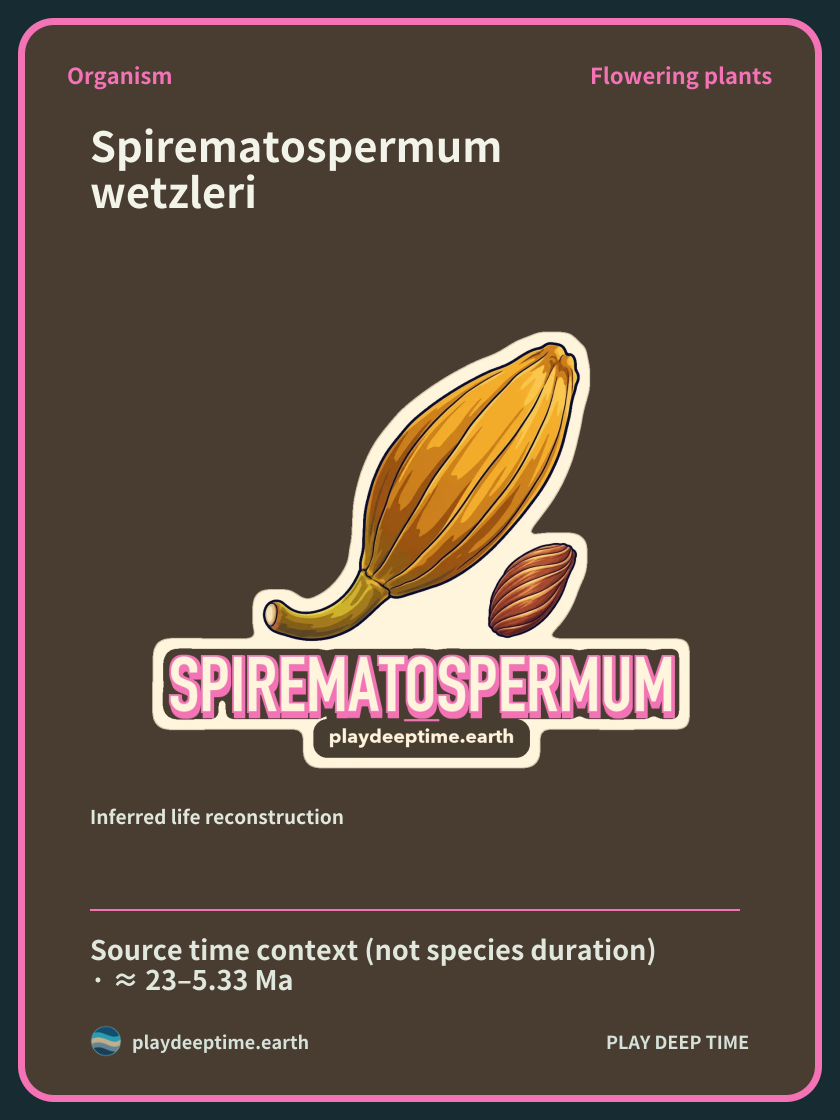
Spirematospermum wetzleri is a Miocene plant known from fossil fruits and seeds. Longitudinal stripes run along its fruits, while spiral patterns cover its seeds. Different organs of the same plant can reveal entirely different patterns.[1]
Loading illustration…
Key facts
The study from Weichang, China, included 30 fruits and 50 seeds. Comparing several fossils revealed shared shapes and differences. Many records of organs can provide a broader view of a plant than a single striking fossil.[1]
Time and place
Miocene material from Weichang in present-day Hebei Province, China, has been studied. The Miocene spanned approximately 23–5.3 million years ago. Associated rhizomes and leaves were discussed in separate Ponholz material, broadening questions about the plant’s body.[1][2][3]
The time range describes source context, not the complete duration of this species.
Size, form and skeleton
The fruits are elongated capsules with their lower ends connected to curved stalks. Reported fruit lengths are 2.3–6.2 cm, and seed lengths are 7.5–12 mm. The longitudinal stripes of the fruits can be compared alongside the spiral patterns of the seeds.[1]
Loading illustration…
Habitat and reproduction
Fruits and seeds provide evidence from a plant’s reproductive organs. Associated rhizomes and ginger-order-type leaves from another locality invite consideration of the remaining body.[1][2]
Fossil discovery
A 2009 study discussed the plant’s form and relationships based on associated organs. The 2018 Weichang study added evidence by comparing many fruits and seeds. Different organs preserved at different localities together raise questions about an ancient plant’s appearance.[1][2]
References
- Li, Yi, Li & Li (2018) · Spirematospermum wetzleri (Heer) Chandler (Zingiberaceae) from the Miocene of Weichang, Hebei Province, North China and the phytogeographic history of the genus
- Fischer et al. (2009) — Body form and relationships of Spirematospermum
- International Commission on Stratigraphy (2024) — Geological time chart
- Study of Late Miocene Ailanthus fruits from Yunnan, China
Research questions
Can leaf shape be known at a locality preserving only fruits? The account explains that no fossils thought to be leaves of this plant were found at Weichang. Researchers connect the body by comparison with associated organs from other localities.[1][2]
Observation
Examine the longitudinal stripes along the elongated fruit, then move your gaze to the seed’s spiral pattern. Comparing changes in organ size and pattern reveals interesting differences within a fossil plant.[1]
Related organisms
 Ailanthus confuciiFlowering plantsFossil record age bounds · ≈ 48.1–5.33 Ma
Different bodies among plants
Explore the bodies of Spirematospermum wetzleri and Ailanthus confucii together. Spirematospermum wetzleri: Spirematospermum wetzleri is a Miocene plant known from fossil fruits and seeds. Ailanthus confucii: Ailanthus confucii is a plant known from fossil winged fruits.