Organism · Animals
Stenopora crinita
Source time context (not species duration) · ≈ 299–252 Ma
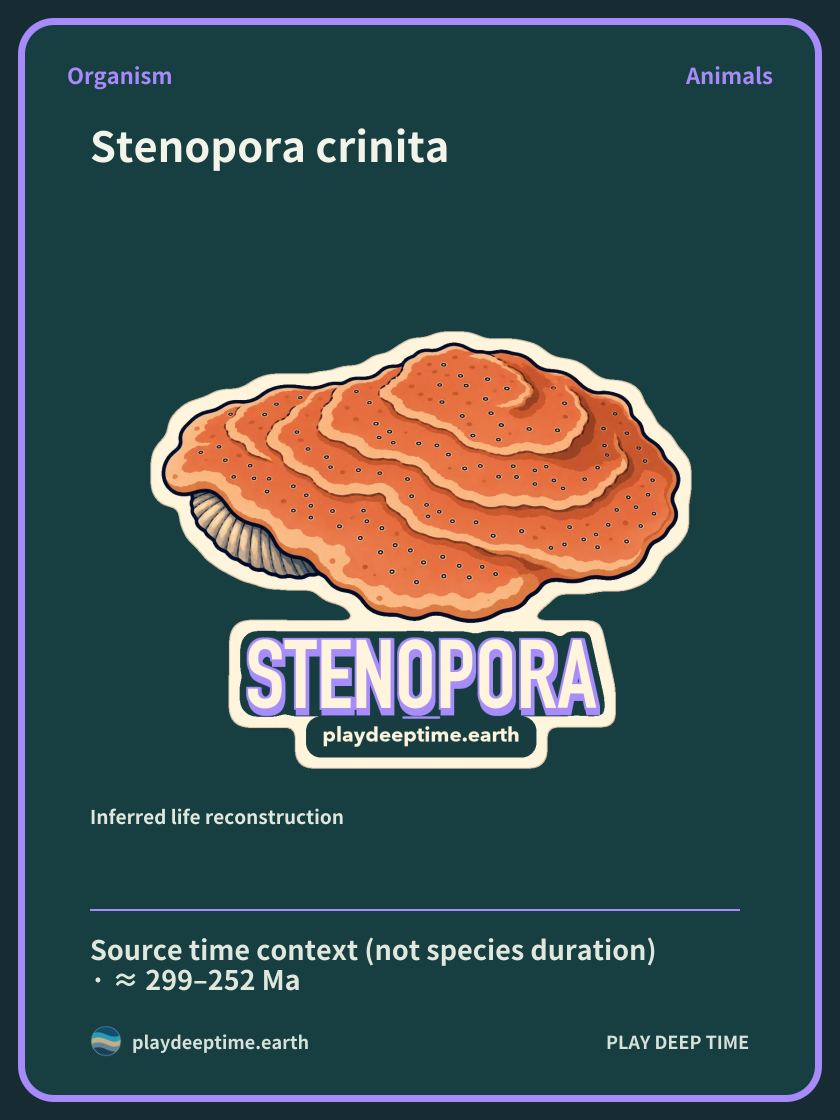
Inferred life reconstruction
Stenopora crinita
Overview
Stenopora crinita is a bryozoan also known from low-spreading colonies that began on the small shell of another animal. The shell belongs to a brachiopod, and the colony covering it is Stenopora. Stories of different organisms overlap in a single fossil.[1]
Loading illustration…
Key facts
A small brachiopod shell provided a base for a young colony to attach to. The colony is described as spreading outward from it in a low form over soft sediment. This material allows us to examine how body form connects with the surrounding substrate.[1]
Time and place
Specimens from St Marys Pass in present-day Tasmania, Australia, have been studied. The literature deals with material from Permian glaciomarine rocks. The Permian spans roughly 300–250 million years ago.[1][2]
The time range describes source context, not the complete duration of this species.
Size, form and skeleton
The colony in the study covers the surface like a low plate. A succession of gentle growth rings is also described. You can examine separately the small shell that formed the base and the colony spreading over it.[1]
Small individuals of Stenopora crinita gathered to form broad colonies. Among colonies that lived in the Permian seas of Tasmania are specimens reaching 35 cm in diameter. They began on hard stones or shells and spread widely across the sediment on the bottom.[3]
Loading illustration…
Habitat and reproduction
What difference do an attachment base and a surface for growth make to an organism? This colony began on a small, hard shell and expanded toward soft sediment. It preserves both the surrounding material and the growth of the colony.[1]
Fossil discovery
The researcher compared large bryozoan material that covered sediment. One complete specimen contains two generations of colonies separated by sediment. Even within a fossil that looks like a single mass, several episodes of growth can be read.[1]
References
- Reid — Bryozoans covering sediments in Tasmania
- International Commission on Stratigraphy (2024) — Geological time chart
- Reid (2013), Large sediment encrusting trepostome bryozoans from the Permian of Tasmania, Australia
- Reid (2013), Large sediment encrusting trepostome bryozoans from the Permian of Tasmania, Australia
- Shintani (2011), Orthotetoids from the Lower Permian (Sakmarian) of the Nagaiwa-Sakamotozawa area, South Kitakami Belt, northeast Japan
Research questions
Did all the overlapping parts of a fossil grow at once? Boundaries between sediments provide clues for recognizing different generations of colonies. There is much to discover in reading a record left by alternating growth and sedimentation.[1]
Observation
Follow the low colony spreading outward from the small shell. Examining the outline of the base separately from the growth rings reveals stories left by different organisms and sediments.[1]
Related organisms
 Derbyia crassaBrachiopodsSource time context (not species duration) · ≈ 299–252 Ma
Bryozoan colonies and brachiopods: different Paleozoic fossils
Examine together the different records of bodies and time preserved in these two organisms. Stenopora crinita: Stenopora crinita is a bryozoan also known from low-spreading colonies that began on the small shell of another animal. The shell belongs to a brachiopod, and the colony covering it is Stenopora. Specimens from St Marys Pass in present-day Tasmania, Australia, have been studied. The literature deals with material from Permian glaciomarine rocks. Derbyia crassa: Derbyia crassa is a brachiopod with a nearly rectangular shell. One valve is almost flat or slightly concave, while the other is more convex. Material from the Nagaiwa and Sakamotozawa areas of the South Kitakami Belt in present-day northeastern Japan has been studied. Its context is the Sakmarian of the Early Permian.