Organism · Cartilaginous fishes
Stethacanthus altonensis
Source time context (not species duration) · ≈ 359–299 Ma
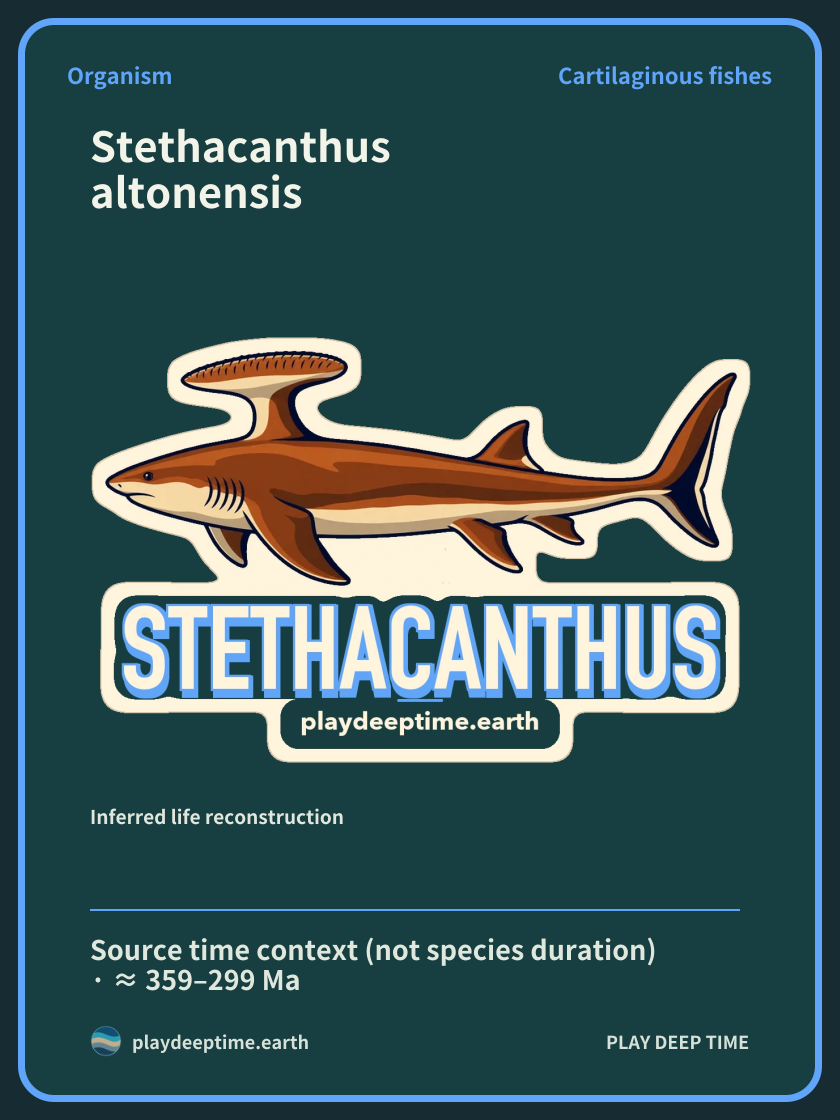
Inferred life reconstruction
Stethacanthus altonensis
Overview
Stethacanthus altonensis is a cartilaginous fish known for its unusually modified first dorsal fin. A structure combining a spine and a brush-like part has been studied. It invites us to imagine a construction unlike the familiar dorsal fin of a shark.[1][3]
Loading illustration…
Key facts
The specialized structure is studied under the name “spine-brush complex.” It is an example of one fin becoming distinctive within the outline of the whole body.[3][4]
Time and place
The museum introduces this species in the context of Carboniferous sharks. The Carboniferous was roughly 360–300 million years ago. Its unusual dorsal fin and material from the pectoral fins have been compared in different studies.[1][5]
The time range describes source context, not the complete duration of this species.
Size, form and skeleton
The first dorsal fin is described as a structure combining a spine and a brush-like part. The internal supports of the pectoral fins have also been discussed in comparative research. The outer outlines and internal frameworks of the fins offer different perspectives.[3][2]
The total body length of Stethacanthus altonensis is summarized as about 1.5m. This is the adult size compared from the literature in a 2015 study of vertebrate size.[16]
Loading illustration…
Habitat and reproduction
What function might the unusual first dorsal fin have served? Studies of this structure have asked about its form, function, and differences among related groups. It is a case of exploring constructions beyond familiar fin shapes.[4][3]
Fossil discovery
The spine-brush of Stethacanthus altonensis was a subject of research in 1984. A 2008 comparison discussed differences in pectoral-fin supports, and a 2009 research abstract discussed the modified first dorsal fin. Different questions arise from different fins on the same body.[4][2][3]
References
- Smithsonian Ocean guide — Carboniferous sharks
- Maisey (2008) — Comparison of Denaea and early cartilaginous fishes
- Maisey (2009) — The spine-brush of early cartilaginous fishes
- Zangerl (1984) — Study of the specialized dorsal fin of Stethacanthus
- International Commission on Stratigraphy (2024) — Geological time chart
- The Naturalist (1924) — Historical morphological illustration of Megalichthys
- International Commission on Stratigraphy (2024) — Geological time chart
- Smithsonian Ocean guide — Carboniferous sharks
- Maisey (2009) — The spine-brush of early cartilaginous fishes
- International Commission on Stratigraphy (2024) — Geological time chart
- Stahl (1980) — Jaw and head skeletons of Carboniferous cartilaginous fishes
- Smithsonian Ocean guide — Carboniferous sharks
- Maisey (2009) — The spine-brush of early cartilaginous fishes
- International Commission on Stratigraphy (2024) — Geological time chart
- Maisey (2008) — Comparison of Denaea and early cartilaginous fishes
- Sallan·Galimberti (2015) — Changes in vertebrate size before and after the end-Devonian extinction
Research questions
Do fin remains assigned to the same name all show the same construction? Comparative research has also discussed differences in the internal supports of the pectoral fins. This research considers other body parts alongside one conspicuous feature.[2]
Observation
Move your gaze from the unusual first dorsal fin to the pectoral fins. Thinking about both the large external shapes and the internal supports helps you compare different fins on one body.[1][2]
Related organisms
 Megalichthys hibbertiLobe-fins and tetrapodsSource time context (not species duration) · ≈ 359–299 Ma
Bodies and fins of Carboniferous fishes
Megalichthys and Stethacanthus are Carboniferous fishes encountered through different kinds of evidence. Examine the lobed paired fins of Megalichthys depicted in a historical anatomical illustration and the specialized first dorsal fin of Stethacanthus in each animal.
 Iniopteryx rushlauiCartilaginous fishesFossil record age bounds · ≈ 315–304 Ma
Fin diversity in Carboniferous cartilaginous fishes
Iniopteryx and Stethacanthus are Carboniferous cartilaginous fishes. Examine the high pectoral-fin skeleton of Iniopteryx in the author’s skeletal reconstruction and the separately studied specialized first dorsal fin of Stethacanthus.