Organism · Echinoderms
Stromatocystites pentangularis
Source time context (not species duration) · ≈ 539–487 Ma
Inferred life reconstruction
Stromatocystites pentangularis
Overview
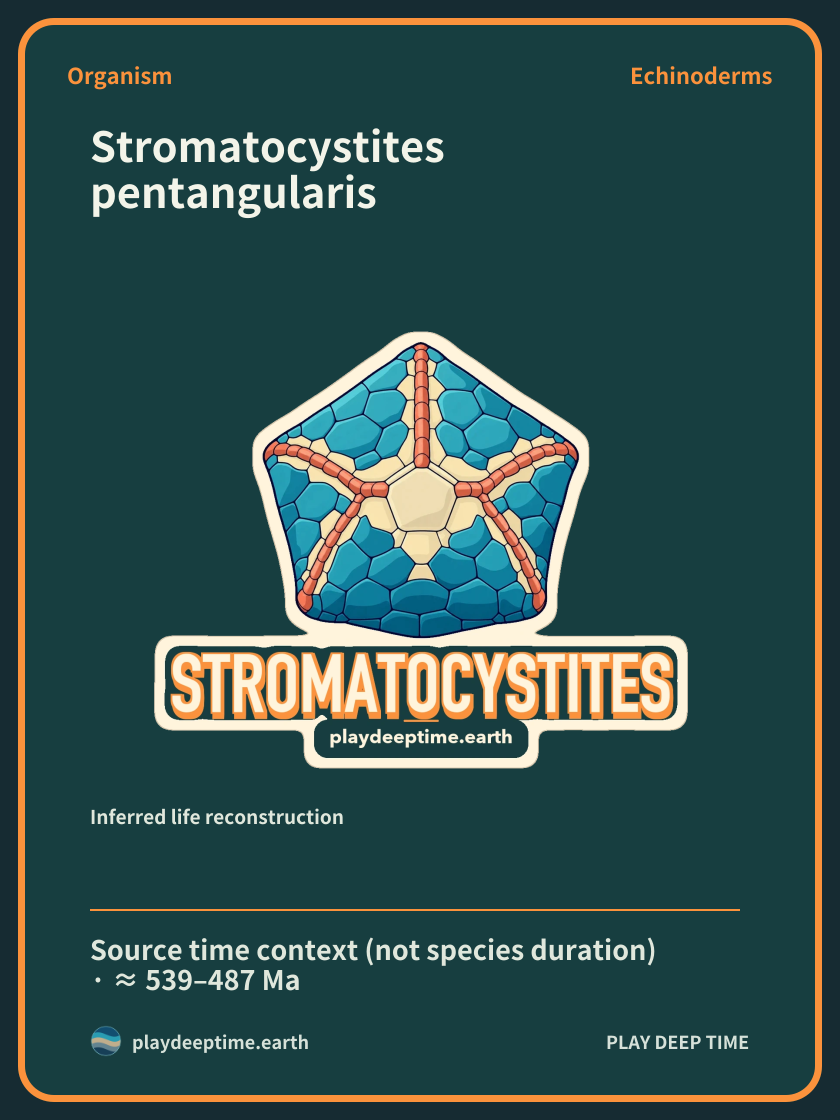
Stromatocystites pentangularis is a pentagonal echinoderm with five rounded corners. Plates covering the whole body and ambulacra along its surface are described. Structures extending in five directions can be explored within one body.[1]
Loading illustration…
Key facts
The five ambulacra do not all meet centrally in the same way. One connects alone, while the remaining four join in two pairs. Different connection patterns occur even among the five branches.[1]
Time and place
It is known through research on Cambrian echinoderms. The Cambrian spanned approximately 540–490 million years ago. Both sides of specimens and the plates covering their bodies reveal the organization of an ancient echinoderm.[1][2]
The time range describes source context, not the complete duration of this species.
Size, form and skeleton
The body is a pentagon with five rounded corners, entirely covered in plates. Narrow, raised ambulacra on the domed ventral surface extend to all five corners. This differs from having separate arms projecting outward.[1]
A study of water flow around the body reconstructed a body approximately 1.4 cm in diameter, matching fossil measurements. This Cambrian animal was compared with the older organism Arkarua. Researchers followed water flow around their bodies to investigate the history of collecting suspended food.[3]
Loading illustration…
Habitat and reproduction
How do the paths across the body surface connect at the center? This organism is described as having one separate ambulacrum and two paired connections. The broad five-directional outline can be read through small central junctions.[1]
Fossil discovery
The plate depicting BM(NH) E16004 is described as showing the same specimen from ventral and dorsal views. Reading different orientations together helps distinguish the domed surface from its surface structures. Two sides of one fossil add information.[1]
References
- Study — The Cambrian echinoderm Stromatocystites
- International Commission on Stratigraphy (2024) — Geological time chart
- Cracknell et al. (2021), Pentaradial eukaryote suggests expansion of suspension feeding in White Sea-aged Ediacaran communities
- Zamora·Rahman (2014) — Body organization of Helicoplacus
Research questions
What changes depending on which side of a pentagonal body is viewed? The plate-covered outline and the surface bearing ambulacra must be examined separately. Establishing body orientation is a starting point for understanding its structures.[1]
Observation
Follow the ambulacra from the five rounded corners toward the center. Keeping the arrangement of one separate and two paired connections in mind reveals different structures within the pentagonal body.[1]
Related organisms
 Helicoplacus gilbertiEchinodermsSource time context (not species duration) · ≈ 539–487 Ma
Different bodies among echinoderms
Explore the bodies and backgrounds of Stromatocystites pentangularis and Helicoplacus gilberti together. Stromatocystites pentangularis is a pentagonal echinoderm with five rounded corners. Plates covering the whole body and ambulacra along its surface are described. Helicoplacus gilberti is a Cambrian echinoderm whose skeletal plates form spiral arrangements. Its distinctive organization with three ambulacra along the body wall has been studied.