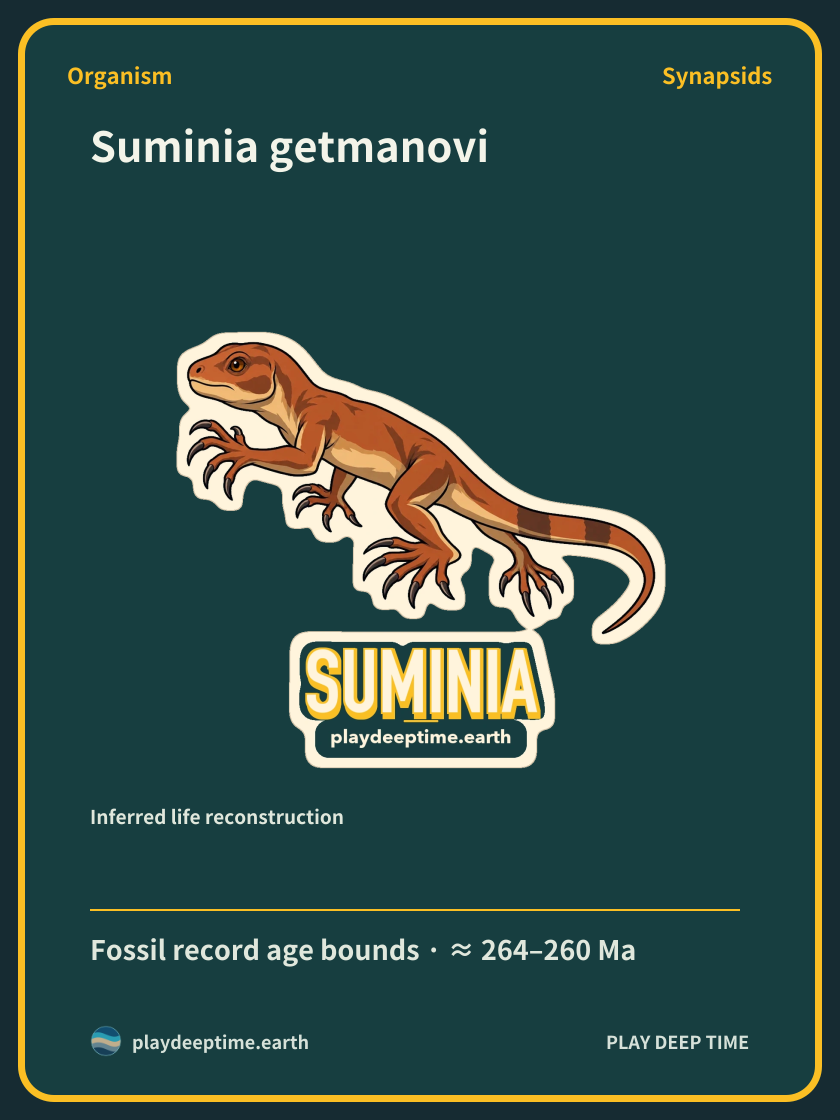
Organism · Synapsids
Suminia getmanovi
Fossil record age bounds · ≈ 264–260 Ma
Inferred life reconstruction
Suminia getmanovi
Overview
Suminia getmanovi is a non-mammalian synapsid that lived in the Permian and belongs to an early branch of the anomodonts. Synapsids are a broad lineage that includes living mammals. Its slender body, long limbs, and well-developed hands and feet make it a subject for exploring the possibility of ancient tree-dwelling life.[1]
Loading illustration…
Key facts
Bones grouped under one specimen number do not necessarily belong to one animal. In 2025, researchers concluded that five long bones grouped as KPM20/99 came from at least two individuals. Comparing growth traces inside the bones revealed records of individuals that died at slightly different ages.[1]
Time and place
The fossil locality is Kotelnich in the Kirov region of present-day Russia. Its red strata are discussed as material from the Capitanian at the end of the Middle Permian or the Wuchiapingian at the beginning of the Late Permian. Alongside research placing it within the Permian, we can encounter the world of terrestrial animals of that time.[1]
The time range describes source context, not the complete duration of this species.
Size, form and skeleton
The limbs and digits are long, and the first digits of the hands and feet are described as diverging from the others. A long, tapering tail extends behind. The 2025 paper reports that earlier research estimated total body lengths of several individuals at about 50cm.[1]
Loading illustration…
Habitat and reproduction
Long digits and claws and the divergent first digits are interpreted as likely related to grasping ability. Researchers considered these body structures alongside bone tissues in discussing possible tree-dwelling life. Occluding teeth and wear traces also lead to an interpretation of oral processing of fibrous plants.[1]
Fossil discovery
The 2025 study examined five long bones collected at Kotelnich by the Vyatka Paleontological Museum field team. Researchers investigated internal bone tissues and structures for clues to growth and lifestyle. The study carried questions from external appearance into the bones.[1]
References
Research questions
The bones examined had thinner walls and larger central cavities than those of other anomodonts used for comparison. Researchers interpreted these differences together with body-form evidence as support for tree-dwelling life. The statistical model classifying lifestyles lacked a separate arboreal category, making it important to read several lines of evidence together.[1]
Observation
The illustration is based on the species-level whole-body reconstruction in the 2025 paper. Follow the connections among four limbs, a long tail, and large hands and feet in a body synthesized from several sources. Posture, facial and body coverings, and colors are interpretations intended to make the overall form easier to read.[1]
Related organisms
 Aulacopleura koninckiiTrilobitesFossil record age bounds · ≈ 433–423 Ma
Growth records found in body segments and inside bones
Researchers reconstructed growth by comparing sizes and body segments in Silurian Aulacopleura exoskeletons. In research on Permian Suminia, tissues inside long bones provided clues to growing bodies. Explore the growth of ancient animals through different records: hard coverings outside the body and bones within it.