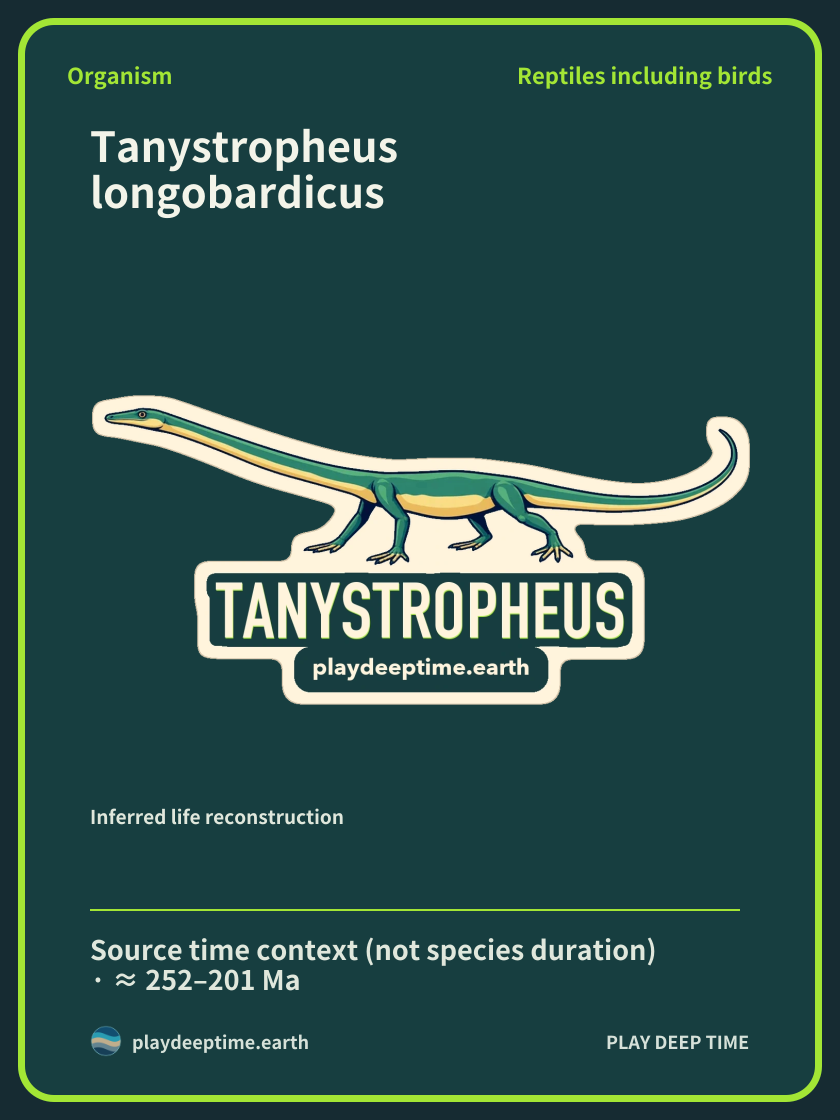
Organism · Reptiles including birds
Tanystropheus longobardicus
Source time context (not species duration) · ≈ 252–201 Ma
Inferred life reconstruction
Tanystropheus longobardicus
Overview
Tanystropheus longobardicus is a reptile known for a small head and an extremely long neck. Specimens of the small form from Besano provide comparative body material. Long ribs extending along the neck have also been studied.[1][2]
Loading illustration…
Key facts
The small form cannot simply be regarded as juveniles of the large form. In 2020, researchers interpreted growth rings as showing maturity in the small form too and distinguished the two size forms as separate species.[2]
Time and place
Middle Triassic specimens from Besano in present-day Lombardy, northern Italy, were studied. The Triassic as a whole was roughly 250–200 million years ago. The small, long-necked form can be compared across several specimens.[1][3]
The time range describes source context, not the complete duration of this species.
Size, form and skeleton
The 2007 description of small-form specimen SC265 explains a small head, an extremely long neck, and long ribs running along the neck. Four limbs and a long tail follow behind. The bones making up the long neck can be examined together with their connection to the whole body.[1]
A 2021 study summarized Tanystropheus longobardicus as a small species whose body length would not have exceeded about 2m. After the larger specimens were separated into another species, small long-necked adults remained in this species.[9]
Loading illustration…
Habitat and reproduction
Does a small body necessarily mean a young individual? Tanystropheus research compared maturity through growth rings. This research separates size differences into questions of growth stage and species identity.[2]
Fossil discovery
A 2007 study reexamined anatomy in a new small specimen from Besano. A 2020 university account introduced the maturity of the small form and its interpretation as a separate species. The small form retained the name longobardicus and was distinguished from the large form.[1][2]
References
- Nosotti (2007) — Tanystropheus anatomy in small specimens from Besano
- University of Zurich (2020) — Long-necked Tanystropheus of different sizes
- International Commission on Stratigraphy (2024) — Geological time chart
- Ferrante·Cavin (2023) — A new view of a short, plump coelacanth
- Nosotti (2007) — Tanystropheus anatomy in small specimens from Besano
- University of Zurich (2020) — Long-necked Tanystropheus of different sizes
- International Commission on Stratigraphy (2024) — Geological time chart
- The research history of the Middle Triassic fishes of Monte San Giorgio: getting out of the shadow of aquatic reptiles
- Spiekman et al. (2021) — Phylogeny and species distinctions in tanystropheids
Research questions
What do growth rings in bones add to information about body size? Examining whether small individuals were mature allows comparison of interpretations as juveniles or as a different species. This is a case in which growth research led to questions of names and classification.[2]
Observation
Follow the extremely long neck from the small head. Imagine the long ribs beside the neck, then move your gaze to the four limbs and tail to examine the neck within the whole body.[1]
Related organisms
 Rieppelia heinzfurreriCoelacanthsFossil record age bounds · ≈ 243–241 Ma
Short trunks and long necks of the Besano region
Compare the short trunk of Rieppelia heinzfurreri with the long neck preserved in the small form of Tanystropheus longobardicus. Both records connect to the Middle Triassic Monte San Giorgio–Besano region along the present-day border of Switzerland and Italy. You can examine how fish and reptile bodies were constructed with different proportions.