Organism · Seed plants
Taxodium dubium
Source time context (not species duration) · ≈ 23–5.33 Ma
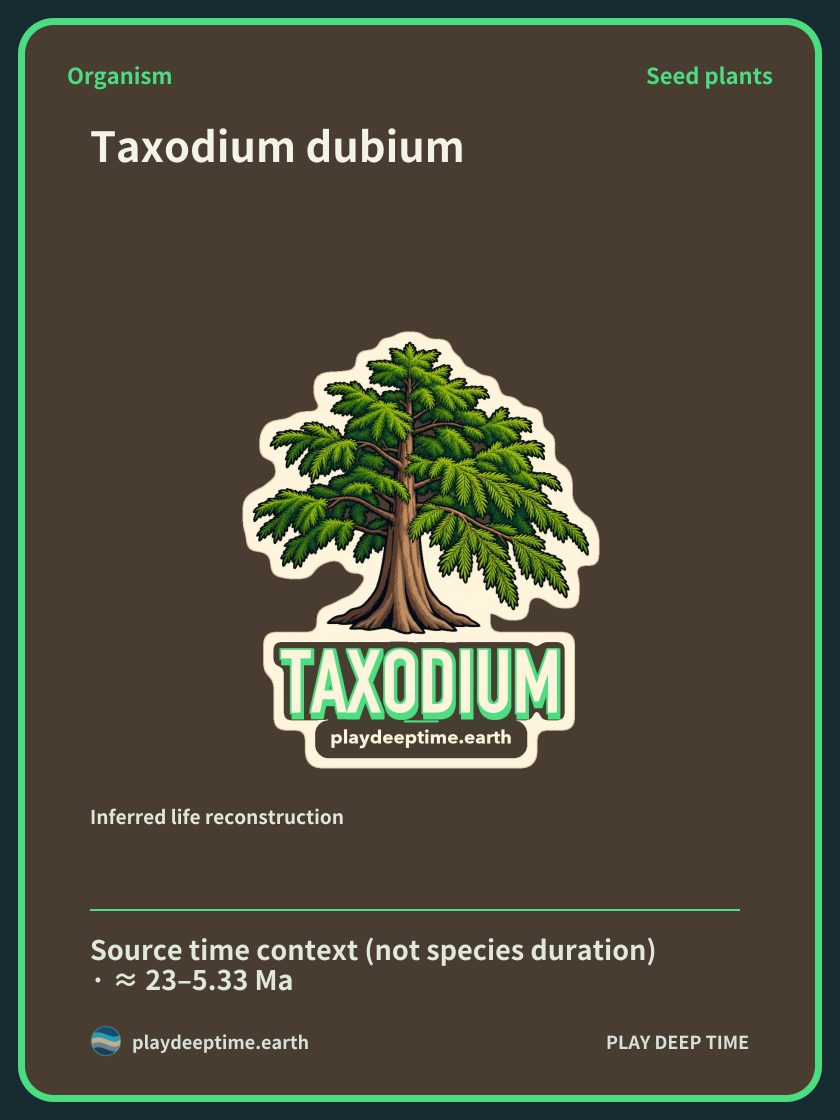
Inferred life reconstruction
Taxodium dubium
Overview
Taxodium dubium is a tree of the bald-cypress genus that evokes ancient European swamp forests. Fossils ranging from leafy branches to cones and seeds continue its story. It conveys the fascination of understanding a tree from scattered fragments.[1]
Loading illustration…
Key facts
Leaves, seed cones, seeds, and pollen-bearing male cones were brought together into the story of one species. Researchers connected the tree’s form by examining several organs together. The view expands from identifying a single leaf to a tree that formed forests.[1]
Time and place
A 2009 study compared Central European material from the Late Eocene to Early Miocene, spanning approximately 38–16 million years ago. It included specimens from present-day Germany, Czechia, and Russia. Early Miocene material from the Most Formation at Bílina, Czechia, was also studied in particular.[1]
The time range describes source context, not the complete duration of this species.
Size, form and skeleton
Branches with slender, needle-like leaves and seed-bearing cones are known. Male cones with pollen preserved in place were also used in comparisons. The study additionally proposed that the fossil wood Taxodioxylon taxodii might belong to the same tree.[1]
Taxodium dubium is a conifer whose slender leaves lie neatly along both sides of small branches. Small fossil branches studied at Knížecí, Czechia, were reported to average approximately 6 cm long. This figure describes the scale of leafy branches, separately from the height of the whole tree.[4]
Loading illustration…
Habitat and reproduction
Taxodium dubium is introduced as a major tree in European Taxodium–Nyssa swamp forests. Examining associated plants as well as leaves and seeds reveals the arrangement of a wet forest. One species’ story leads to an ancient forest landscape.[1]
Fossil discovery
A 2009 study reexamined Taxodium fossils from several regions and times. It treated their diverse forms as variation within the single species Taxodium dubium. The research wove organs scattered among museums and localities into the history of one tree.[1]
References
Research questions
How can we tell whether detached leaves and cones came from the same tree? Their forms, patterns of association, and detailed structures must be compared. Extending the story to wood and roots is another important question in research on ancient trees.[1]
Observation
Examine leafy branches, cones, and seeds together. Picture how separately preserved fragments connect into a tree of an ancient swamp forest.[1]
Related organisms
 Ernestiodendron filiciformeSeed plantsFossil record age bounds · ≈ 299–274 Ma
Conifer branches from different times
Taxodium and Ernestiodendron can be compared through conifer material from very different times. Follow Late Eocene–Early Miocene material from Central Europe and Early Permian branches from Planitz, Germany, to explore the stories conveyed by leafy branches.