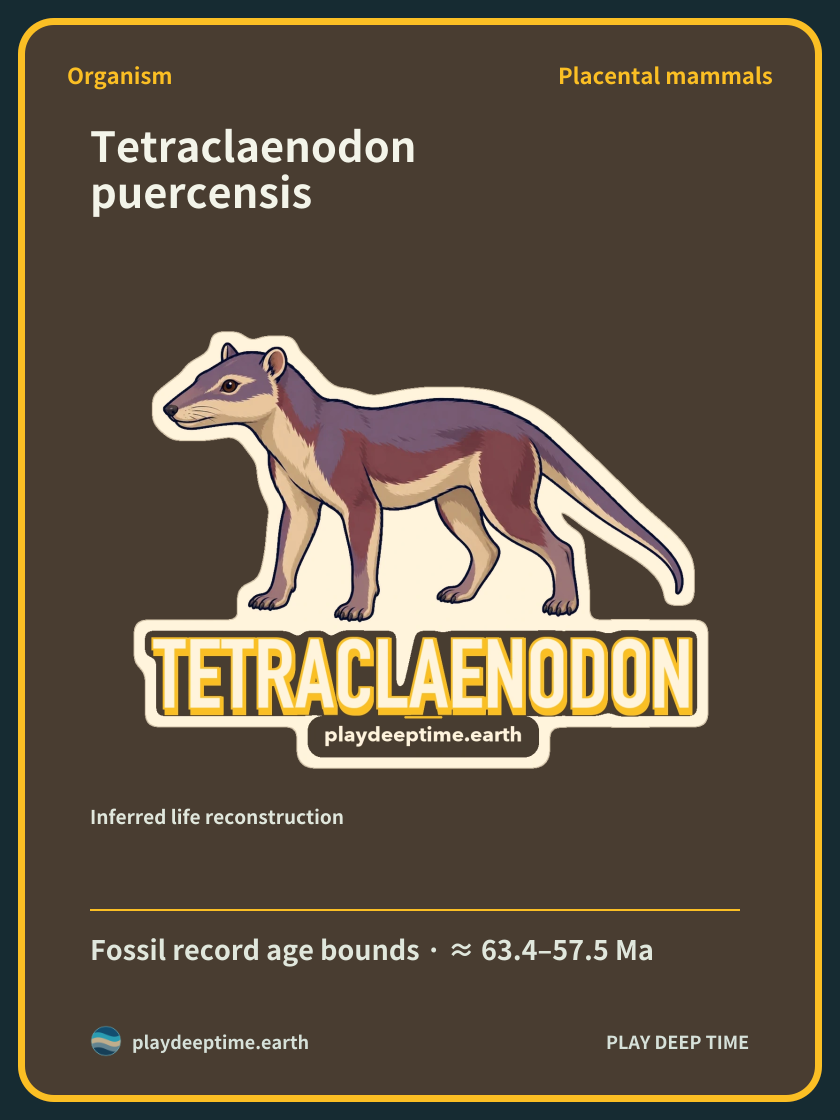
Organism · Placental mammals
Tetraclaenodon puercensis
Fossil record age bounds · ≈ 63.4–57.5 Ma
Inferred life reconstruction
Tetraclaenodon puercensis
Overview
Tetraclaenodon puercensis is a mammal that lived in early Paleocene North America. Small differences preserved in jaws and teeth are keys to recognizing it. A well-preserved skeleton of the same genus also opened a window onto body movement.[2][1]
Loading illustration…
Key facts
Several cusps rise from the molars. Comparing the lengths and cusp arrangements of premolars and molars helps distinguish similar mammals. A small tooth row can serve as a map to the name of an extinct animal.[2]
Time and place
The Paleocene spans roughly 66–56 million years ago, and this species is known from its early part in North America. Tetraclaenodon fossils have been studied in the San Juan Basin of New Mexico, USA. Skeletons and teeth from the Nacimiento Formation connect studies of the region’s early mammals.[2][3]
The time range describes source context, not the complete duration of this species.
Size, form and skeleton
The type specimen preserves an upper-jaw fragment and molars from both lower jaws. Lower molars have elongated rectangular outlines, while upper molars bear several cusps. An articulated skeleton of the same genus reveals a relatively lightly built terrestrial mammal.[2][1]
Its estimated body mass is approximately 9.4 kg. This value connects features preserved in small jaws and teeth with the size of the entire body.[4]
Loading illustration…
Habitat and reproduction
Skeletal research on the same genus interpreted several arm and leg bones as suited to terrestrial life. Researchers also linked some shoulder and arm features to climbing adaptations. It invites us to consider how ground walking and climbing could coexist in one body.[1]
Fossil discovery
Finding teeth associated with postcranial bones is particularly valuable because it connects an animal identified from its teeth with its actual body. A 2012 skeletal study examined precisely this connection in a Tetraclaenodon specimen preserving both dentition and skeleton.[2][1]
References
- Nearly complete skeleton of Tetraclaenodon (Mammalia, Phenacodontidae) from the early Paleocene of New Mexico: morpho-functional analysis
- Early Paleocene (Puercan and Torrejonian) archaic ungulates of the San Juan Basin, New Mexico
- International Commission on Stratigraphy (2024) — Geological time chart
- Smits (2017), Remodeling the Fossil Record: Analysis of Emergent Evolutionary and Ecological Patterns
- Gelfo, López & Bond (2024) · New insights on the anatomy, paleobiology, and biostratigraphy of Xenungulata (Mammalia) from the Paleogene of South America · Palaeontologia Electronica 27(2):a30 · DOI 10.26879/1360
Research questions
How did it differ from Phenacodus and Copecion? Comparisons of premolar length and upper-molar cusps reveal differences among similar forms. Research on the trunk and limbs together raises further questions about relationships among these early mammals.[2][1]
Observation
Follow the jaw from the premolars to the rear molars. Examine cusp numbers and positions and front-to-back lengths as well as tooth size. Small teeth that initially look alike begin to reveal distinct forms.[2]
Related organisms
 Carodnia feruglioiPlacental mammalsSource time context (not species duration) · ≈ 66–56 Ma
Different bodies among mammals
Explore the bodies and backgrounds of Tetraclaenodon puercensis and Carodnia feruglioi together. Tetraclaenodon puercensis: an early Paleocene North American mammal recognized through small differences in jaws and teeth. Carodnia feruglioi: an unusual hoofed mammal from Paleocene South America, belonging to an ancient group native to South America rather than to the groups of today’s horses or cattle.