Organism · Lizards and snakes
Tianyusaurus zhengi
Source time context (not species duration) · ≈ 143–66 Ma
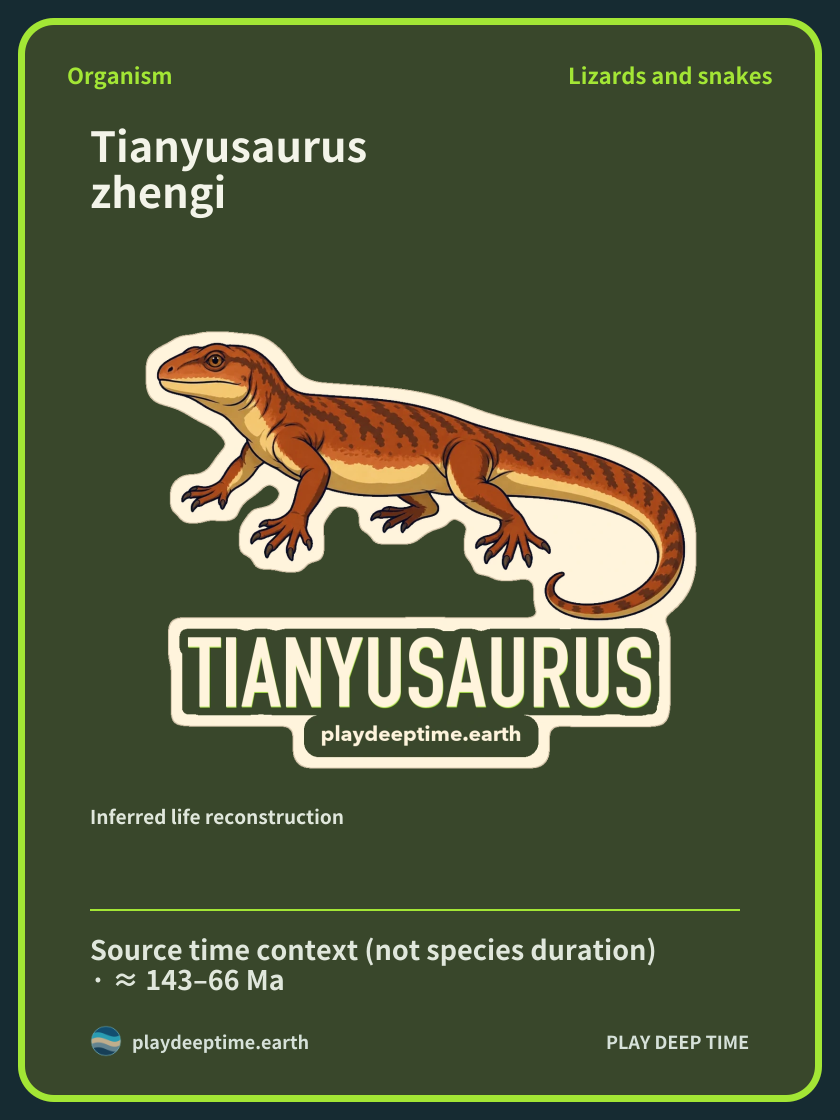
Inferred life reconstruction
Tianyusaurus zhengi
Overview
Tianyusaurus zhengi is a lizard with an unusual bony bar in its skull. The opening below and behind the eye is completely enclosed by bone. A small cranial structure prompted a reconsideration of the broader picture of lizard evolution.[1]
Loading illustration…
Key facts
Alongside its closed lower temporal bar, the quadrate bone supporting the jaw is firmly fixed. This combination differs from the heads of familiar living lizards. The way bones connect provides clues to how the mouth moves.[1]
Time and place
This southern Chinese lizard lived at the end of the Late Cretaceous, around 66 million years ago. The reference specimen came from the Qiupa Formation in present-day Henan Province. New skulls have also been reported from the Nanxiong Formation at Ganzhou, Jiangxi Province.[1]
The time range describes source context, not the complete duration of this species.
Size, form and skeleton
The reference specimen preserves the skull and lower jaw together with eight anterior neck vertebrae and the shoulder girdle. Three Jiangxi specimens have head lengths of about 8.74 cm, 7.95 cm, and 5.6 cm. Comparing skulls of different sizes also allows changes during growth to be examined.[1]
Loading illustration…
Habitat and reproduction
The study placed Tianyusaurus in a group of large lizards that mainly ate plants. Its unusual combination of skull and jaw features was linked to the possibility of using food that required a wide gape. This fossil invites us to consider food and jaw movement together.[1]
Fossil discovery
After the first report in 2008, new specimens from Jiangxi were compared. A 2010 paper analyzed form and function using better-preserved heads. It also examined in greater detail the original outline that had been difficult to discern in a single compressed fossil.[1][2]
References
- Mo, J.-Y., Xu, X. & Evans, S.E. (2010), “The evolution of the lepidosaurian lower temporal bar: new perspectives from the Late Cretaceous of South China,” Proceedings of the Royal Society B 277: 331–336.
- Lü, Ji & Dong2008 — A Late Cretaceous lizard with a lower temporal arch
- Dong et al. (2022), “A new stem-varanid lizard (Reptilia, Squamata) from the early Eocene of China,” Philosophical Transactions B 377:20210041.
- IVPP — 中国巨蜥科化石新属种支持巨蜥科的亚洲起源说
- Mo, Xu & Evans2010 — Evolution of the lower temporal bar in lizards
Research questions
Does a closed bony bar always represent a primitive condition? This study showed that a bony bar could develop anew during the evolution of lizard relatives. Even structures that look alike can have different histories of origin.[1]
Observation
Find the bony bar surrounding the area below and behind the eye. Examining it alongside the jaw joint makes the arrangement of the head that enables mouth movement more intriguing.[1][2]
Related organisms
 Archaeovaranus liiLizards and snakesSource time context (not species duration) · ≈ 56–48 Ma
Heads of Asian lizards from different times
Read the skulls of Archaeovaranus and Tianyusaurus in sequence. In Early Eocene and latest Cretaceous material from present-day China, compare cranial features such as the bones behind the eye and the palate to explore the varied structures of lizards.