Organism · Placental mammals
Tomarctus hippophaga
Fossil record age bounds · ≈ 18.5–12.5 Ma
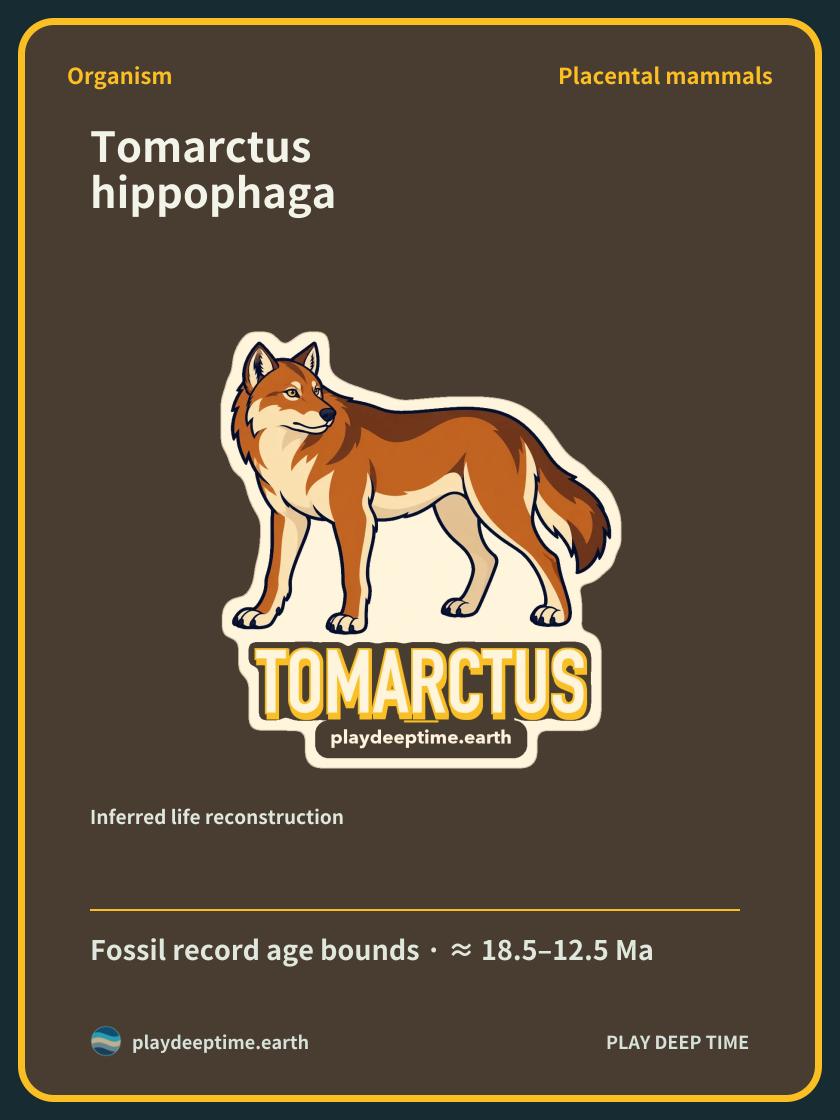
Inferred life reconstruction
Tomarctus hippophaga
Overview
Tomarctus hippophaga is a member of the dog family that lived in Miocene North America. Its identification begins with a lower jaw from Nebraska, USA. The teeth lined up in that jaw preserve features used to distinguish ancient canids.[1]
Loading illustration…
Key facts
Tomarctus once played a prominent role in accounts of the origins of modern canids. A 1999 study reassessed several traits and interpreted these animals within the borophagine lineage. Changes in how fossils are studied can rewrite familiar evolutionary stories.[2]
Time and place
The Miocene spans roughly 23–5.3 million years ago. The type specimen of this species came from the Lower Snake Creek beds in present-day Sioux County, Nebraska, USA. The faunal interval called the Barstovian is also used to describe its age.[1][3]
The time range describes source context, not the complete duration of this species.
Size, form and skeleton
The type specimen is a right lower jaw preserving a canine, premolars, and molars. Enlarged premolars and a relatively broad forehead are cited as features of Tomarctus. Alongside jaw outlines, tooth cusps and posterior depressions can be compared.[1][2]
A model based on dental data in the 2021 CarniFOSS study estimated a body mass of approximately 22 kg.[8]
Loading illustration…
Habitat and reproduction
The Lower Snake Creek fauna of Nebraska is a starting point for exploring the world of this canid. Comparisons with canid fossils from other regions of the same age begin to reveal differences among North American faunas. Here, jaws and teeth connect us with that ancient world.[1]
Fossil discovery
The species was introduced in 1909 under the genus name Tephrocyon. Later classification in Tomarctus changed the name used in the literature. Type specimen number AMNH 13836 continues to identify the same lower jaw through those name changes.[1][2]
References
- USGS Open-File Report 80-878 — Type specimen and dentition of Tomarctus
- Wang et al. (1999) — Characteristics of the genus Tomarctus
- International Commission on Stratigraphy (2024) — Geological time chart
- Study — Head and teeth of Eucastor from Nebraska
- Paleobiology Database — Strata yielding Eucastor
- USGS Open-File Report 80-878 — Type specimen and dentition of Tomarctus
- International Commission on Stratigraphy (2024) — Geological time chart
- Faurby·Morlo·Werdelin(2021) — CarniFOSS fossil carnivorous mammal body-mass data
Research questions
What relationships might similar teeth indicate? Studies comparing Tomarctus and Aelurodon used several premolar and skull features together. Considering them alongside living dogs and foxes reveals the many branches of canid history.[2]
Observation
Follow the teeth of the right lower jaw from front to back. The premolars behind the canine differ from the molars farther back. Examine raised cusps and depressions on the rear molars to see how much can be compared in one jaw fragment.[1]
Related organisms
 Eucastor tortusPlacental mammalsSource time context (not species duration) · ≈ 23–4.7 Ma
Different mammals of Miocene Nebraska
Eucastor and Tomarctus are connected through Miocene fossil records from present-day Nebraska, USA. Compare rodent research on the Valentine Formation with a canid lower jaw from the Lower Snake Creek beds as different kinds of evidence.