Organism · Turtle lineage
Toxochelys latiremis
Source time context (not species duration) · ≈ 143–66 Ma
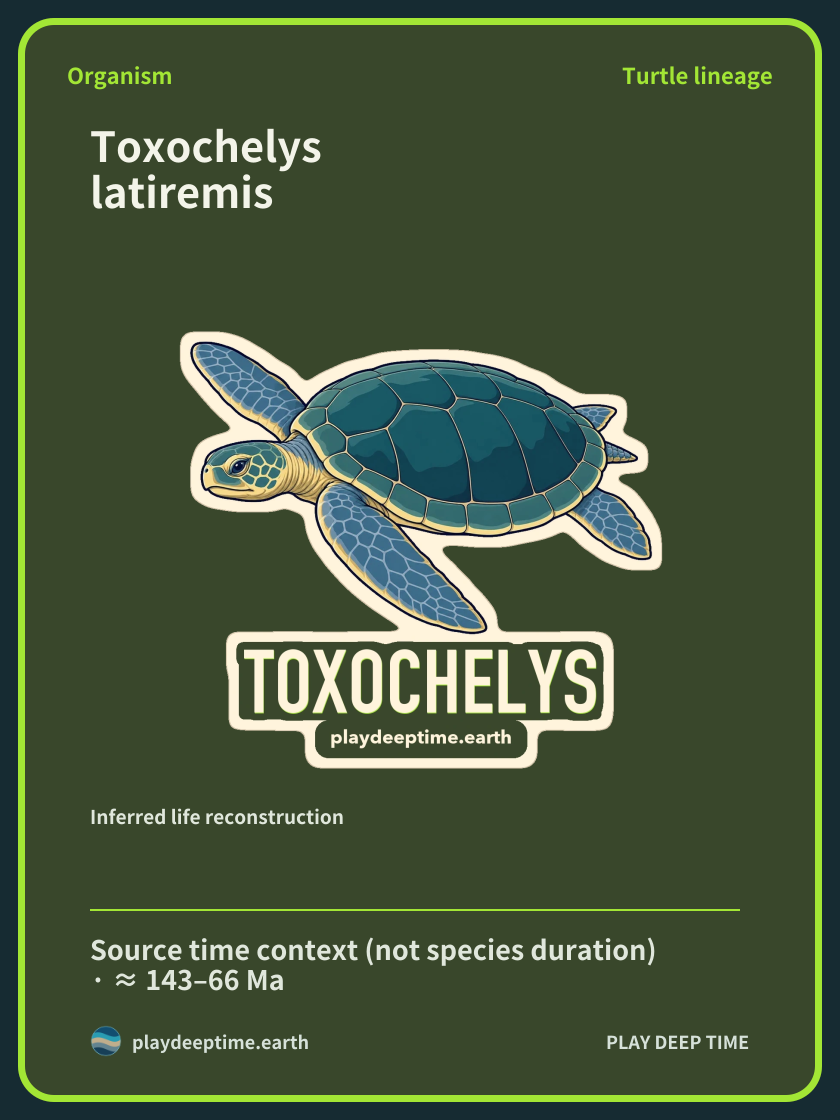
Inferred life reconstruction
Toxochelys latiremis
Overview
Toxochelys latiremis is a turtle that traveled the Cretaceous seas. It is studied as an ancient relative within the broad group related to modern sea turtles. A new fossil extended the map of this turtle's marine distribution southward.[1]
Loading illustration…
Key facts
Was a turtle's carapace always a completely solid covering? Broad gaps remain in the carapace of this species. Within the rounded outline visible from the outside, different turtles have different arrangements of bone.[1]
Time and place
This sea turtle lived in the early Campanian of the Late Cretaceous, around 80 million years ago. It has been found in several marine strata in North America, and fossils from the Mooreville Chalk in present-day Alabama, USA, were reported in 2018. Its distribution reveals an ancient sea extending from Canada to the US Gulf Coast.[1]
The time range describes source context, not the complete duration of this species.
Size, form and skeleton
The plates along the edge of the carapace have no serrations, and the rear of the carapace lacks a long, raised keel. In the Alabama specimen, the articular head at the upper end of the humerus was recorded as about 6.5 cm wide. This material allows comparison of the carapace plates and the joint of the forelimb together.[1]
Loading illustration…
Habitat and reproduction
This turtle lived in the broad seas of North America. The 2018 discovery showed that its distribution overlapped with that of another turtle in the same genus. Placing the traces of these turtles on a map reveals different distributions even within a single sea.[1]
Fossil discovery
RMM5614 preserves a carapace and humerus, while RMM5615 preserves parts of the carapace, neck vertebrae, shoulder blade, and pelvis. The different parts of the two specimens were examined together to identify the species. The first report from Alabama also filled a gap in the record of discovery locations.[1]
References
- Gentry, A. D. & Ebersole, J. A. (2018). “The first report of Toxochelys latiremis Cope, 1873 (Testudines: Panchelonioidea) from the early Campanian of Alabama, USA.” PaleoBios 35. DOI: 10.5070/P9351037558.
- Gentry & Ebersole2018 — Fossils of Toxochelys latiremis from Alabama
- Natural History Museum — Giant fossil sea turtles
- Cope1872 — Protostega reported from an expedition to Kansas
- Hay1908 — Fossil Turtles of North America
Research questions
Why are turtle fossils preserving both the head and carapace valuable? They connect features of the head and body in a single animal, allowing comparisons of evolutionary relationships. Such connections also lead to important questions in the study of Toxochelys.[1]
Observation
Examine the broad gaps and smooth edges of the carapace. Looking at them alongside the forelimb bones allows a more detailed comparison of the body of a turtle that moved through the water.[1]
Related organisms
 Protostega gigasTurtle lineageSource time context (not species duration) · ≈ 143–66 Ma
Sea turtles of Late Cretaceous North America
Toxochelys and Protostega can be compared through different sea-turtle material from Late Cretaceous North America. Read the new fossil record from present-day Alabama alongside the story of earlier expeditions in Kansas to broaden the map of that ancient sea.