Organism · Cartilaginous fishes
Tribodus limae
Source time context (not species duration) · ≈ 143–66 Ma
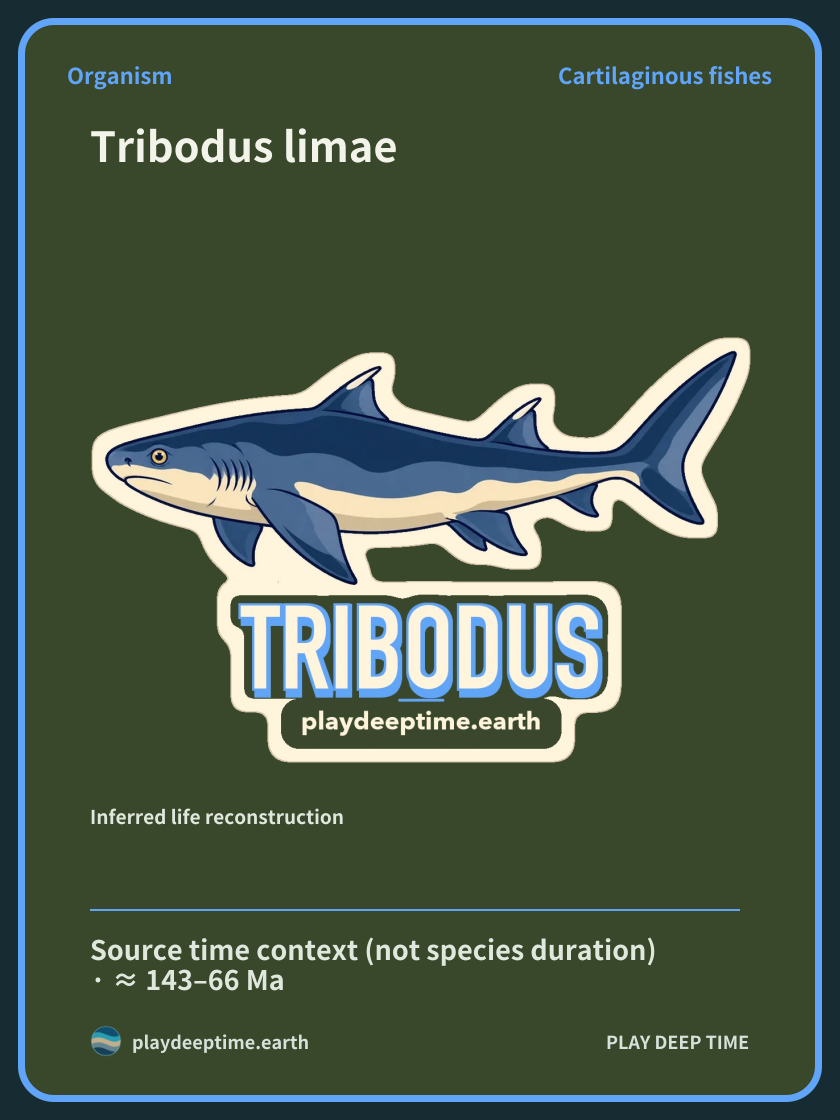
Inferred life reconstruction
Tribodus limae
Overview
Tribodus limae is an Early Cretaceous hybodont fish whose pectoral-fin supports have been studied. It reveals how the skeleton connects inside the fins beside the trunk. Small connections within the whole body tell an important story.[1]
Loading illustration…
Key facts
Some material preserves the scapulocoracoid supporting the pectoral fins completely in three dimensions. The authors of a 2009 study explained that it provided new insight into this structure in hybodonts. A fossil preserving one region particularly well can be an important discovery.[1]
Time and place
It is known from Early Cretaceous material from the Araripe region in present-day northeastern Brazil. The Early Cretaceous spanned approximately 140–100 million years ago. Separate pectoral-fin material studied after the original description added to its anatomical story.[1][2][3]
The time range describes source context, not the complete duration of this species.
Size, form and skeleton
The pectoral girdle and partial fins provide the main anatomical clues. Summaries of earlier descriptions also introduce crushing dentition and dorsal spines.[1][2]
In Tribodus limae specimen AMNH FF 13958, the part of the skull enclosing the brain is approximately 11.3 cm long. Researchers used CT to examine this three-dimensionally preserved specimen, even tracing the paths of nerves and blood vessels through it.[4]
Loading illustration…
Habitat and reproduction
A fish’s pectoral fins connect to supporting structures inside the trunk. A 2009 study described the articulation surface as forming an oblique posterior ridge. It draws attention to the internal supports of the fins as well as the body’s outer outline.[1]
Fossil discovery
After its description in 1989, four new specimens with well-preserved pectoral girdles were studied in 2009. Three-dimensional preservation allowed comparison of the posterior surface, which had been difficult to see in earlier material. Differences in preservation thus offered a new way to read the body.[1][2]
References
- Lane·Maisey (2009) — Pectoral-fin structure of Tribodus
- Brito·Ferreira (1989) — Description of Tribodus from Brazil
- International Commission on Stratigraphy (2024) — Geological time chart
- Lane (2010) — The braincase of Tribodus examined with CT
- Coates·Sequeira (2001) — An unusual cartilaginous fish discovered at Bearsden
Research questions
How do flattened and three-dimensional fossils reveal the same structure? Researchers compared articulation surfaces in new specimens with previous reconstructions. One well-preserved region can prompt reconsideration of an older interpretation of the entire body.[1]
Observation
Locate the base of the pectoral fin beside the trunk. Imagining the structures that supported it internally, as well as the fin spreading outward, gives a more three-dimensional understanding of the fish.[1]
Related organisms
 Akmonistion zangerliCartilaginous fishesFossil record age bounds · ≈ 330–327 Ma
Different bodies among cartilaginous fishes
Explore the bodies and backgrounds of Tribodus limae and Akmonistion zangerli together. Tribodus limae is an Early Cretaceous hybodont fish whose pectoral-fin supports have been studied. It reveals how the skeleton connects inside the fins beside the trunk. Akmonistion zangerli is a Carboniferous cartilaginous fish with a striking large structure on its back. An anvil-like structure rises above the pectoral fins of its elongated body.