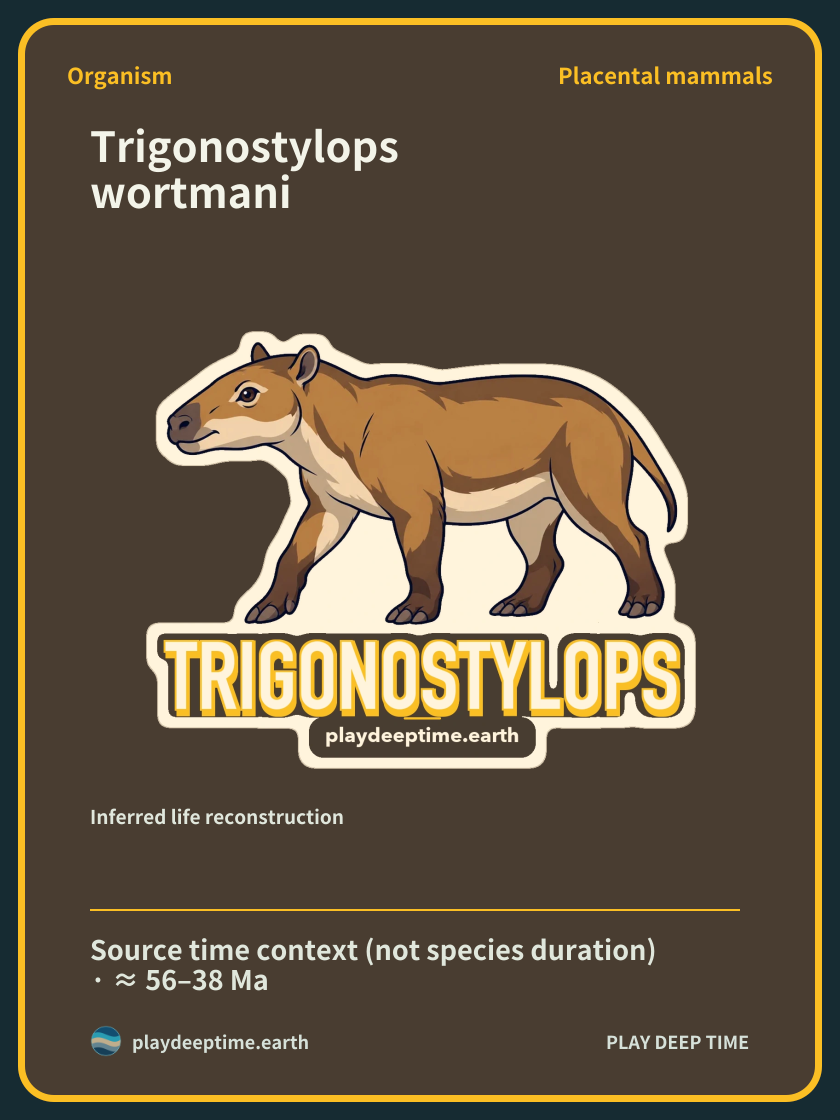
Organism · Placental mammals
Trigonostylops wortmani
Source time context (not species duration) · ≈ 56–38 Ma
Inferred life reconstruction
Trigonostylops wortmani
Overview
Trigonostylops wortmani is an ancient native South American hoofed mammal from the Eocene. Nasal bones that are not retracted and robust canine teeth lead the story of its head. The relationships of this distinctive-looking head were studied for a long time.[1][2]
Loading illustration…
Key facts
Does a very unfamiliar appearance mean isolation on the family tree? Simpson, who studied the skull in 1933, noted this animal’s distinctiveness. A 2021 comparison clarified its relationship to the group containing Astrapotherium and Astraponotus.[2]
Time and place
It is a South American animal from the Eocene, roughly 56–34 million years ago. Important skull material is associated with present-day Argentine Patagonia. It can be encountered when exploring the region’s distinctive mammal evolution.[1][2]
The time range describes source context, not the complete duration of this species.
Size, form and skeleton
The nasal bones are normally developed rather than retracted. The upper canines are described as robust and the bones in the incisor region as reduced. The short gap formed between them is another feature for comparing head structure.[1]
Trigonostylops wortmani is compared in size with a living collared peccary. In 2019, researchers examined skull, lower-jaw, and tooth dimensions together and proposed the collared peccary, weighing about 17–30kg, as a size reference.[7]
Loading illustration…
Habitat and reproduction
In a food-processing head, canines, molars, and jaw connections work together. Comparing the front of the head of Trigonostylops with relatives raises questions about changes in feeding structures. It invites consideration of a body history unlike that of familiar living hoofed mammals.[1][2]
Fossil discovery
New material from the front of the head supplemented the skull introduced in 1933. In 2021, CT-based skull comparisons and phylogenetic analysis followed. This research examines visible outlines together with structures inside the head.[1][2]
References
- Soria & Bond — New material on the anterior skull of Trigonostylops
- MacPhee et al.2021 — Cranial morphology and phylogenetic relationships of Trigonostylops wortmani
- Soria & Bond — New material on the anterior skull of Trigonostylops
- MacPhee et al.2021 — Cranial morphology and phylogenetic relationships of Trigonostylops wortmani
- Study of the first skeleton of Notostylops murinus and its Eocene relatives
- International Commission on Stratigraphy (2024) — Geological time chart
- Kramarz et al. (2019) — Size and diversity of early astrapotheres from Patagonia
Research questions
Do the nasal bones and structures around the ear point to the same family tree? Researchers combine several head features to analyze relationships with related groups. Which differences are gathered under the name wortmani remains a question for continued comparison.[1][2]
Observation
Move your gaze from the nasal bones and canines toward the back of the head. Consider how the features of this unfamiliar head connect with other South American mammals.[1][2]
Related organisms
 Notostylops murinusPlacental mammalsFossil record age bounds · ≈ 56–37.7 Ma
Unfamiliar mammals of Eocene Patagonia
Trigonostylops and Notostylops are encountered through Eocene mammal material from present-day Patagonia. Examine the skull and robust canines of the former and the reported body skeleton and leg connections of the latter, following different clues to ancient South American mammals.