Organism · Archosaurs
Tupuxuara longicristatus
Source time context (not species duration) · ≈ 120–110 Ma
Inferred life reconstruction
Tupuxuara longicristatus
Overview
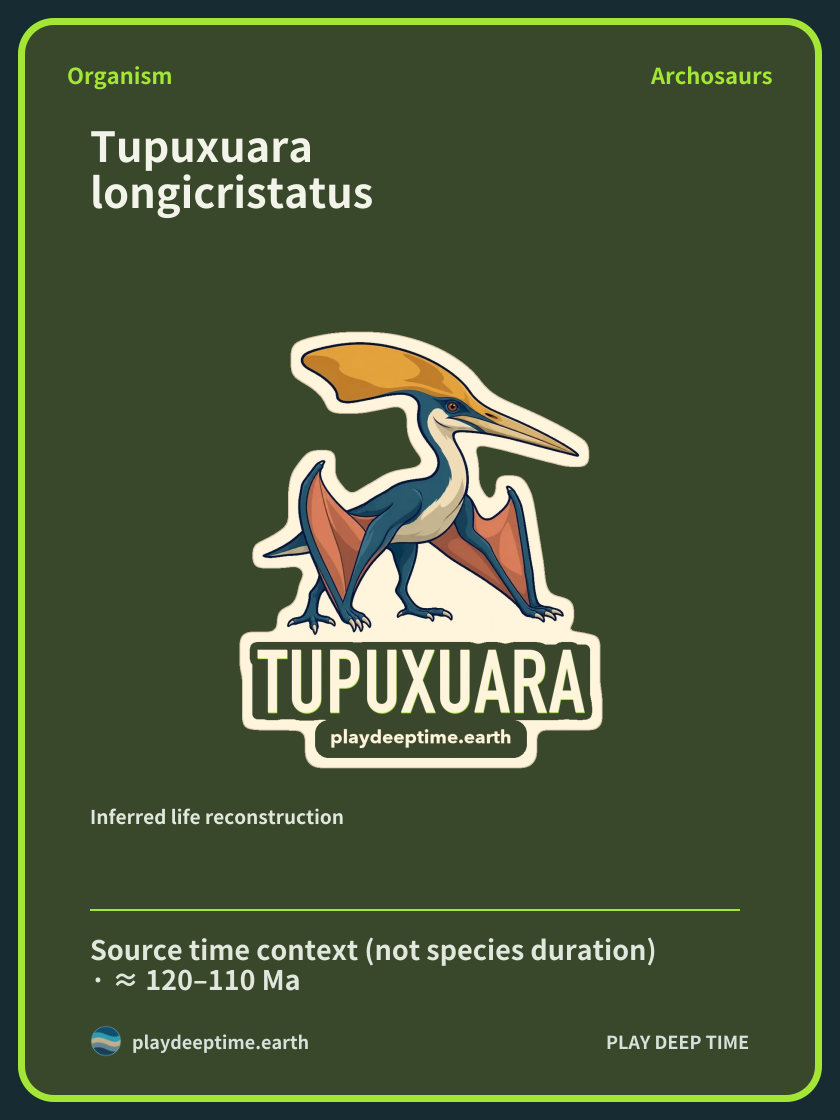
Tupuxuara longicristatus was a Cretaceous pterosaur distinguished by a crest extending above its head. Skull and wing bones are assigned together in the reference material. Questions can expand from the striking head outline to the winged body.[1][2]
Loading illustration…
Key facts
The crest is more than simply an ornament atop the skull. Descriptions explain a region extending above the large opening in front of the nose and eye. Considering the crest and the opening below it together reveals the skull’s organization.[1]
Time and place
Holotype MN6591-V was preserved in a carbonate concretion of the Romualdo Formation. The formation lies in the Araripe Basin of present-day northeastern Brazil. Registered fossil-bearing layers are summarized as Cretaceous material from approximately 120–110 million years ago.[3][1][2]
The time range describes source context, not the complete duration of this species.
Size, form and skeleton
The head crest is described as extending above the large opening in front of the nose and eye. Skull and wing elements are assigned together to reference specimen MN6591-V. The large skull outline and wing-bone material reveal features of different regions.[1][2]
Tupuxuara longicristatus was a pterosaur flying over what is now Brazil during the Early Cretaceous. Research on the type specimen’s skull and wing bones estimated a spread wingspan of about 2.5–3 m. It had a large head crest and a toothless beak.[4]
Loading illustration…
Habitat and reproduction
A pterosaur’s skull and wings are different body regions. In this animal, evidence from both can be compared together. Looking beyond the striking crest to where wings connect with the body gives a fuller sense of its organization.[1]
Fossil discovery
Following a 2004 study of head features, a taxonomic reassessment of Tupuxuara appeared in 2025. Later research also distinguishes reference specimen MN6591-V from material of other species. New evidence and comparisons prompt renewed readings of names and features.[1][2]
References
- Kellner (2004) — The head crest and relationships of Tupuxuara
- Pinheiro et al. (2025). Cretaceous Pterosaurs of the Araripe Basin: A Comprehensive Taxonomic Update and Paleobiological Insights.
- Paleobiology Database — Stratigraphic records of Tupuxuara fossils
- Kellner (2004) — Morphology and relationships of tapejarid pterosaurs
- Wellnhofer (1987) — Crested pterosaurs from Brazil
- Kellner et al. (2013) — Comparative specimens of Tropeognathus
Research questions
Where should comparison of head crests begin? Consider the crest’s starting position separately from its relationship to the large opening beneath it. A striking silhouette can be understood anew as connections among smaller structures.[1]
Observation
Move your gaze from the crest above the head to the large opening below it. Examine the positions of head, neck, and wings in sequence to reveal how large structures connect within the body.[1]
Related organisms
 Tropeognathus mesembrinusArchosaursSource time context (not species duration) · ≈ 143–66 Ma
Different bodies among pterosaurs
Compare the bodies of Tupuxuara longicristatus and Tropeognathus mesembrinus. Tupuxuara longicristatus: a Cretaceous pterosaur with a striking crest extending above its head. Tropeognathus mesembrinus: a pterosaur introduced through crests above and below the fronts of its jaws.