Organism · Lizards and snakes
Tylosaurus proriger
Source time context (not species duration) · ≈ 143–66 Ma
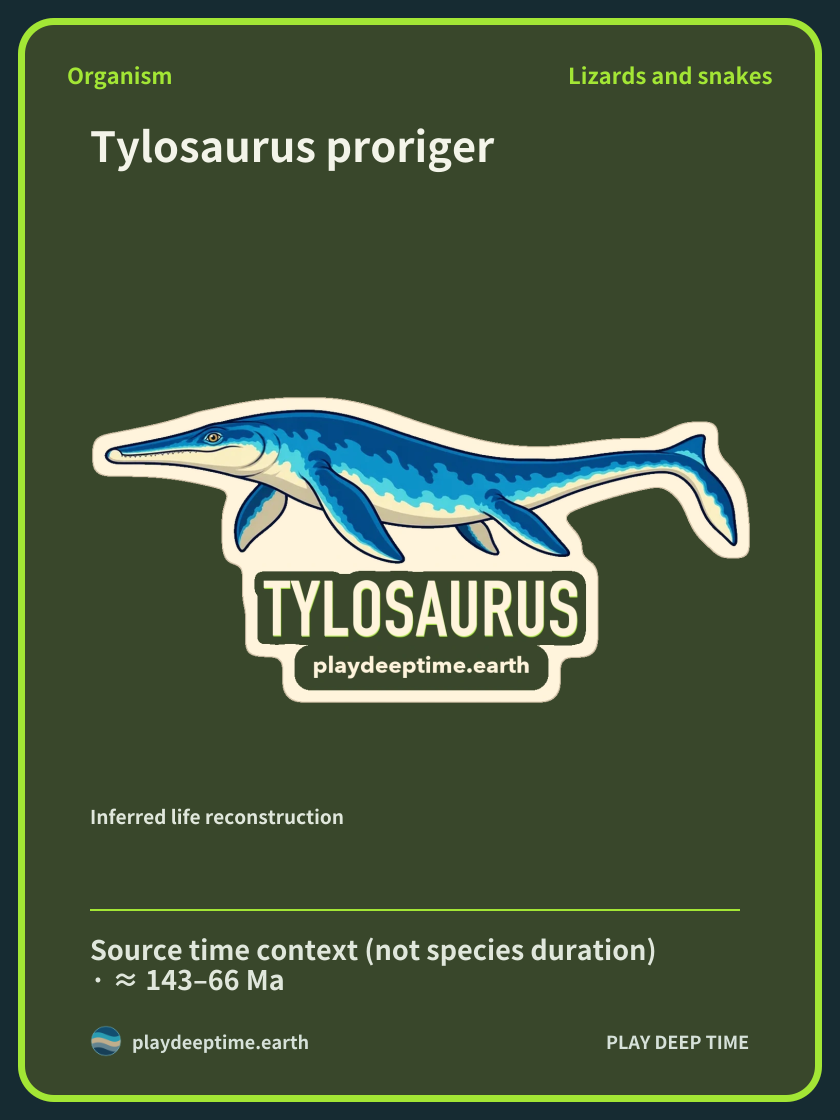
Inferred life reconstruction
Tylosaurus proriger
Overview
Tylosaurus proriger was a large reptile of Cretaceous seas. The tip of its snout projects beyond the tooth-bearing region. Its marine mosasaur body can be explored alongside a story of rediscovery in a museum.[1][6]
Loading illustration…
Key facts
An important fossil thought to be lost was identified again in museum storage: MCZ 4374, preserving the skull, jaws, and vertebrae. Recognizing an old collection item can itself become a new discovery.[3][5]
Time and place
The type specimen is known from present-day western Kansas, United States. During the Late Cretaceous, the Western Interior Seaway covered this region, and the specimen was buried in chalk formed from plankton shells. The Cretaceous spans approximately 140–66 million years ago.[3][4]
The time range describes source context, not the complete duration of this species.
Size, form and skeleton
A long snout, four flipper-like limbs, and an elongated tail are characteristic. The very front of the snout extends beyond the tooth-bearing jaw. An institution compares its large size to a bus.[1][5]
Loading illustration…
Habitat and reproduction
It was a large reptile that hunted in the sea. Its four limbs were flipper-shaped, and its tail was elongated. Research comparing vertebrae and tail bones expands questions toward how the body moved underwater.[1][2]
Fossil discovery
According to institutional records, the specimen was discovered in 1868. Louis Agassiz purchased it in April 1869, adding it to Harvard’s MCZ collection. The museum reports also rediscovering the original purchase receipt.[3]
A 1967 study incorrectly reported the fossil as lost. However, photographs shared by a collections manager in 2020 prompted researchers to recognize the specimen held in the museum. The fossil, receipt, and photographs connected a long research history.[3]
References
- Jiménez-Huidobro & Caldwell (2019) — Morphology and relationships of tylosaurines
- Song & Lindgren (2026) — Reconstruction of mosasaur tail fins
- Harvard (2026) — A giant marine predator discovered twice
- International Commission on Stratigraphy (2024) — Geological time chart
- MCZ Specimen Sparks New Scientific Insights
- Fukui Prefectural Dinosaur Museum — Tylosaurus proriger specimen
- Smithsonian Ocean — Xiphactinus
Research questions
How can the shape of a tail fin be inferred when only bones remain? Researchers predicted the form of the tail tip using a model combining several skeletal sources. Comparing fossil bone arrangements and models helps explore marine reptile movement.[2]
Observation
First examine the snout tip extending ahead of the tooth-bearing jaw. Then move your gaze to the four flippers beside the body and the long tail to reveal its marine reptile body plan.[1]
Related organisms
 Xiphactinus audaxRay-finned fishesSource time context (not species duration) · ≈ 143–66 Ma
Large predators of Cretaceous seas
Tylosaurus was a marine reptile, while Xiphactinus was a large fish. They allow comparison of predators with different body plans in Late Cretaceous seas.