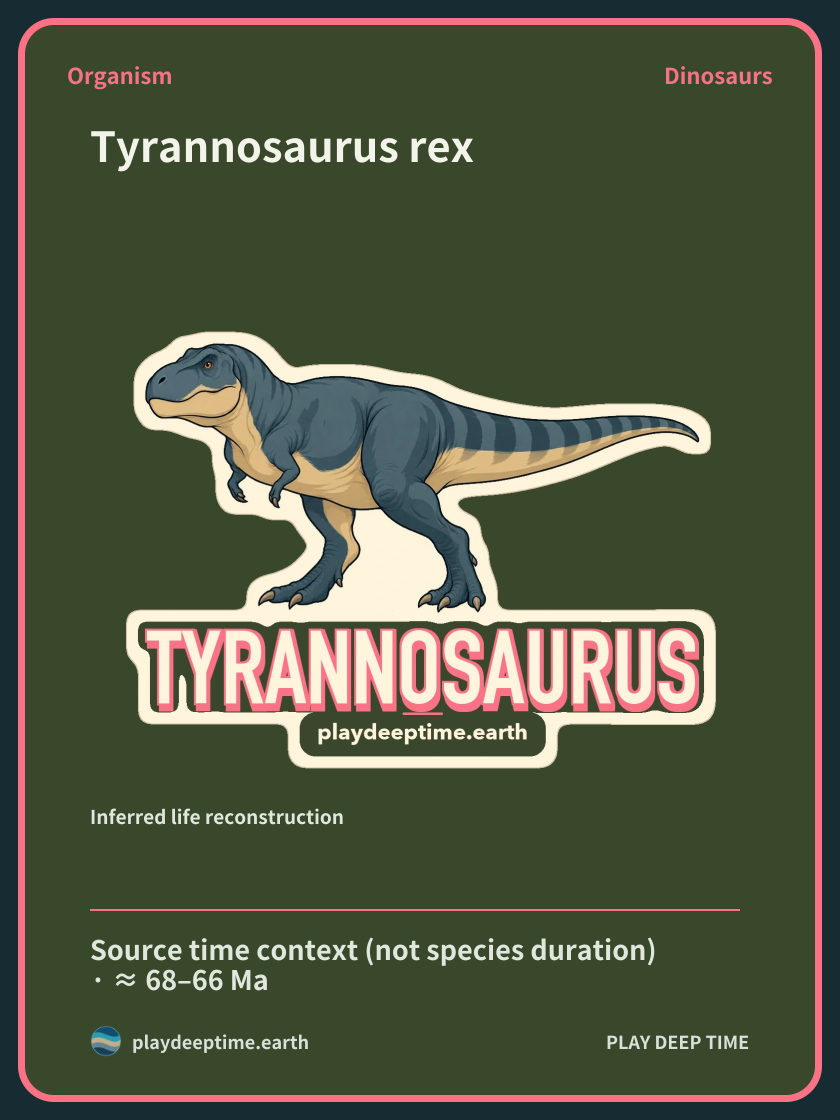
Organism · Dinosaurs
Tyrannosaurus rex
Source time context (not species duration) · ≈ 68–66 Ma
Inferred life reconstruction
Tyrannosaurus rex
Overview
A massive head, powerful hind legs, and a long balancing tail: Tyrannosaurus rex is a representative predatory dinosaur of latest Cretaceous North America. Traces of its life preserved in fossils are as striking as its name.[1]
Loading illustration…
Key facts
A Tyrannosaurus tooth was discovered in the tail vertebrae of a herbivorous dinosaur. Remarkably, the surrounding bone had healed. The attacked animal survived and recovered from its wound. One fossil fragment preserves a moment of hunting and survival.[3]
Time and place
It is known from North America roughly 68–66 million years ago, just before the end of the Cretaceous. Fossils in the present-day USA and Canada introduce the world of this enormous dinosaur.[4]
The time range describes source context, not the complete duration of this species.
Size, form and skeleton
Picture a body length of approximately 12 m for large individuals such as SUE. Compared with the powerful head and jaws, the forelimbs were small, with two externally visible fingers. The tail extending behind the trunk counterbalanced weight and helped stabilize the bipedal body.[1][2]
Loading illustration…
Habitat and reproduction
Traces of attacks on other dinosaurs and powerful jaws reveal a carnivorous life. Researchers interpret it as having eaten animals already dead as well as hunted prey. The use of both live prey and carcasses is also seen in many predators today.[1][3][5]
Fossil discovery
Named skeletons such as SUE at Chicago’s Field Museum connect Tyrannosaurus research with the public. Alongside large skeletons, accumulating evidence from teeth, injuries, and skin impressions has enriched the picture of this animal.[2][6]
References
Research questions
The story of Tyrannosaurus goes beyond contests over size. Research asks how it grew, what it ate, and what covered its body. Bones, skin, and wounds on prey animals answer different questions.[1][3][6]
Observation
Examine the balance extending from the head through the trunk to the tail. The contrast between small forelimbs and large hind limbs is another important identifying feature.[1]
Related organisms
 Edmontosaurus annectensDinosaursFossil record age bounds · ≈ 83.6–66 Ma
A dinosaur that survived an attack
A Tyrannosaurus tooth became embedded in a hadrosaur’s tail vertebrae, and the surrounding bone healed. Researchers considered Edmontosaurus annectens the most likely identity of the animal. The predator’s weapon and the prey’s survival were preserved together.