Organism · Coelacanths
Undina penicillata
Fossil record age bounds · ≈ 152–149 Ma
Inferred life reconstruction
Undina penicillata
Overview
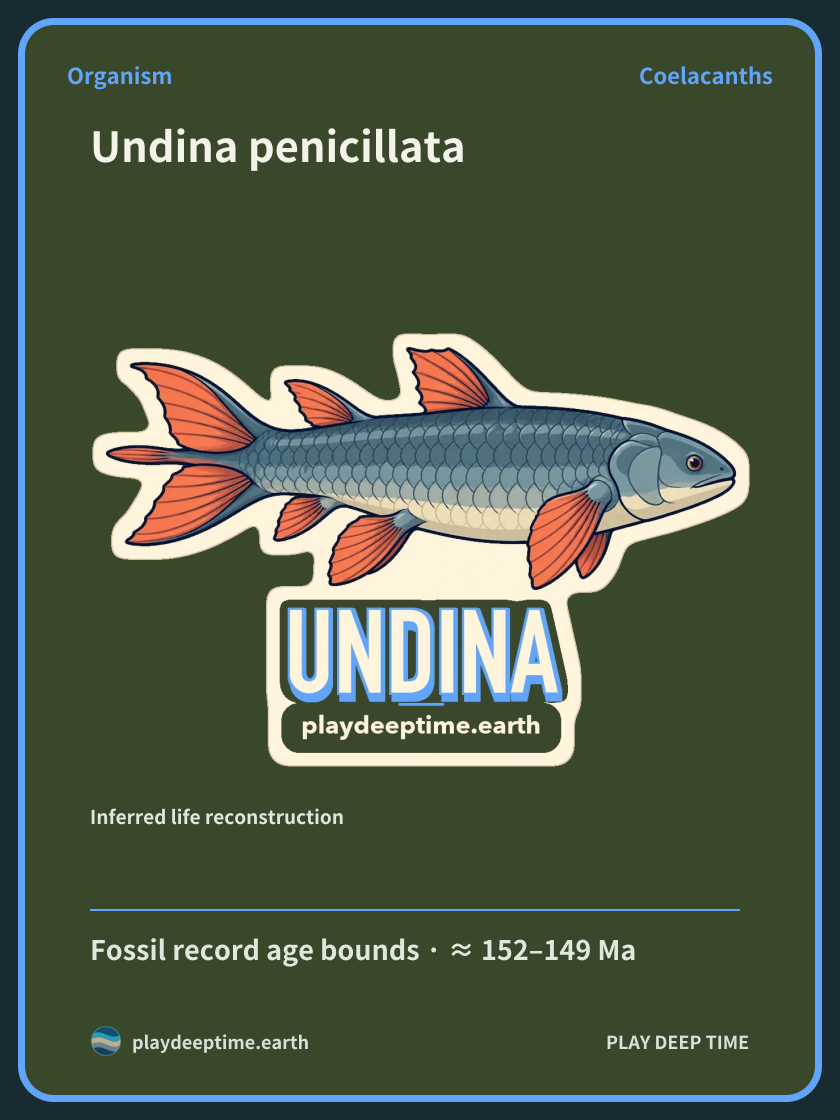
Undina penicillata was a Late Jurassic coelacanth. One fossil preserves a sequence from the head through the scaled trunk to the fins and tail. Following the overall outline reveals the organization of an ancient fish.[1]
Loading illustration…
Key facts
The supplementary lobe at the tail tip is another comparative feature. The paper explains that Undina’s supplementary lobe is long but less pronounced than that of Libys. Even within coelacanths, differences in tail-tip projection change the silhouette.[1]
Time and place
The figure caption in a 2022 paper identifies this specimen as Late Jurassic material from present-day Germany. Its number is BSM 1870 XIV 22. This record of place and time provides the context for encountering Undina.[1]
The time range describes source context, not the complete duration of this species.
Size, form and skeleton
The scaled trunk tapers backward into the caudal peduncle. Fan-like fin rays appear on the dorsal and ventral sides, and a supplementary lobe at the tail center projects slightly beyond the outer outline. The transition from trunk to tail is a point of observation.[1]
Loading illustration…
Habitat and reproduction
Scales and fin rays in the fossil provide clues for following the fish’s exterior. Examining the preserved connections reveals where the fins lay and how the body continued into the tail. The surviving outline is a starting point for understanding a body once extended underwater.[1]
Fossil discovery
A 2022 study by Ferrante, Menkveld-Gfeller, and Cavin introduced this specimen while comparing Jurassic coelacanths. It separately presented a photograph of the whole specimen and its trunk scales as comparative material. A single specimen’s broad outline and tiny scales became different windows of observation.[1]
References
- Ferrante et al. (2022) — Comparing outlines and scales of Jurassic coelacanths
- Ferrante et al. (2022) — Comparing outlines and scales of Jurassic coelacanths
- Ebert (2026) — Reassessment of Mesturus and related fishes
- 2020 study — Comparing pycnodont fishes
- International Commission on Stratigraphy (2024) — Geological time chart
Research questions
Researchers presented the outline visible in the whole-body photograph alongside comparative material of the trunk scales. Alternating between large features such as tail projections and small structures such as scales follows the process of distinguishing similar fishes.[1]
Observation
The illustration centers on the lateral outline preserved in specimen BSM 1870 XIV 22. Head details are restrained to follow the outline, while spaces between fin rays and narrow damaged areas are depicted by connecting preserved structures. Membranes, color, and body thickness are limited interpretations intended to make the observed outline easier to read.[1]
Related organisms
 Mesturus verrucosusRay-finned fishesSource time context (not species duration) · ≈ 201–143 Ma
Two fishes in Late Jurassic layers of present-day Germany
Undina penicillata and Mesturus verrucosus are encountered through Late Jurassic material from present-day Germany. Compare the projecting center of Undina’s tail with the rounded tail of Mesturus and the scales covering both bodies. This connection explores the Late Jurassic record of the German region through different fish outlines.