Organism · Valeria
Valeria lophostriata
Fossil record age bounds · ≈ 1,800–720 Ma
Inferred life reconstruction
Valeria lophostriata
Overview
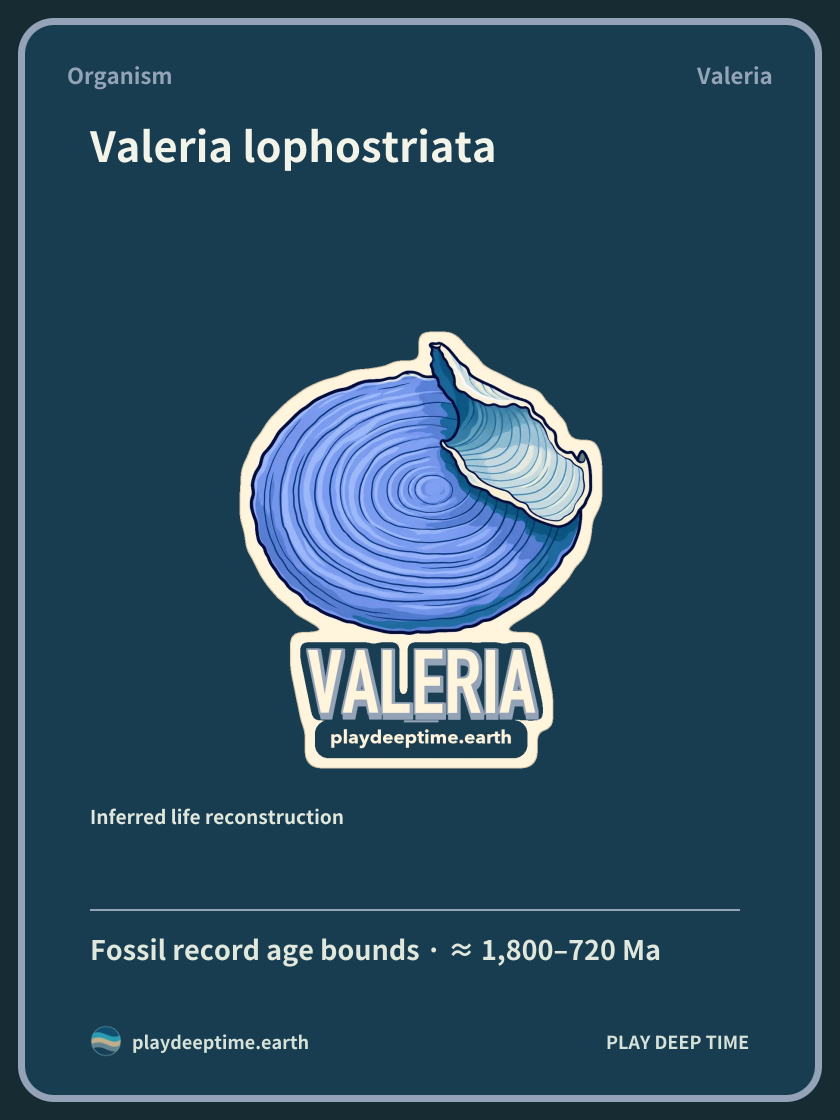
Valeria lophostriata is a microfossil with concentric striations preserved on its wall. Follow the lines on a small wall fragment to explore the very ancient world of the Mesoproterozoic.[1]
Loading illustration…
Key facts
Fossils do not preserve only fully opened forms. Examining partly rolled walls alongside walls still splitting reveals different states of preservation under the same name.[1]
Time and place
It appears in research on the early Mesoproterozoic Roper Group. The locality is in present-day Northern Territory, Australia. The study examined minute traces of life preserved in thick sedimentary rocks there.[1]
The time range describes source context, not the complete duration of this species.
Size, form and skeleton
The vesicle wall characteristically bears striations that appear to encircle a center. Specimens beginning to split through the middle were presented alongside ones whose walls had partly rolled after splitting.[1]
The sac-like fossils presented in a 2022 study are approximately 60–250 µm in diameter. Converted to millimeters, these small fossils measure about 0.06–0.25 mm.[4]
Loading illustration…
Habitat and reproduction
The Roper assemblage studied was most diverse in nearshore settings. Microfossils interpreted as eukaryotes were also abundant in shales of the nearshore continental shelf.[1]
Fossil discovery
The researchers recorded slide numbers together with coordinates so that the same microfossils could be located again. Several slides of U6 material preserve different states of Valeria.[1]
References
Research questions
Javaux and Knoll’s 2017 study compared 34 taxa in the Roper assemblage. By combining the forms and environments of small fossils, it explored the diversity of early eukaryotes.[1]
Observation
In the illustration, examine the curve of the partly rolled wall and then the concentric striations on its surface. Moving your gaze from the open surface to the curled edge reveals differences across a small surface.[1]
Related organisms
 Germinosphaera bispinosaAcritarchaFossil record age bounds · ≈ 1,800–720 Ma
Proterozoic life revealed by small patterns
Explore Tonian Germinosphaera alongside the earlier Mesoproterozoic Valeria. Different microfossils from present-day Sweden and Australia reveal contrasting features: long tubular processes and concentric striations.