Organism · Animals
Vauxia gracilenta
Source time context (not species duration) · ≈ 539–487 Ma
Inferred life reconstruction
Vauxia gracilenta
Overview
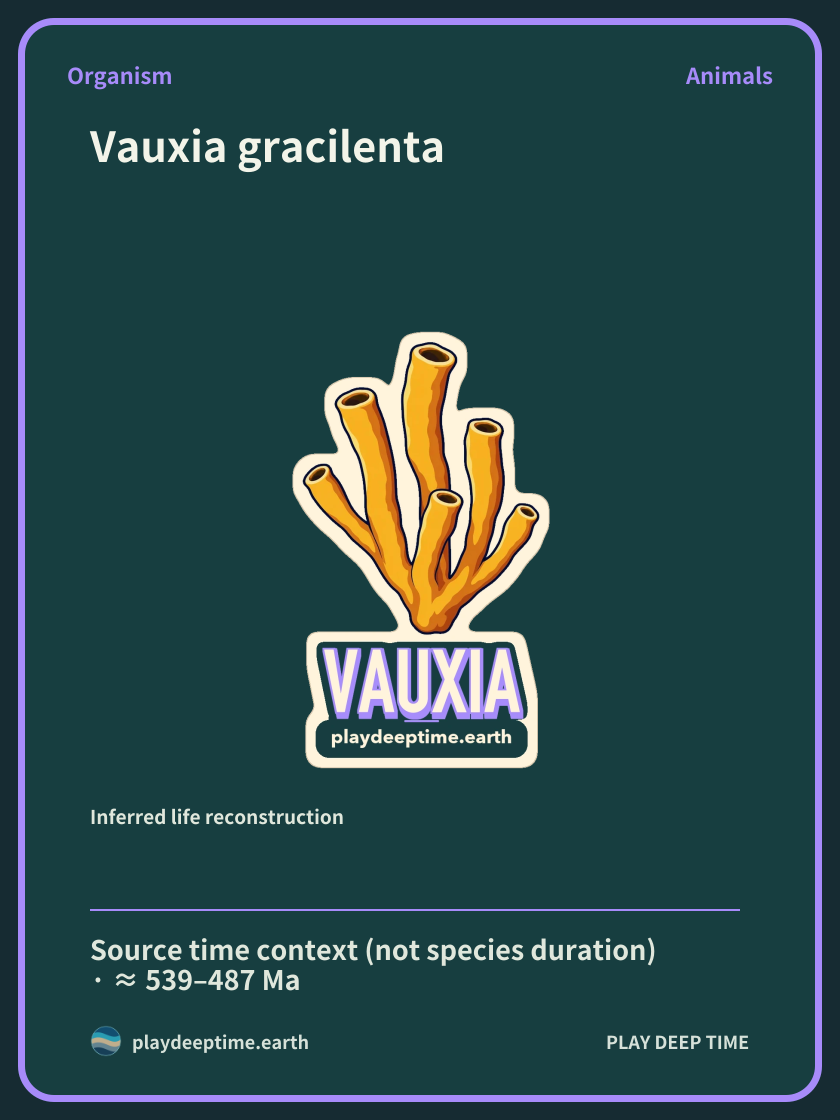
Vauxia gracilenta is a sponge known from simple bodies to forms dividing into several branches. Hollow spaces within the branches lead to outlets at their tips. This organism invites consideration of external branching together with internal connections.[1]
Loading illustration…
Key facts
The branches are described as nearly conical cylinders. Their internal cavities connect to openings at the branch tips. The outside shape and internal space of one branch connect within the same body.[1]
Time and place
The lectotype USNM 66515 and paralectotype USNM 66511 of Vauxia gracilenta came from the Walcott Quarry. This locality is on Fossil Ridge in present-day British Columbia, Canada. The Cambrian as a whole was roughly 540–490 million years ago.[1][2][3][4]
The time range describes source context, not the complete duration of this species.
Size, form and skeleton
The body is described in forms ranging from simple to branched. Each branch is nearly cylindrical, and its internal cavity leads to a terminal osculum. The external outline of branching and the hollow spaces inside can be examined separately.[1]
Reference specimen USNM66515, introduced by the museum, is 74mm tall.[5]
Loading illustration…
Habitat and reproduction
The institutional account explains the sessile life of Vauxia. A body attached in one place extends into several branches, and the inside of each branch connects to an opening at the tip. Body position and internal construction can be read together.[1]
Fossil discovery
USNM 66511 and USNM 66515 are each introduced as branched specimens. Branching arrangements can be compared in different material of the same species. This is a case of exploring the range of body forms through several specimens.[1]
References
Research questions
Did every individual of a branching sponge have the same number of branches? The description considers material ranging from simple to branched forms. Shared branch construction can be examined separately from the overall outline that differs among individuals.[1]
Observation
Move your gaze from the base to each branch tip. Considering the outline of the cylindrical branches together with their internal cavities and terminal oscula connects the outside with the inside.[1]
Related organisms
 Choia carteriAnimalsSource time context (not species duration) · ≈ 539–487 Ma
Different bodies among sponges
Explore the bodies of Vauxia gracilenta and Choia carteri together. Vauxia gracilenta: Vauxia gracilenta is a sponge known from simple bodies to forms dividing into several branches. Choia carteri: Choia carteri is a sponge with spicules radiating from a flat oval disc.