Organism · Dinosaurs
Velociraptor mongoliensis
Source time context (not species duration) · ≈ 143–66 Ma
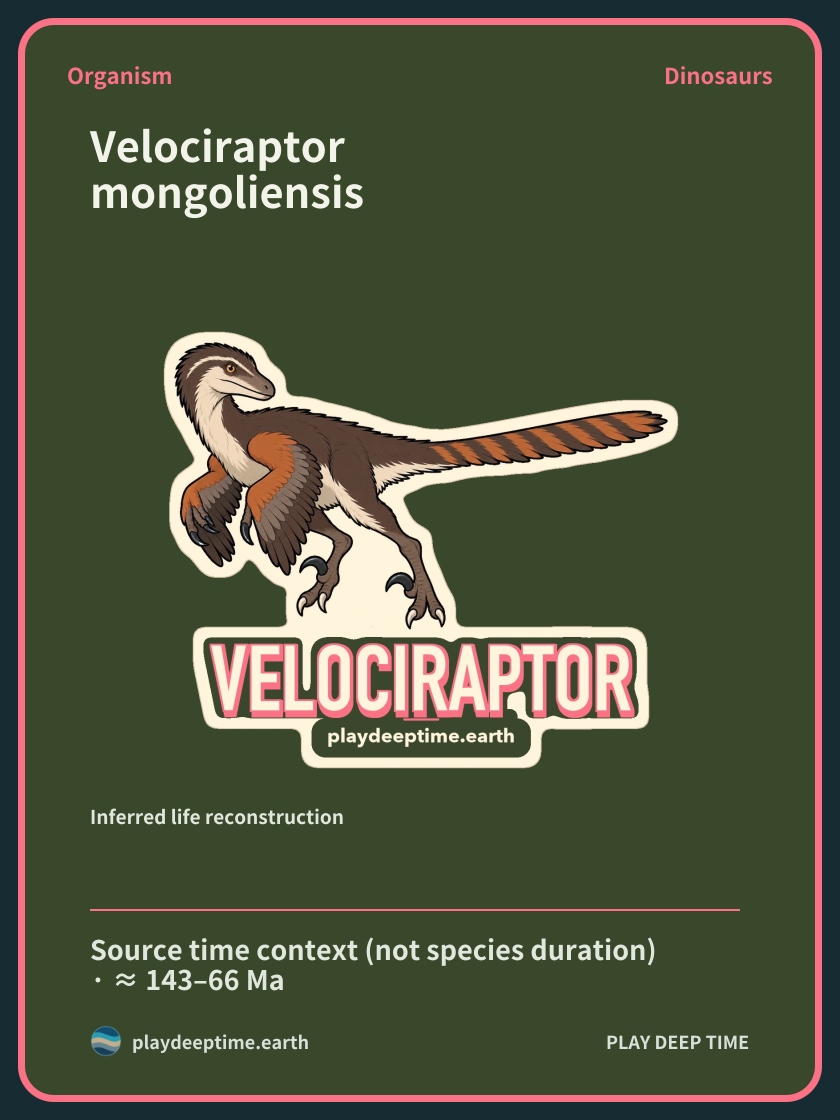
Inferred life reconstruction
Velociraptor mongoliensis
Overview
Velociraptor mongoliensis is a small carnivorous dinosaur with a long tail and feathers. The real animal is described as much smaller than its enormous film portrayals. Traces on its arm bone reveal body features linking dinosaurs and birds.[2][1]
Loading illustration…
Key facts
Even when feathers themselves are lost, traces can remain on bone. Small bumps associated with attachment sites for large feathers are known on the arm bone of Velociraptor. Tiny changes on a bone surface led to the story of its feather covering.[1]
Time and place
It lived in the region of present-day Mongolia in the Late Cretaceous, around 75 million years ago. Its world was much later than that of feathered dinosaurs such as Microraptor. Comparing related animals from different times reveals the long history of feathers.[2][1]
The time range describes source context, not the complete duration of this species.
Size, form and skeleton
Museums give a body length of approximately 1.8 m, including the tail, for the genus Velociraptor. It supported its body on two legs, with a long tail extending behind. Arm-bone traces of wing-feather attachments invite us to picture skeleton and feathers together.[2][1]
Loading illustration…
Habitat and reproduction
It was a carnivorous dinosaur that moved on two legs. Looking at its feather covering and long tail together reveals similarities to and differences from birds. Picture the life of a small theropod finding food and moving through its surroundings.[2][1]
Fossil discovery
A 2007 study reported wing-feather attachment traces on the arm bone of Velociraptor mongoliensis. Researchers interpreted their significance by comparing them with feather attachment sites in birds. Reexamining small bone surfaces can reveal new stories even in a well-known dinosaur.[1]
References
Research questions
If it had large birdlike feathers, how did it use them? The presence of feathers and the ability to fly are studied by comparing different body features. Considering it alongside fellow dromaeosaur Microraptor reveals diversity in feather arrangement and body size.[1][2]
Observation
Move your gaze from the long tail to the arms and feathers. Picture how traces on a small arm bone connect with feathers outside the body.[1][2]
Related organisms
 Microraptor guiDinosaursSource time context (not species duration) · ≈ 143–66 Ma
Close relatives with feathers
Velociraptor and Microraptor belong to the dromaeosaurs. Compare fossils from different times and regions to explore diversity in feathers and body size.
 Protoceratops andrewsiDinosaursSource time context (not species duration) · ≈ 143–66 Ma
A Cretaceous moment with claw and beak locked together
A Late Cretaceous fossil discovered in present-day Mongolia preserves two dinosaurs in a close-combat posture. The hind-foot claw of Velociraptor lies near the neck of Protoceratops, while the beak of Protoceratops rests on its opponent’s arm. Read bodily weapons alongside their opposing postures to examine a moment of struggle preserved in the fossil.