Organism · Animals
Vetulicola cuneata
Source time context (not species duration) · ≈ 539–487 Ma
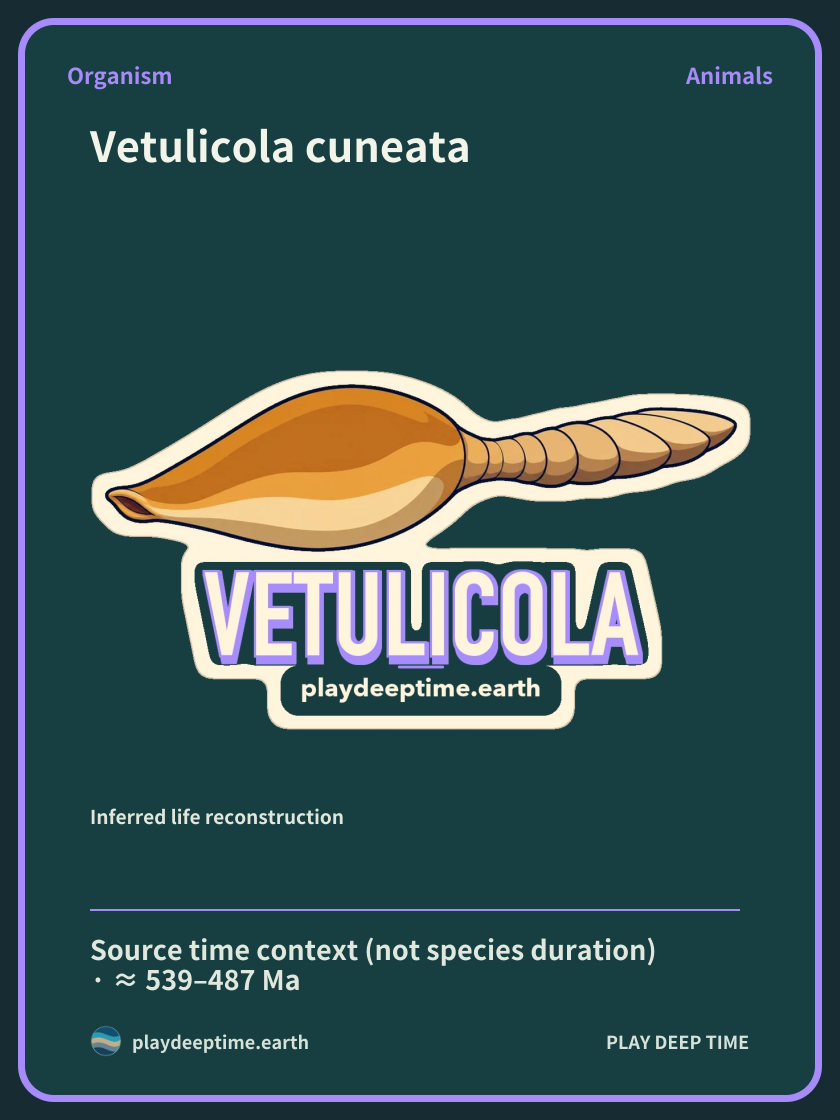
Inferred life reconstruction
Vetulicola cuneata
Overview
Vetulicola cuneata is a Cambrian organism with distinctly different front and rear body regions. Behind a body that narrows toward the front, a slender junction leads to a segmented rear region. Simply comparing the front and back reveals an unfamiliar arrangement.[1]
Loading illustration…
Key facts
The front end is described as a lip-like projection. Behind it, the front body region and segmented rear meet at a narrow junction. We can examine the two large divisions and the boundary between them together.[1]
Time and place
It is known from studies of the morphology and evolutionary relationships of Cambrian vetulicolians. The Cambrian spanned approximately 540–490 million years ago. Several specimens assigned to the species reveal features of the front and rear body regions.[1][2]
The time range describes source context, not the complete duration of this species.
Size, form and skeleton
The front body region narrows forward and has a lip-like projection at its tip. A segmented rear follows a narrow junction. The researchers interpreted the last four segments as horizontally flattened and bilaterally symmetrical.[1]
A 2020 study reconstructed this species using a specimen approximately 6 cm long. The figure conveys the size of a small animal with a front body region followed by a segmented rear, and refers specifically to the specimen used in the study.[3]
Loading illustration…
Habitat and reproduction
Can the segmented rear be pictured like a familiar fish tail? Research on this organism proposed that its terminal region was horizontally flattened. Similar-looking long outlines can differ in their orientation and construction.[1]
Fossil discovery
Studies of the species include several specimens, such as RCCBYU 10298, YKLP 10901, and YKLP 10903. Each preserves different parts and views. Researchers place these records side by side to investigate the front and rear regions.[1]
References
- Study — Morphology and relationships of vetulicolians
- International Commission on Stratigraphy (2024) — Geological time chart
- Li et al. 2020 — Vetulicola and small organisms living attached to its body
- Li et al. 2020 — Vetulicola and small organisms living attached to its body
- Conway Morris et al. — A study of Cambrian Banffia from Utah
- Paleobiology Database — Strata yielding Banffia
Research questions
How can we compare an organism whose front and rear differ so greatly? Researchers examine the overall silhouette, junction, and segment shapes separately. The investigation starts with a combination of structures rather than a single familiar animal body plan.[1]
Observation
Move your gaze from the lip-like front tip to the narrow junction and segmented rear. Considering the two large divisions and the direction in which the terminal region is flattened reveals its distinctive arrangement.[1]
Related organisms
 Banffia episomaAnimalsSource time context (not species duration) · ≈ 510–500 Ma
Front and rear body regions in Cambrian seas
Explore the different bodies and records of time preserved in these two organisms. Vetulicola cuneata: Vetulicola cuneata is a Cambrian organism with distinctly different front and rear body regions. Behind a body that narrows toward the front, a slender junction leads to a segmented rear region. It is known from studies of the morphology and evolutionary relationships of Cambrian vetulicolians. The Cambrian spanned approximately 540–490 million years ago. Banffia episoma: Banffia episoma is a Cambrian fossil animal with clearly divided front and rear body regions. The front is narrow and short, while transverse rings run along the larger rear region. It lived in the Cambrian, around 500 million years ago. Its type specimen came from Miners Hollow in the Wellsville Mountains of present-day Utah, USA.