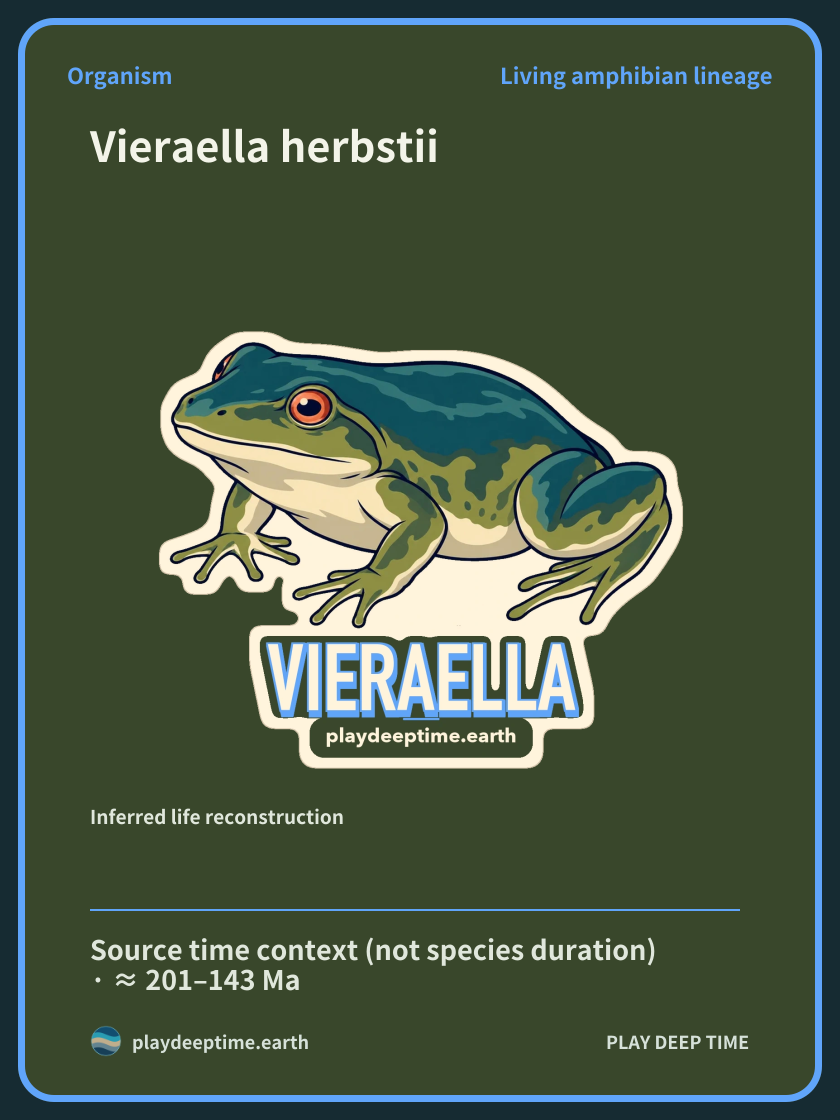
Organism · Living amphibian lineage
Vieraella herbstii
Source time context (not species duration) · ≈ 201–143 Ma
Inferred life reconstruction
Vieraella herbstii
Overview
Vieraella herbstii appears in research on ancient frog fossils from South America. The head, trunk, and limbs of one individual are partly articulated. Several bones of its small body offer clues to early frogs.[1][2]
Loading illustration…
Key facts
PVL2488 and MLP64-VII-15-1 are not two different frogs. They are counterpart specimens showing dorsal and ventral material from the same individual. Looking at both faces of a fossil helps us understand one organism.[1]
Time and place
The literature treats Vieraella as a Jurassic frog from South America. The Jurassic was roughly 200–140 million years ago. Old material and new reexaminations have repeatedly explored the anatomy of the same individual.[2][3]
The time range describes source context, not the complete duration of this species.
Size, form and skeleton
The 1965 description includes a shield-shaped head and fused forearm bones. It also describes the axial skeleton of the trunk, the upper arm, thigh, and lower leg bones, and some hand and foot bones. You can examine the connections from the head through the trunk to all four limbs.[1]
Body length is estimated at about 3.3cm from the tip of the snout to the cloaca. This excludes the long hind limbs. It gives a sense of the stature of a small frog relative that lived in Jurassic South America.[4]
Loading illustration…
Habitat and reproduction
Understanding a frog’s small body also requires examining the trunk, arms, and legs separately. This fossil preserves connected parts, and a new reexamination also addresses internal structures such as a short, tapering urostyle. It is intriguing to imagine the exterior while reading the skeleton inside.[1][2]
Fossil discovery
This fossil continued to be reexamined after the 1965 study. A recent reexamination abstract recognizes a small bone called the prepollex, unlike the earlier account. New observations can change anatomical interpretations even in the same specimen.[1][2]
References
Research questions
What changes when a tiny bone is rediscovered? The new interpretation of the prepollex shows why fossils studied long ago deserve reexamination. Discovery includes not only finding new fossils but also rereading material already known.[2]
Observation
Move your gaze from the head to the short trunk and four limbs. Thinking of the dorsal and ventral perspectives helps you consider how the bones of one individual connect.[1]
Related organisms
 Czatkobatrachus polonicusLiving amphibian lineageSource time context (not species duration) · ≈ 252–201 Ma
Different bodies among frogs
Explore the bodies of Vieraella herbstii and Czatkobatrachus polonicus together. Vieraella herbstii: Vieraella herbstii appears in research on ancient frog fossils from South America. Czatkobatrachus polonicus: Czatkobatrachus polonicus is an Early Triassic frog relative.