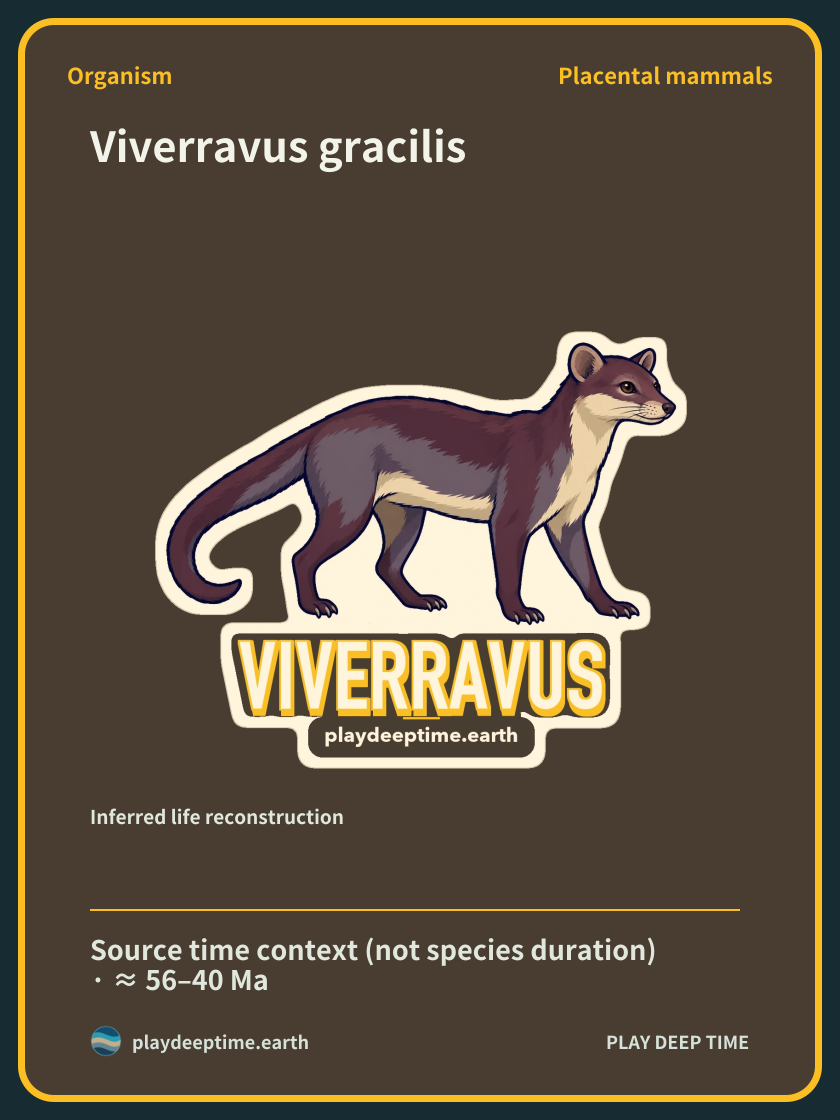
Organism · Placental mammals
Viverravus gracilis
Source time context (not species duration) · ≈ 56–40 Ma
Inferred life reconstruction
Viverravus gracilis
Overview
Viverravus gracilis is an early carnivoran relative from Eocene North America. This mammal is explored through comparisons of lower jaws and teeth. It provides evidence for the diversification of ancient predator groups.[1]
Loading illustration…
Key facts
Teeth assigned to the same species can differ in size. Washakie specimens in a 2021 study have larger teeth than the type specimen. It becomes important to distinguish differences between species from variation within one species.[1]
Time and place
It is associated with Eocene material from the western USA, particularly around 50 million years ago. The type specimen came from Grizzly Buttes in the Bridger Basin of present-day Wyoming. Fossils from the Washakie Basin were later compared with it.[1]
The time range describes source context, not the complete duration of this species.
Size, form and skeleton
The type specimen preserves both lower jaws and several teeth. Premolars, molars, and their roots are also compared in the Washakie specimens. Viewing tooth positions and chewing surfaces side by side reveals small differences.[1]
A model based on dental data in the 2021 CarniFOSS study estimated a body mass of approximately 630 g.[6]
Loading illustration…
Habitat and reproduction
How did these early carnivoran relatives use the ground and trees? Postcranial bones of the same genus and an ankle bone tentatively attributed to this species were used in such comparisons. Researchers explore dietary stories from teeth together with movement stories from limbs.[2][1]
Fossil discovery
The species retains a name established by Marsh in 1872. Postcranial research on the genus in 2006 was followed by dental comparisons from the Washakie Formation in 2021. New specimens and questions continue to accumulate around a long-known name.[1][2]
References
- Tomiya et al.2021 — Diversity of carnivorous mammals in the Washakie Formation
- Heinrich & Rose2006 — Postcranial bones and living environment of Viverravus
- Tomiya et al.2021 — Diversity of carnivorous mammals in the Washakie Formation
- Tomiya et al.2021 — Diversity of carnivorous mammals in the Washakie Formation
- Smithsonian — Specimen catalogue for Mesonyx obtusidens
- Faurby·Morlo·Werdelin(2021) — CarniFOSS fossil carnivorous mammal body-mass data
Research questions
Do teeth of similar size necessarily belong to the same species? Researchers compare dimensions, shapes, and the layers in which specimens were found. Gathering several small fossils helps reveal diversity among early carnivoran relatives.[1]
Observation
Follow the lower jaw to examine premolars and molars in turn. Remember that legs used for movement and teeth used for feeding tell different stories about life.[1][2]
Related organisms
 Mesonyx obtusidensPlacental mammalsSource time context (not species duration) · ≈ 56–33.9 Ma
Different mammals of Eocene Wyoming
Viverravus and Mesonyx are mammals known from Eocene strata in present-day Wyoming, USA. Compare the bodies and bones of different specimens to explore a wider range of this region’s ancient mammals.