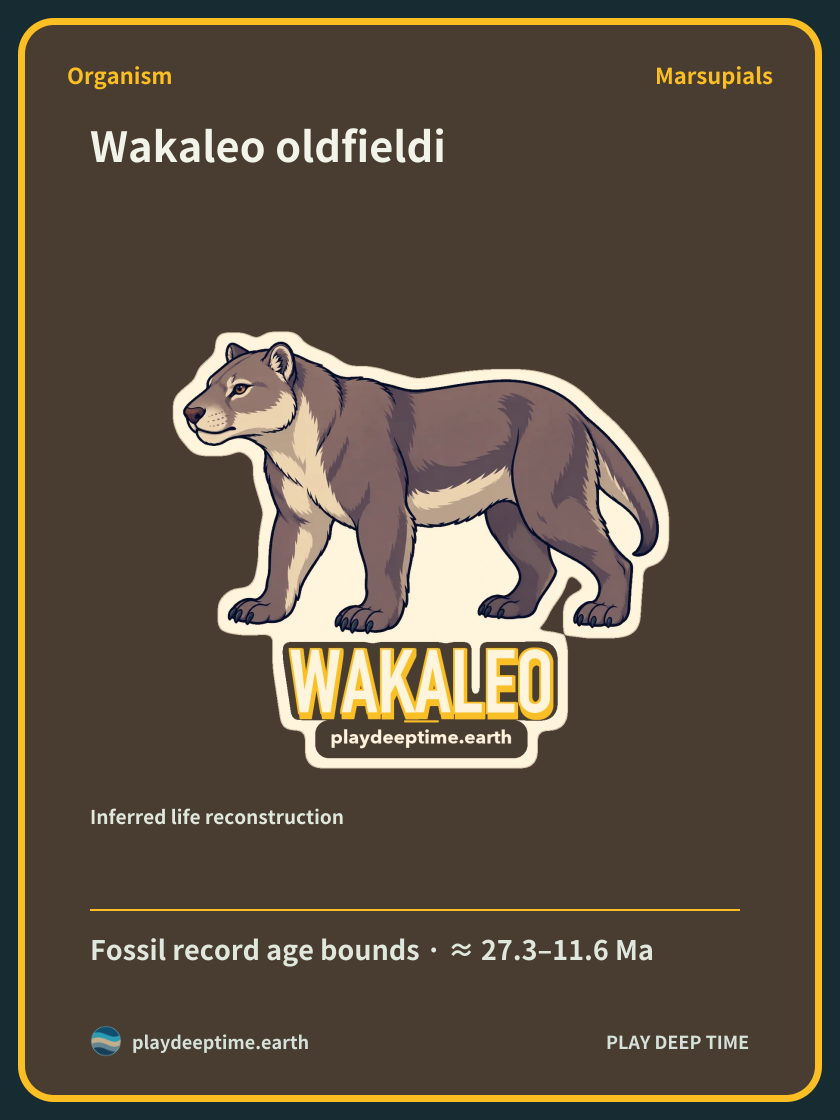
Organism · Marsupials
Wakaleo oldfieldi
Fossil record age bounds · ≈ 27.3–11.6 Ma
Inferred life reconstruction
Wakaleo oldfieldi
Overview
Wakaleo oldfieldi is an Australian marsupial lion. Despite its name, it is not a member of the cat family like living lions. Known through lower-jaw fossils, it reveals another evolutionary path taken by Australian mammals.[1]
Loading illustration…
Key facts
A single left lower jaw can anchor a species name. SAMA P17925 is presented as the type specimen of Wakaleo oldfieldi. Researchers compare such reference specimens with the features of new fossils to assess whether they belong to the same species.[1]
Time and place
The type specimen of this species is a Miocene record. It was found at Leaf Locality, Lake Ngapakaldi, in present-day South Australia. Following the lake and locality names helps locate the setting of ancient marsupials within Australia’s modern geography.[1]
The time range describes source context, not the complete duration of this species.
Size, form and skeleton
A 2017 revision compares the cranial structure of Wakaleo with that of another marsupial lion genus, Thylacoleo. The genus diagnosis includes a head shape distinct from Thylacoleo’s short, broad skull. Even among marsupial lions, detailed comparisons of heads and teeth reveal different features.[2]
In a lower-jaw specimen of Wakaleo oldfieldi, the third premolar measures 1.25 cm from front to back. This gives an actual measurement of the large cutting teeth characteristic of marsupial lions. It is a specimen measurement of a single tooth, rather than body mass.[4]
Loading illustration…
Habitat and reproduction
The name Leaf Locality also leads to a story about plant fossils. A leaf-fossil bed containing acacias, eucalypts, and other plants has been reported above the strata containing vertebrate fossils. Examining the stratigraphy of animal and plant fossils together provides clues to landscapes from different times preserved at the locality.[3]
Fossil discovery
The type specimen was discovered in 1971. Flinders University’s specimen account connects this discovery with the 1974 description by Clemens and Plane. Through study, the discovered lower jaw acquired a name and specimen number and remained a reference for subsequent research.[1]
References
- Flinders University VAMP — Fossil lower jaw of Wakaleo oldfieldi
- Gillespie·Archer·Hand (2017) — Taxonomic revision of Wakaleo and marsupial lions
- (2025) Review of plant fossils around Kati Thanda–Lake Eyre — Lake Ngapakaldi Leaf Locality
- Yates (2015) — Comparison of the jaws and teeth of Wakaleo
- 1999 study — Barinya from Riversleigh
Research questions
The classification of marsupial lions has changed as new comparative material became available. In 2017, researchers compared the teeth and humerus of pitikantensis, once placed in Priscileo, with other material and transferred it to Wakaleo. Reassessing relationships among related species also helps explain the group to which Wakaleo oldfieldi belongs.[2]
Observation
First look at the outline of the head and imagine where the lower jaw and teeth would sit. When examining fossil material, trace how the teeth or their sockets continue along the left lower jaw. An observation beginning with a whole-body illustration leads to clues in a small jawbone.[1]
Related organisms
 Barinya wangalaMarsupialsSource time context (not species duration) · ≈ 23–16 Ma
Different bodies among marsupials
Explore the bodies and backgrounds of Wakaleo oldfieldi and Barinya wangala together. Wakaleo oldfieldi is an Australian marsupial lion. Despite its name, it is not a member of the cat family like living lions. Barinya wangala is a dasyuromorphian known from Miocene Riversleigh. Its skull, jaws, and teeth provide clues to relationships with other extinct and living groups.