Organism · Coccolithophyceae
Watznaueria barnesiae
Source time context (not species duration) · ≈ 140–66 Ma
Inferred life reconstruction
Watznaueria barnesiae
Overview
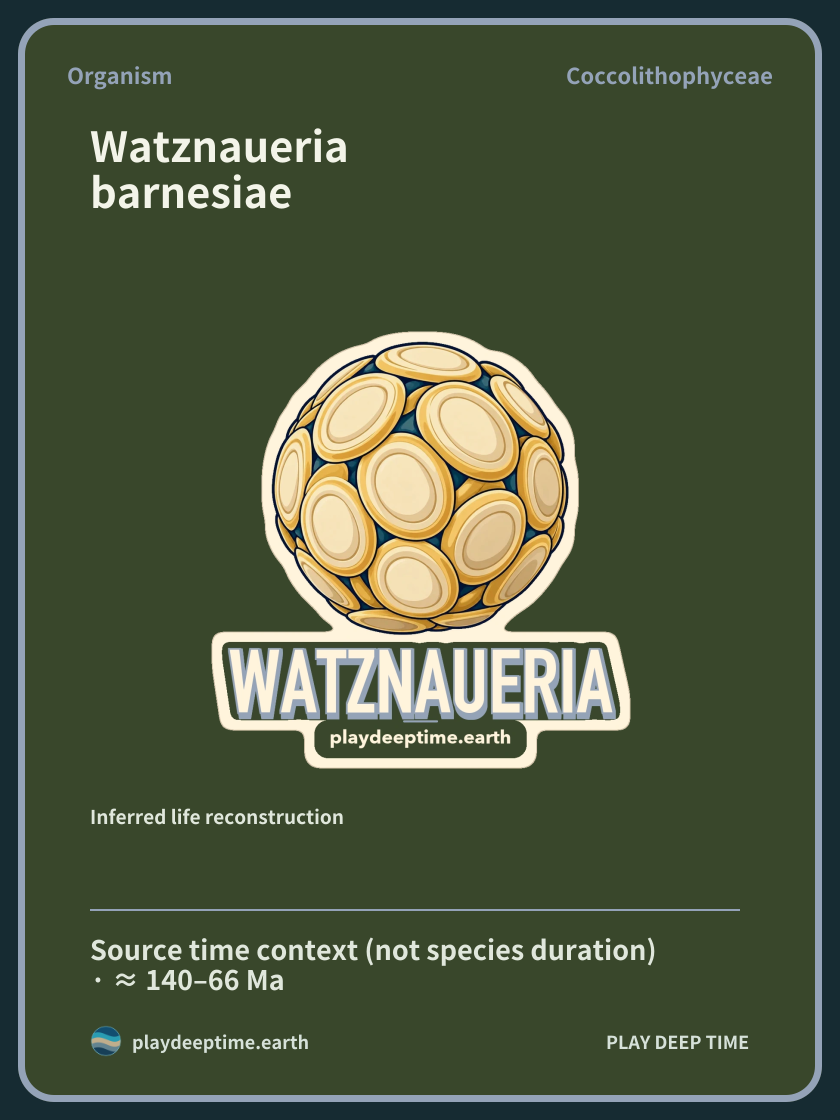
Watznaueria barnesiae is a fossil microorganism whose cell exterior was covered by multiple calcareous plates. The rounded covering formed by these plates is called a coccosphere. It is fascinating to distinguish one tiny plate from the whole body enclosed by many plates.[1][2]
Loading illustration…
Key facts
A coccosphere does not mean a single isolated plate. It is the covering of multiple plates around a cell. Comparing one plate with the complete covering allows the same microorganism to be examined at different structural scales.[1]
Time and place
Occurrence layers in the current fossil database are summarized as Cretaceous material from approximately 140–66 million years ago. Tiny calcareous plates and plate coverings convey the form of microorganisms of that time. Even minute fossils in rock allow ancient bodies to be compared.[3][1]
The time range describes source context, not the complete duration of this species.
Size, form and skeleton
Multiple calcareous plates surround the cell. This species’ plates are described as having a closed central area. Considering the center of one plate separately from the complete covering distinguishes different structural levels.[1][2]
A study comparing material from two Early Cretaceous sites reported calcareous plate lengths of about 3.1–7.7 µm.[4]
Loading illustration…
Habitat and reproduction
The calcareous plates of a coccosphere lie outside the cell. Studying isolated plates and studying the plate covering provide different information. Questions about the body change according to the unit used to view a tiny fossil.[1]
Fossil discovery
A 2018 study examined the relationship between plate size and coccospheres. A 2021 account also distinguishes this species’ plate coverings from isolated plates. It illustrates studying minute fossils as both wholes and parts.[1][2]
References
- 2021 study — Calcareous plates and coccospheres
- 2018 study — Size and shape of Watznaueria plates
- Paleobiology Database — Stratigraphic records of Watznaueria fossils
- Size patterns of the coccolith Watznaueria barnesiae in the lower Cretaceous
- Monteiro et al.2016 — Why marine phytoplankton calcify
- Manton & Leedale1969 — The cell surface of Coccolithus pelagicus
- Nannotax — Coccolithus pelagicus
- Swedish Meteorological and Hydrological Institute — Coccolithus pelagicus
- Nannotax — The geological record of Coccolithus
Research questions
Can the size of one plate reveal the arrangement of the whole covering? Isolated plates and coccospheres each have features that require examination. Identifying what a tiny fossil forms part of is the first step toward understanding its body.[1][2]
Observation
First view the surrounding plate covering, then move your gaze to the central area of one plate. Alternating between the rounded whole and small components gives the microorganism’s body a fuller sense of structure.[1][2]
Related organisms
 Coccolithus pelagicusCoccolithophyceaePresent
Ocean time read through tiny calcareous plates
Examine the different records of bodies and time preserved in these two organisms. Watznaueria barnesiae: a fossil microorganism with multiple calcareous plates covering the cell exterior, forming a rounded coccosphere. Current fossil database occurrence layers are summarized as Cretaceous material from approximately 140–66 million years ago. Tiny plates and plate coverings convey its form. Coccolithus pelagicus: a single-celled organism enclosed in small calcareous plates, living as light-using phytoplankton suspended in the sea. Its fossil record extends from the Paleocene to the present. The Paleocene spans approximately 66–56 million years ago.