Organism · Molluscs
Wiwaxia corrugata
Source time context (not species duration) · ≈ 539–487 Ma
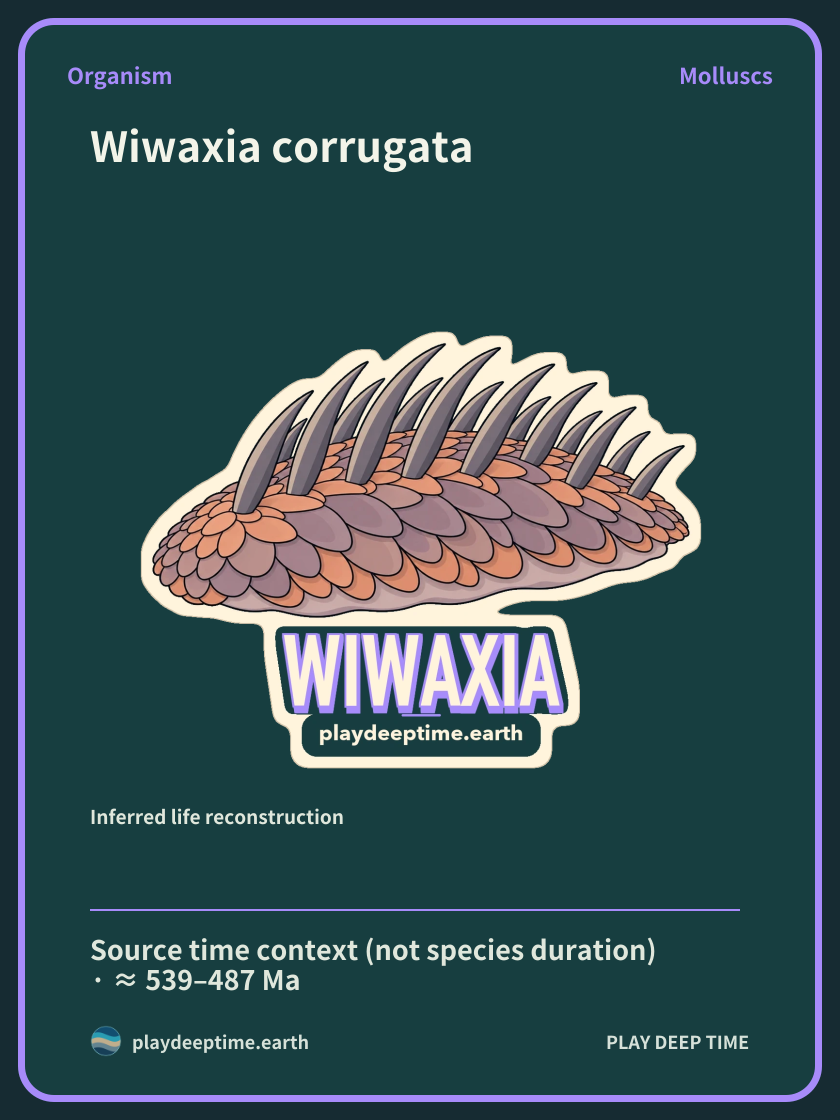
Inferred life reconstruction
Wiwaxia corrugata
Overview
Wiwaxia corrugata is a small marine animal covered in overlapping sclerites and long spines. It evokes a slug crawling along the bottom, but its covering is far more unfamiliar. One hard fragment led to the story of the entire animal’s identity.[1]
Loading illustration…
Key facts
The first known fossil was one sclerite rather than a whole body. It was therefore once thought to be a worm-tube-like structure. Later discoveries of better-preserved bodies revealed where the small piece had belonged.[1]
Time and place
This animal lived in Middle Cambrian seas around 505 million years ago. It is known from localities including the Walcott Quarry and Mount Stephen in the Burgess Shale of present-day Canada. Alongside diverse bottom-dwelling organisms, it reveals an ancient sea.[1]
The time range describes source context, not the complete duration of this species.
Size, form and skeleton
Large specimens are reported to reach approximately 5.5 cm in body length. Overlapping sclerites cover most of the oval body, while two rows of long spines rise from the back. Its mouth contains a feeding apparatus made of plates bearing small teeth.[1]
Loading illustration…
Habitat and reproduction
It has been proposed that the animal scraped microbial mats on the seafloor. Its feeding apparatus is compared with that of Odontogriphus. The hard covering and long spines also suggest other survival strategies of a small bottom-dwelling animal.[1]
Fossil discovery
Matthew described a fragmentary fossil in 1899. Walcott established the genus Wiwaxia in 1911 using more complete material. The original reference fragment was recognized again in a museum collection in 1977.[1]
References
Research questions
Do the sclerites and feeding apparatus point to the same relatives? Researchers have compared these structures with molluscs, annelids, and other groups. Considering several regions together rather than one feature is important for investigating the ancestry of unfamiliar fossils.[1]
Observation
Move your gaze from the overlapping sclerites to the two rows of long spines. Keeping the feeding apparatus beneath the body in mind gives a more complete view of this small seafloor animal.[1]
Related organisms
 Odontogriphus omalusMolluscsSource time context (not species duration) · ≈ 539–487 Ma
Bodies that scraped food from the seafloor
The feeding apparatuses of Wiwaxia and Odontogriphus are compared with one another. Their small-toothed structures may have exploited microbial mats, inviting exploration of feeding among different bottom-dwelling organisms.
 Anomalocaris canadensisArthropodsFossil record age bounds · ≈ 510–497 Ma
Appendages and sclerites in Cambrian seas
Anomalocaris and Wiwaxia are Cambrian marine animals known from the Burgess Shale of present-day Canada. Compare spiny frontal appendages with body-covering sclerites and spines to explore different bodies.