Organism · Dinosaurs
Wuerhosaurus homheni
Source time context (not species duration) · ≈ 140–100 Ma
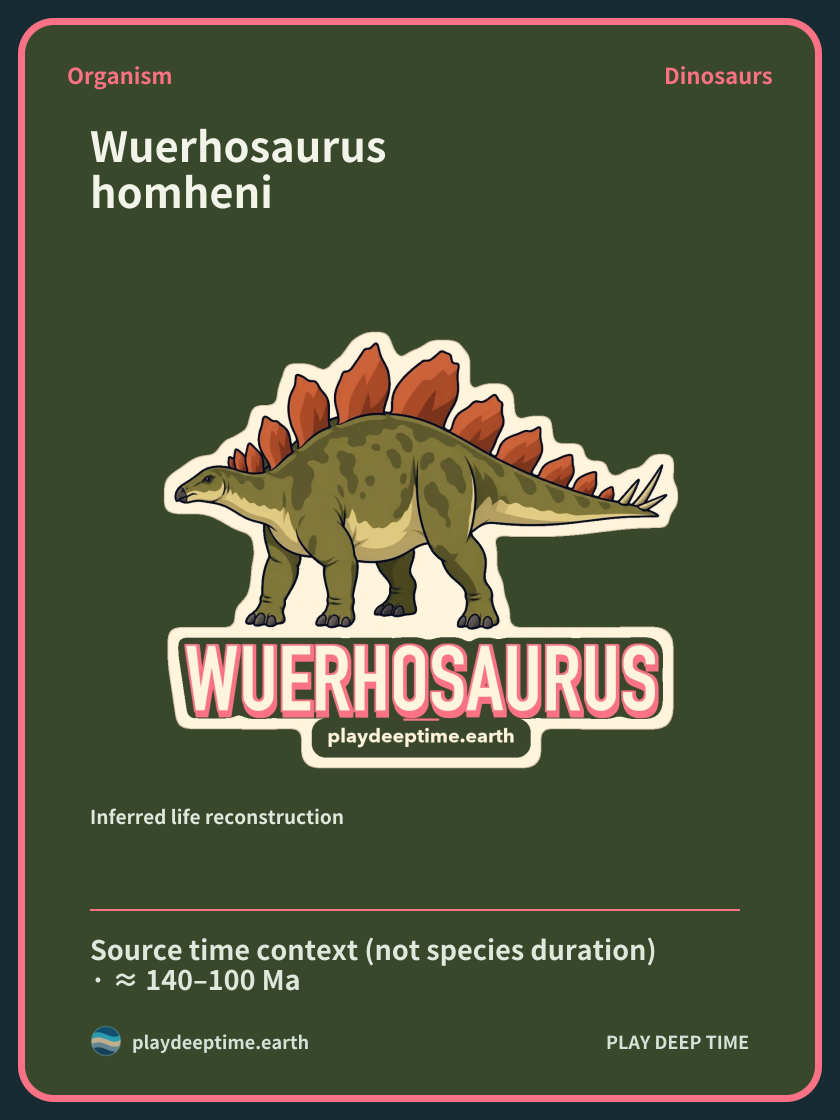
Inferred life reconstruction
Wuerhosaurus homheni
Overview
Wuerhosaurus homheni is a Cretaceous stegosaur studied through shoulder, forelimb, vertebral, and pelvic material. Several body regions and broken plates tell a distinctive research story. Follow the preserved bones to compare stegosaur bodies.[1][2]
Loading illustration…
Key facts
When the upper part of a plate is broken, its complete shape is difficult to establish. A long, flat base does not prove that the entire plate was a low rectangle. Fossil damage can change our impression of an animal’s appearance.[2]
Time and place
Fossil-bearing strata in the database are summarized as Cretaceous material roughly 140–100 million years old. Research is based on the shoulder, forelimbs, axial skeleton, and pelvis. Comparing the regions preserved in each specimen helps reveal stegosaur bodies of the time.[3][1]
The time range describes source context, not the complete duration of this species.
Size, form and skeleton
V4006 includes shoulder material, both humeri, a partial forearm, vertebrae, and pelvic material. Tail vertebrae V4007 and separate dorsal-vertebral material belong to different specimens.[1]
Large individuals of Wuerhosaurus homheni are described as having been approximately 7–8 m long. This estimated range was summarized from several partial skeletons in a 2004 synthesis of stegosaurs.[4]
Loading illustration…
Habitat and reproduction
The arrangement can be followed from shoulder and forelimbs to the axial skeleton and pelvis. The bases of body plates are considered separately from their broken upper portions. This stegosaur allows comparisons between the skeleton and external armor through different material.[1][2]
Fossil discovery
A 2008 study compiled skeletal material by specimen, and a comparative passage in a 2015 study revisited the broken plates. Even familiar plate shapes in old reconstructions invite renewed questions when preserved portions are checked. Later comparisons can change how the same fossil is viewed.[1][2]
References
- 2008 study — The skeleton of Wuerhosaurus and comparisons with stegosaurs
- 2015 stegosaur study — Comparison of the plates of Wuerhosaurus
- Paleobiology Database — Stratigraphic records of Wuerhosaurus fossils
- Galton·Upchurch (2004) · Stegosauria
- Xu et al.2003 — Four-winged dinosaurs from China
- Natural History Museum — Microraptor
Research questions
What shape did a plate’s top have when only its base survives? Before imagining a complete outline, examine where it is broken. This raises the important distinction between the fossil’s current shape and the living animal’s form.[2]
Observation
Move your gaze from the shoulder and forelimbs to the back and pelvis. Consider plate-base length separately from the upper outline to clarify what the surviving bones actually reveal.[1][2]
Related organisms
 Microraptor guiDinosaursSource time context (not species duration) · ≈ 143–66 Ma
Different bodies among dinosaurs
Explore the bodies and backgrounds of Wuerhosaurus homheni and Microraptor together. Wuerhosaurus homheni: a Cretaceous stegosaur studied through shoulder, forelimb, vertebral, and pelvic material, whose body regions and broken plates tell a distinctive research story. Microraptor: Microraptor gui is a small dinosaur with long wing feathers on both forelimbs and hind limbs, an unusual four-winged arrangement.