Organism · Placental mammals
Xiphiacetus cristatus
Source time context (not species duration) · ≈ 23–5.33 Ma
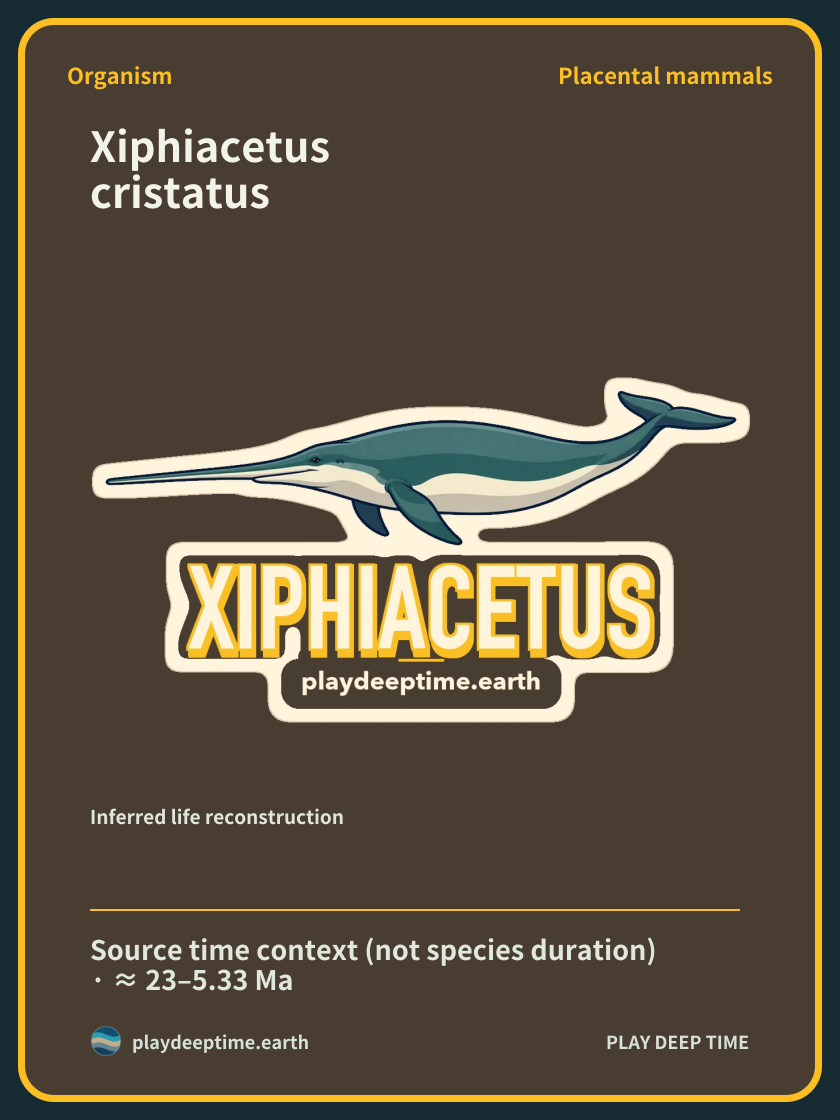
Inferred life reconstruction
Xiphiacetus cristatus
Overview
Xiphiacetus cristatus was a Miocene toothed whale with an elongated snout. Its type specimen includes a partial skull associated with neck and thoracic vertebrae and several ribs. Questions can expand from the appearance of the head to the front of the body axis.[1]
Loading illustration…
Key facts
The description of the genus explains that the snout is longer than the lower jaw. Considering the upper and lower jaws separately reveals the organization of the elongated face.[1]
Time and place
The type specimen is recorded from Antwerp in present-day Belgium, while other skull specimens are from the middle Miocene Calvert Formation on the eastern coast of the United States. The Miocene as a whole spans approximately 23–5.3 million years ago. Specimens from different regions add material for comparing head shape.[1][2]
The time range describes source context, not the complete duration of this species.
Size, form and skeleton
The type specimen includes a partial skull with associated neck and thoracic vertebrae and several ribs. Another specimen, USNM 21363, preserves a nearly complete snout. Different specimens allow examination of several skull regions alongside their connection to the front of the body.[1]
The total skull length of specimen USNM21363 was reported as 117 cm.[1]
Loading illustration…
Habitat and reproduction
What can be compared among whales with elongated snouts? Relationships between the upper and lower parts of the head, the snout, and structures around the ears and skull are used in classification. Questions sometimes begin with small differences in the head rather than the familiar large body of a whale.[1]
Fossil discovery
The research reexamined material under the historical name Priscodelphinus cristatus. Some previously referred specimens were reclassified as another Xiphiacetus species. Separating fossils once grouped under one name helps reveal species-specific features.[1]
References
Research questions
If elongated snouts look alike, do they all belong to the same species? The researcher compared other skull regions and the parts preserved in each specimen. This illustrates the distinction between broad similarities of appearance and small anatomical features.[1]
Observation
Move your gaze from the elongated snout to the lower jaw, rear of the head, and neck. Examine relative lengths above and below together with the connection from head to body.[1]
Related organisms
 Livyatan melvilleiPlacental mammalsSource time context (not species duration) · ≈ 12–7.2 Ma
Different bodies among whales
Compare the bodies of Xiphiacetus cristatus and Livyatan. Xiphiacetus cristatus: a Miocene toothed whale with an elongated snout. Livyatan: Livyatan melvillei was a fossil toothed whale from Miocene Peru.