Organism · Tetrapod lineage
Acanthostega gunnari
Source time context (not species duration) · ≈ 420–359 Ma
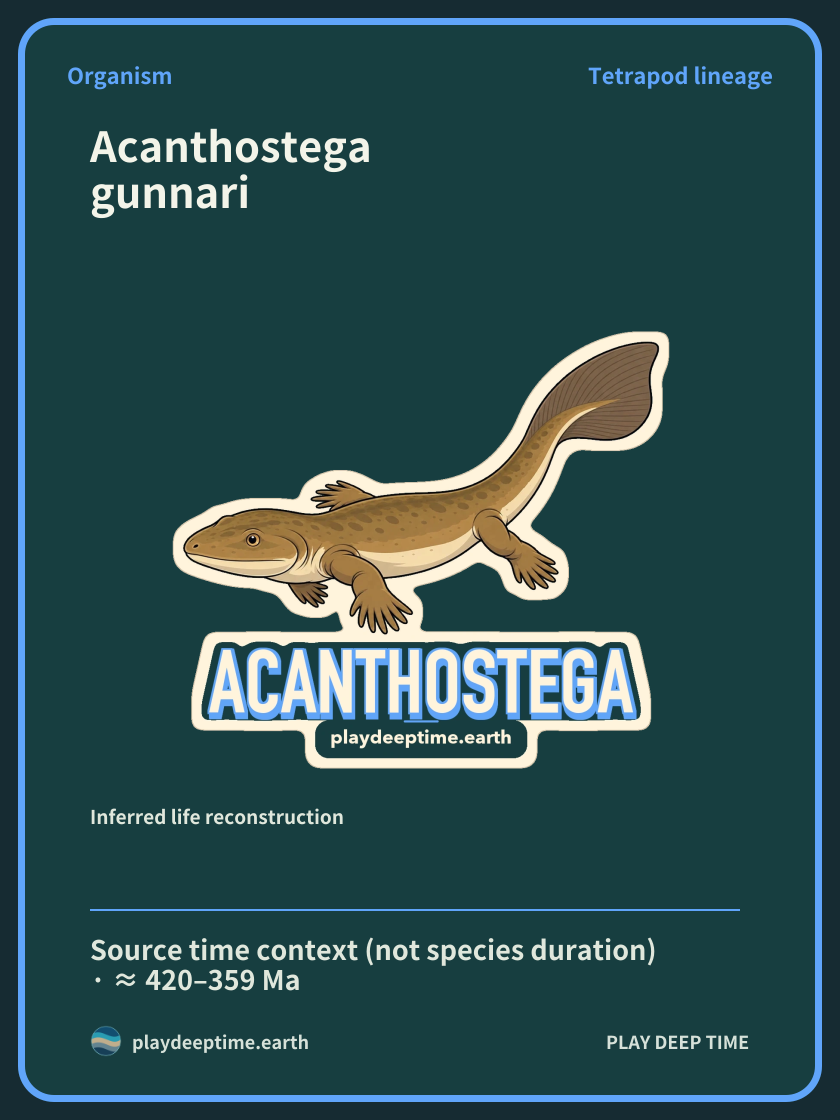
Inferred life reconstruction
Acanthostega gunnari
Overview
Acanthostega gunnari is an early tetrapod that had hands and feet but lived mainly in water. It also has evidence of a fish-like tail and gills. This fossil raised the question of whether limbs or life on land came first.[1][3]
Loading illustration…
Key facts
Its forefoot had eight digits, unlike the five familiar in many tetrapods today. This shows that the number of digits in early limbs was not fixed to one pattern from the outset.[3][1]
Time and place
It is an animal from the Late Devonian, around 365 million years ago. Fossils came from the Britta Dal Formation of present-day eastern Greenland. The region reveals the diversity of tetrapods living in aquatic worlds at that time.[2]
The time range describes source context, not the complete duration of this species.
Size, form and skeleton
It had paddle-like limbs and a deep tail with fin rays. Eight digits in the forefoot are compared with at least eight known in the hind foot. Evidence of fish-like internal gills is also present behind the head.[1][3]
Loading illustration…
Habitat and reproduction
Four limbs did not necessarily serve only walking on land. The limbs, tail, and gills of Acanthostega support an interpretation of mainly aquatic life. It invites exploration of how structures used in water later connected with other environments.[1]
Fossil discovery
During a 1987 expedition, Jenny Clack’s team found new body-skeleton material in Greenland. Some pieces connected with skulls collected during earlier expeditions. Returning to the field after a long interval reconnected the story of one animal.[5]
References
- Clack2006 — Acanthostega gunnari
- Fukui Prefectural Dinosaur Museum — Fossil records of Acanthostega
- Coates & Clack1990 — Multiple digits in early tetrapods
- Clack2009 — The transition from fishes to tetrapods
- Jenny Clack — The story of research on Acanthostega
- Ahlberg et al.2008 — Ventastega and the origin of the tetrapod body
- Clack2006 — Acanthostega gunnari
- Approximate size comparison — Genus guide and reconstruction of Acanthostega
Research questions
In what sequence did changes from fins to hands and feet occur? The head, shoulder, limbs, and respiratory structures are compared together. The discovery of eight digits shows that the past cannot be drawn simply from present-day body patterns.[1][3]
Observation
After looking at the forefoot digits, examine the paddle-like limbs and deep tail. Remembering that it was an aquatic animal with legs reveals an appearance different from familiar terrestrial animals.[1]
Related organisms
 Ichthyostega stensioeiLobe-fins and tetrapodsSource time context (not species duration) · ≈ 420–359 Ma
Many digits in early hands and feet
The known forefoot of Acanthostega has eight digits, and the known hind foot of Ichthyostega has seven. Comparing different limbs shows that the hands and feet of early tetrapods were not fixed at five digits from the beginning.
 Ventastega curonicaLobe-fins and tetrapodsSource time context (not species duration) · ≈ 420–359 Ma
Exploring early tetrapod bodies together
Comparing the shoulders and pelves of Ventastega and Acanthostega allows exploration of changes in early tetrapod bodies. Researchers studying Ventastega also examined body relationships through comparisons with Acanthostega.