Organism · Lobe-fins and tetrapods
Ventastega curonica
Source time context (not species duration) · ≈ 420–359 Ma
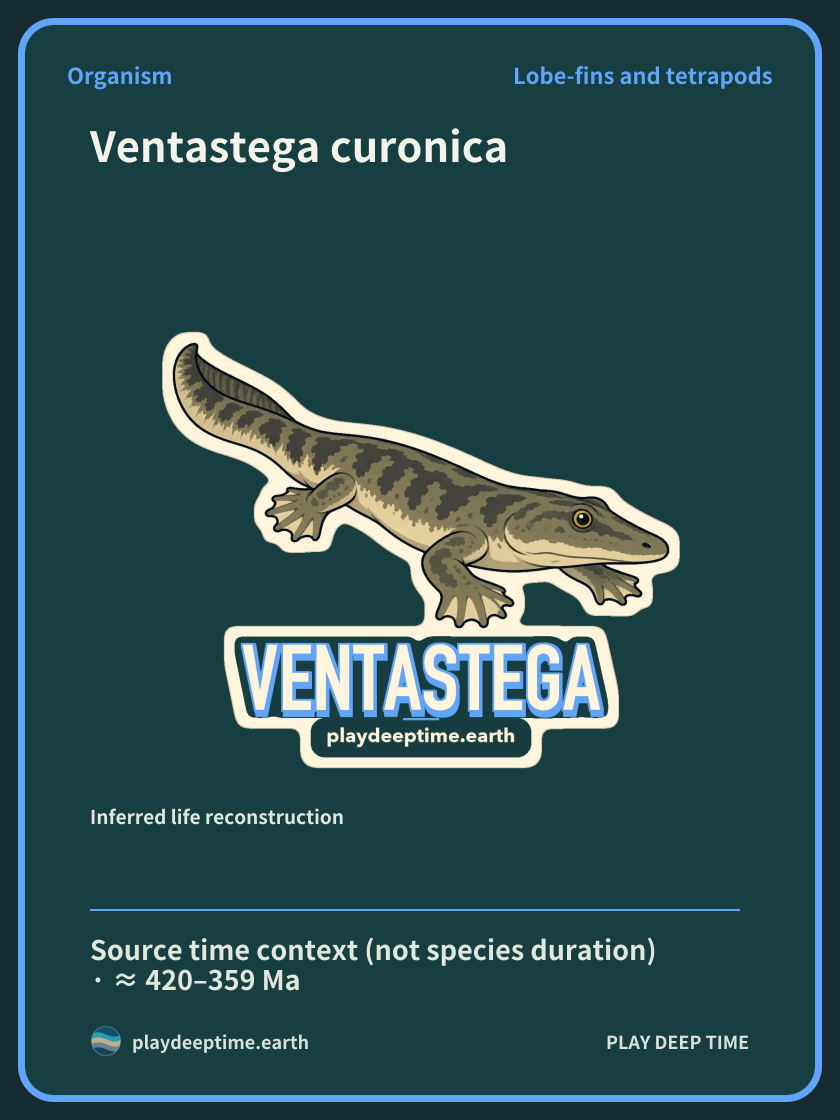
Inferred life reconstruction
Ventastega curonica
Overview
Ventastega curonica reveals body changes from fishes to early tetrapods. Its appearance is explored through the head, shoulder, and part of the pelvis. It is an important fossil for comparisons between fin-bearing relatives and relatives with hands and feet.[1][2]
Loading illustration…
Key facts
Changes seen in the head and those seen in the body do not always occur together. The head and shoulder of Ventastega are compared with features of different relatives. This encourages reading the evolutionary stories conveyed by several regions of one body together.[1]
Time and place
It is a Late Devonian animal from around 365 million years ago. Fossils came from present-day Latvia. Ancient strata in this region reveal a time when early tetrapod bodies were diversifying.[1][3]
The time range describes source context, not the complete duration of this species.
Size, form and skeleton
A nearly complete skull, braincase, shoulder bones, and part of the pelvis are known. The way several shoulder bones joined was also studied. Comparing the discovered regions with Acanthostega helps consider relationships of the whole body.[1][2]
Ventastega is reconstructed as having been about 1.1m long from snout to tail tip. This estimate, summarized in a 2015 study of vertebrate size, conveys body size during the transition from fishes to tetrapods.[4]
Loading illustration…
Habitat and reproduction
How did the limbs of early tetrapods relate to aquatic life? The shoulder and pelvis of Ventastega show structures connecting the body and limbs. Comparing fish-like relatives with other early tetrapods allows exploration of changes in locomotion.[1][2]
Fossil discovery
In 2008, Ahlberg’s team reported new head, shoulder, and pelvic material in detail. Comparisons of several specimens revealed more body regions than before. Latvian fossils added a new scene to research on early tetrapod evolution.[1][3]
References
Research questions
In what order did head and limb changes occur? That sequence is studied by comparing Ventastega with Panderichthys, Acanthostega, and others. As known body regions are added one by one, varied branches emerge rather than a simple ladder.[1][2]
Observation
Move your gaze from the head to the shoulder and pelvis. Comparing the bodies of relatives from the same time helps you consider how bodies used in water changed.[1][2]
Related organisms
 Acanthostega gunnariTetrapod lineageSource time context (not species duration) · ≈ 420–359 Ma
Exploring early tetrapod bodies together
Comparing the shoulders and pelves of Ventastega and Acanthostega allows exploration of changes in early tetrapod bodies. Researchers studying Ventastega also examined body relationships through comparisons with Acanthostega.