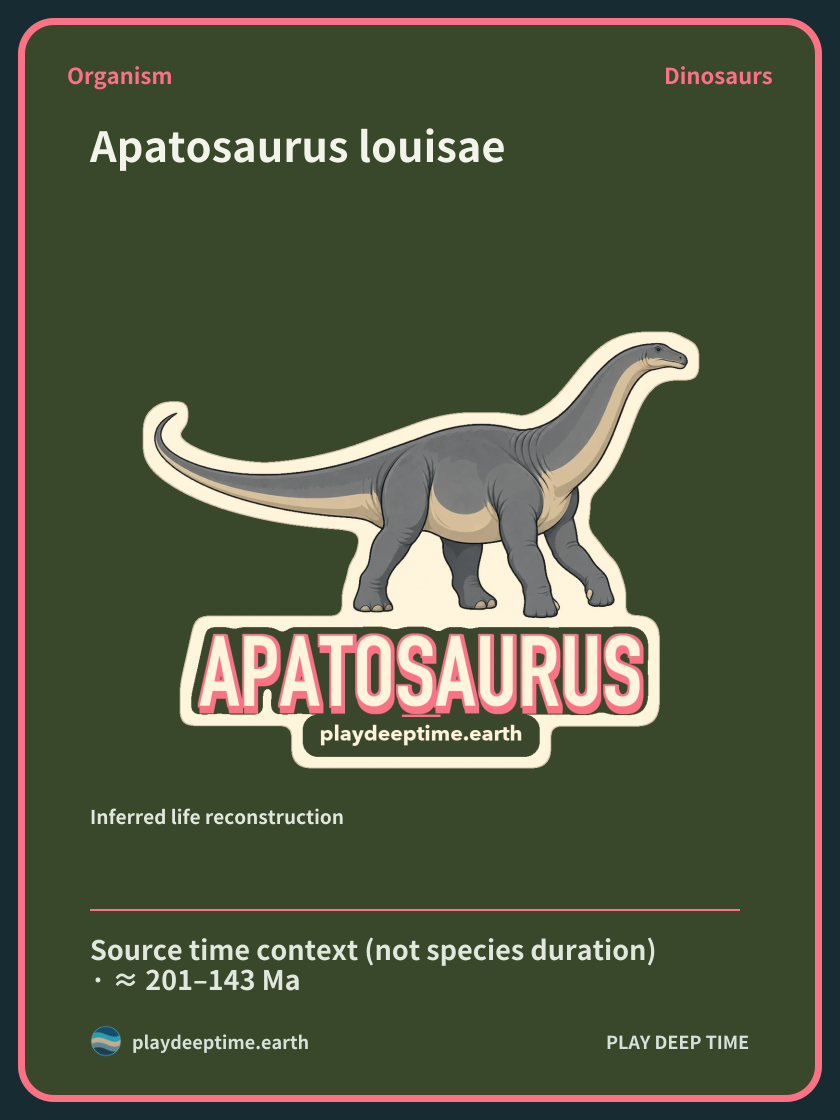
Organism · Dinosaurs
Apatosaurus louisae
Source time context (not species duration) · ≈ 201–143 Ma
Inferred life reconstruction
Apatosaurus louisae
Overview
Apatosaurus louisae is a large herbivorous dinosaur with a long neck. Four legs support its massive body, with a long tail extending behind. The story of a museum display whose head was replaced also makes it intriguing.[1][2]
Loading illustration…
Key facts
This skeleton first went on display without a head at the Carnegie Museum in 1915. A Camarasaurus-shaped head was added in 1932 and remained for 47 years. The head was replaced in 1979, creating the long-necked dinosaur appearance familiar today.[1]
Time and place
It lived in the Late Jurassic, around 150 million years ago. Important fossils are known from the region of present-day western North America. It can be compared with other long-necked dinosaurs of the time, including Diplodocus.[1]
The time range describes source context, not the complete duration of this species.
Size, form and skeleton
This sauropod’s long neck and large trunk were supported on four legs. The left forefoot of type specimen CM3018 is described as having metacarpals arranged in an arc. A large claw on the first digit is another important feature of the weight-supporting forefoot.[1][2]
The US National Park Service describes Apatosaurus louisae as reaching approximately 21 m in body length. This includes both the long neck and tail.[3]
Loading illustration…
Habitat and reproduction
It was a large plant-eating sauropod. Researchers compare the long neck and trunk with weight-bearing legs and feet. This raises questions about whether giant herbivorous dinosaurs lived similarly and how their bodies differed.[1]
Fossil discovery
A Diplodocus-like skull found with the skeleton in 1910 was reexamined. Berman and McIntosh concluded in 1978 that it was the most likely correct head. The Carnegie Museum reflected the research by replacing the displayed skeleton’s head in 1979.[1]
References
Research questions
What evidence is needed to connect head and body? Discovery records and bone form are compared with other sauropods. Small regions such as the forefeet also provide important information for understanding whole-body reconstruction.[1][2]
Observation
Follow the small head through the long neck and trunk. Then picture the arched arrangement of forefoot bones and large first-digit claw to see the structures supporting the enormous body.[1][2]
Related organisms
 Massospondylus carinatusDinosaursSource time context (not species duration) · ≈ 201–143 Ma
Different bodies among dinosaurs
Explore the bodies and backgrounds of Apatosaurus and Massospondylus carinatus together. Apatosaurus: Apatosaurus louisae is a large herbivorous dinosaur with a long neck, four legs supporting a massive body, and a long tail extending behind. Massospondylus carinatus: an Early Jurassic dinosaur known for a small head and long neck, with studies comparing embryonic and adult body proportions.