Organism · Mammals
Arboroharamiya allinhopsoni
Source time context (not species duration) · ≈ 201–143 Ma
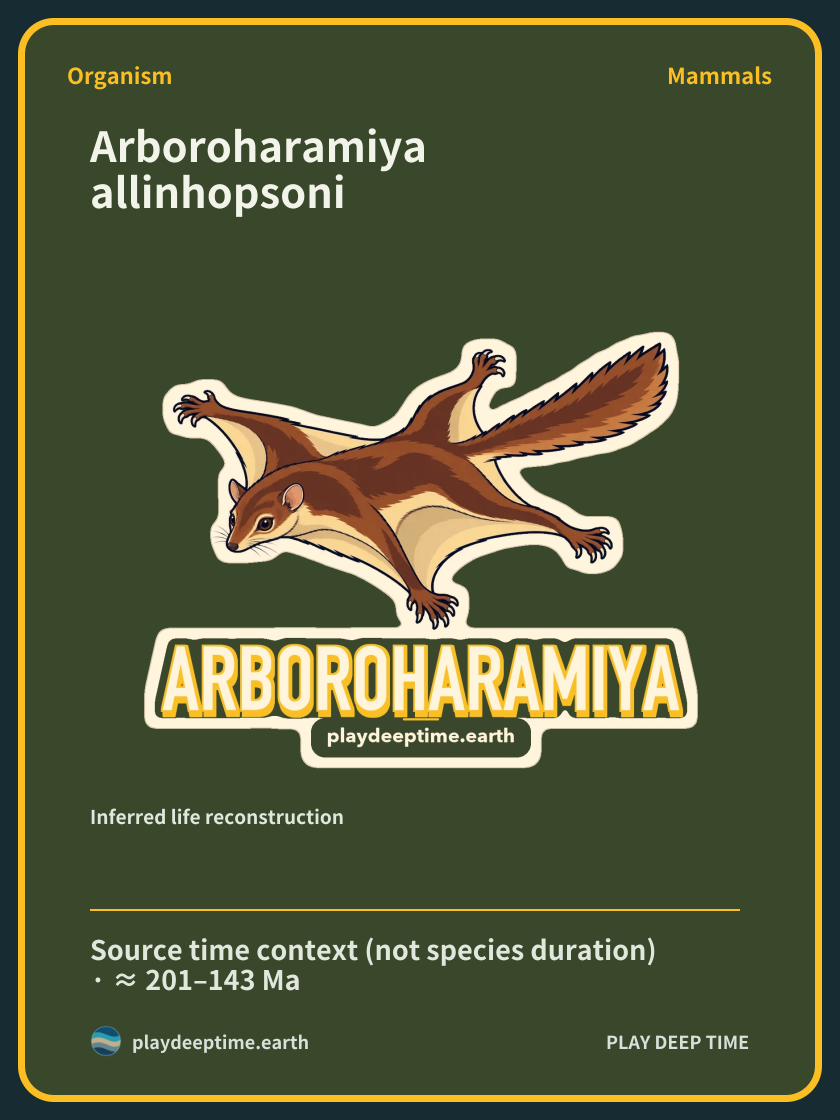
Inferred life reconstruction
Arboroharamiya allinhopsoni
Overview
Arboroharamiya allinhopsoni is studied as an early mammal from the Jurassic. Traces of fur and a skin membrane are known alongside its skull and body skeleton. The membrane outside the body and the tiny auditory bones inside the head tell different evolutionary stories.[1]
Loading illustration…
Key facts
The two slabs of a single fossil can reveal different body parts. The main slab of HG-M017 is described as preserving the skull and most of the vertebral column, while the counterpart preserves most of the limb structures. Examining both slabs gives a fuller understanding of the evidence from one individual.[1]
Time and place
The type specimens came from the Tiaojishan Formation around Nanshimen village in Qinglong County, in present-day Hebei Province, China. It is studied as a Jurassic animal; the Jurassic spans roughly 200–140 million years ago. Its fur, skin membrane and hearing-related bones allow comparisons of the diverse bodies of early mammals.[1][2]
The time range describes source context, not the complete duration of this species.
Size, form and skeleton
HG-M017 provides evidence of the skull, teeth, vertebrae and limbs. A separate specimen, HG-M018, preserves the trunk skeleton together with impressions of fur and a skin membrane. These two different specimens offer clues to both the skeleton and the body's covering.[1]
The tibia of the juvenile holotype is 21.5 mm long. This small bone, about 2.2 cm in length, should be distinguished from the length of the whole body.[3]
Loading illustration…
Habitat and reproduction
Traces of the skin membrane have been linked to research on gliding. Unlike an examination based only on bones, this material also allows comparison of the shape of the membrane preserved alongside the skeleton. The preservation of fur and a skin membrane offers new clues to the life of this Jurassic animal.[1]
Fossil discovery
The research considered the type specimen HG-M017 together with a separate specimen, HG-M018. One provided evidence of the skull and body skeleton, while the other was examined for traces of fur and a skin membrane. It is an example of different kinds of preservation revealing different information about the body.[1]
References
- Jurassic Arboroharamiya — Study of skin membranes and five auditory bones
- International Commission on Stratigraphy (2024) — Geological time chart
- Mao et al. (2019) — Study of tooth replacement in Yanliao mammals
- Mao et al. (2019) — Study of tooth replacement in Yanliao mammals
- Ji et al. (2006) — A swimming mammal relative from the Middle Jurassic
Research questions
The tiny auditory bones raise questions about how mammalian ears changed. The paper described five bones involved in hearing. It is intriguing that both the broad external form of a skin membrane and the tiny structures inside the ear can be studied together.[1]
Observation
Imagine the skin membrane around the trunk and limbs, then move your gaze to the small head. Consider how the visible body covering and the internal auditory bones provide information at very different scales.[1]
Related organisms
 Castorocauda lutrasimilisMammaliaformsSource time context (not species duration) · ≈ 201–143 Ma
Traces of fur and skin in Mesozoic mammals and their relatives
Explore the different records of body form and time preserved in these two animals. Arboroharamiya allinhopsoni: Arboroharamiya allinhopsoni is studied as an early mammal from the Jurassic. Traces of fur and a skin membrane are known alongside its skull and body skeleton. The type specimens came from the Tiaojishan Formation around Nanshimen village in Qinglong County, in present-day Hebei Province, China. It is studied as a Jurassic animal; the Jurassic spans roughly 200–140 million years ago. Castorocauda: Castorocauda lutrasimilis was a mammal relative known for traces of guard hairs and underfur, and a broad, flattened tail. A partial Middle Jurassic skeleton was studied together with traces of soft tissues. It is known from the original description of Middle Jurassic material. The Jurassic as a whole spans roughly 200–140 million years ago.