Organism · Vascular plants
Archaeopteris hibernica
Fossil record age bounds · ≈ 382–359 Ma
Inferred life reconstruction
Archaeopteris hibernica
Overview
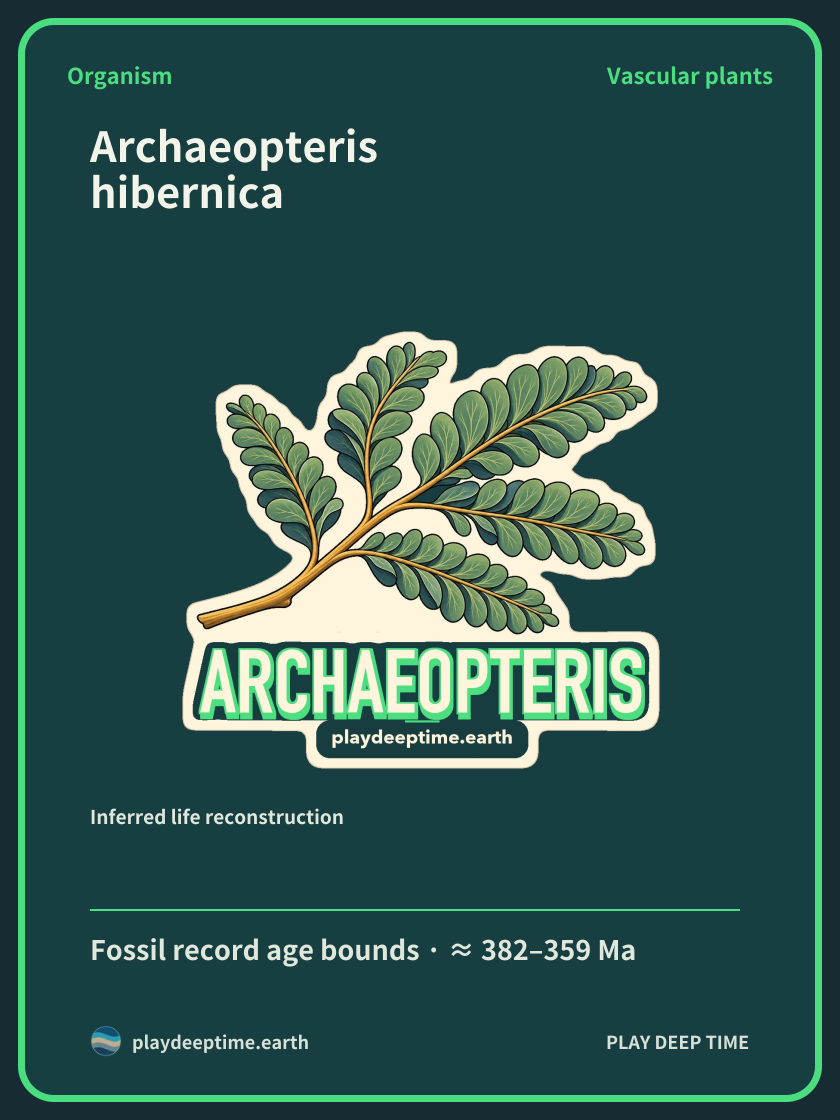
Archaeopteris hibernica is a Devonian plant encountered through fossil foliage bearing overlapping small leaflets. Examine the shape and margins of the leaflets arranged along the axis one by one.[1]
Loading illustration…
Key facts
The Kilkenny frond specimen presented in a 1910 book is more than 80 cm long. It shows how small leaflets together make up a large frond.[1]
Time and place
The original Irish specimen is recorded as having been found in Late Devonian rocks at Kilkenny in present-day Ireland. A specimen housed in Dublin was presented as the material for Fig.368.[1]
The time range describes source context, not the complete duration of this species.
Size, form and skeleton
The leaflets are obovate, broader toward their tips, and overlap their neighbors. Their margins are smooth or very slightly divided, creating a dense outline along branch-like sections of the frond.[1]
Loading illustration…
Habitat and reproduction
Seward described spindle-shaped sporangia arranged on reproductive portions of the frond that he treated separately. Comparing foliage and reproductive structures together was an important clue to understanding this plant at the time.[1]
Fossil discovery
In 1852, Forbes introduced foliage found by Irish surveyors as Cyclopteris hibernica. Through Baily’s more detailed description and later clarification of names, it came to be known as Archaeopteris.[1]
References
Research questions
The 1910 book records how researchers’ interpretations of this plant’s reproductive structures changed. It illustrates how reexamining detailed structures can change our view of a plant even when its foliage looks fern-like.[1]
Observation
In the illustration, examine the overlapping leaflets along a short section of the frond. Move your gaze from the widened tips to the smooth or slightly divided margins.[1]
Related organisms
 Hexagonaria davidsoniCnidariansFossil record age bounds · ≈ 443–372 Ma
Late Devonian leaves and coral skeletons
Read the overlapping leaf fragments of Archaeopteris alongside the adjoining corallites of a Hexagonaria colony. Different Late Devonian records from present-day Ireland and Iran convey contrasting forms of plants and marine animals.