Organism · Bangiophyceae
Bangiomorpha pubescens
Source time context (not species duration) · ≈ 2,500–539 Ma
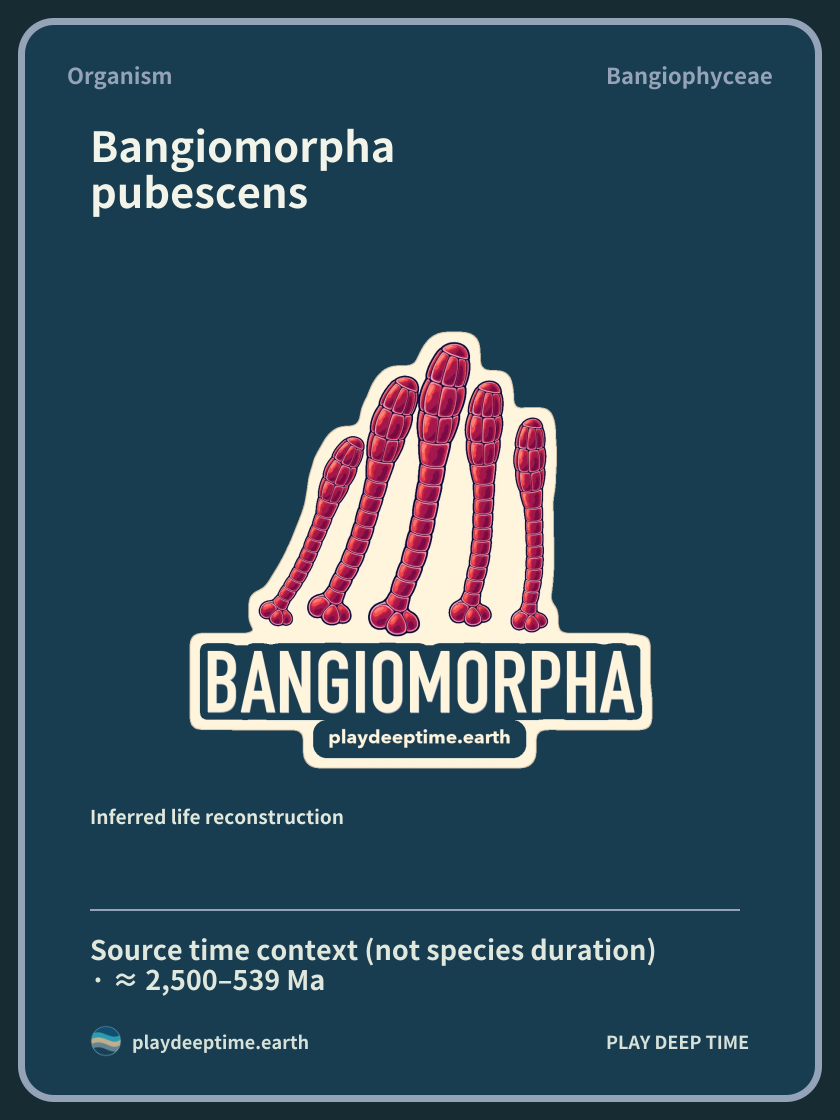
Inferred life reconstruction
Bangiomorpha pubescens
Overview
Bangiomorpha pubescens is a Proterozoic fossil organism composed of elongated rows of cells. Butterfield interpreted it as a red alga based on features of cell division. The arrangement of tiny cells became a clue to the identity of an ancient organism.[1]
Loading illustration…
Key facts
Parts with cells in a single row and others with several rows are described. An outer sheath surrounds them, and a multicellular attachment structure lies below. Different arrangements of small cells create separate body regions.[1]
Time and place
The type locality is in the lower Hunting Formation on Somerset Island in present-day Arctic Canada. The material is Proterozoic, an eon spanning approximately 2.5 billion to 540 million years ago. Cell arrangements were studied in microscopic fossils within the island’s rocks.[1][2]
The time range describes source context, not the complete duration of this species.
Size, form and skeleton
Unbranched cell rows, an outer sheath, and a lobed multicellular attachment structure are described. The attachment structure connects to the remaining cell row through a single cell. The upper and basal parts of this small organism have different arrangements.[1]
The filamentous bodies presented in the original description were up to approximately 2 mm long.[3]
The portions with cells in a single row were reported as approximately 15–45 µm wide.[3]
Loading illustration…
Habitat and reproduction
A 2000 study compared cell arrangements at several growth stages and the development of attachment structures. Differences in spore and gamete formation were discussed in relation to reproduction and the evolution of multicellularity. Small cell rows led to large questions about biological evolution.[1]
Fossil discovery
Butterfield described Bangiomorpha as a new genus and species in 2000. Cell arrangements and attachment structures were compared in several specimens within rock thin sections. Small specimens together provided evidence about growth and body arrangement.[1]
References
- Butterfield (2000) — Bangiomorpha and the evolution of multicellular life
- International Commission on Stratigraphy (2024) — Geological time chart
- Butterfield (2000) — Original description of Bangiomorpha pubescens
- Butterfield (2000) — Original description of Bangiomorpha pubescens
- Dunn et al. (2019) — A study of the morphology of Charnia
Research questions
What changes when one cell becomes part of a multicellular body? The study examined elongated cell rows together with the attachment structure securing the base. Connections between different regions invite consideration of multicellular organization.[1]
Observation
The representative magnet repeats the same reconstruction motif in a decorative arrangement. Grouping and spacing are artistic; the description below concerns each source motif. Move your gaze from the elongated cell rows to the attachment structure below. Distinguishing the multicellular basal part from its single-cell connection makes the small body’s arrangement clearer.[1]
Related organisms
 Charnia masoniAnimalsSource time context (not species duration) · ≈ 635–539 Ma
Different bodies preserved in the Proterozoic
Explore the different bodies and records of time preserved in these two organisms. Bangiomorpha pubescens: Bangiomorpha pubescens is a Proterozoic fossil organism composed of elongated rows of cells. Butterfield interpreted it as a red alga based on features of cell division. The type locality is in the lower Hunting Formation on Somerset Island in present-day Arctic Canada. The material is Proterozoic, an eon spanning approximately 2.5 billion to 540 million years ago. Charnia: Charnia masoni is known for alternating branches, repeated branching, and a small attachment disc. Smaller branches continue within its broad, leaf-like outline. It is treated as Ediacaran material. That period spanned approximately 640–540 million years ago.