Organism · Crocodylomorphs
Baurusuchus pachecoi
Source time context (not species duration) · ≈ 84–66 Ma
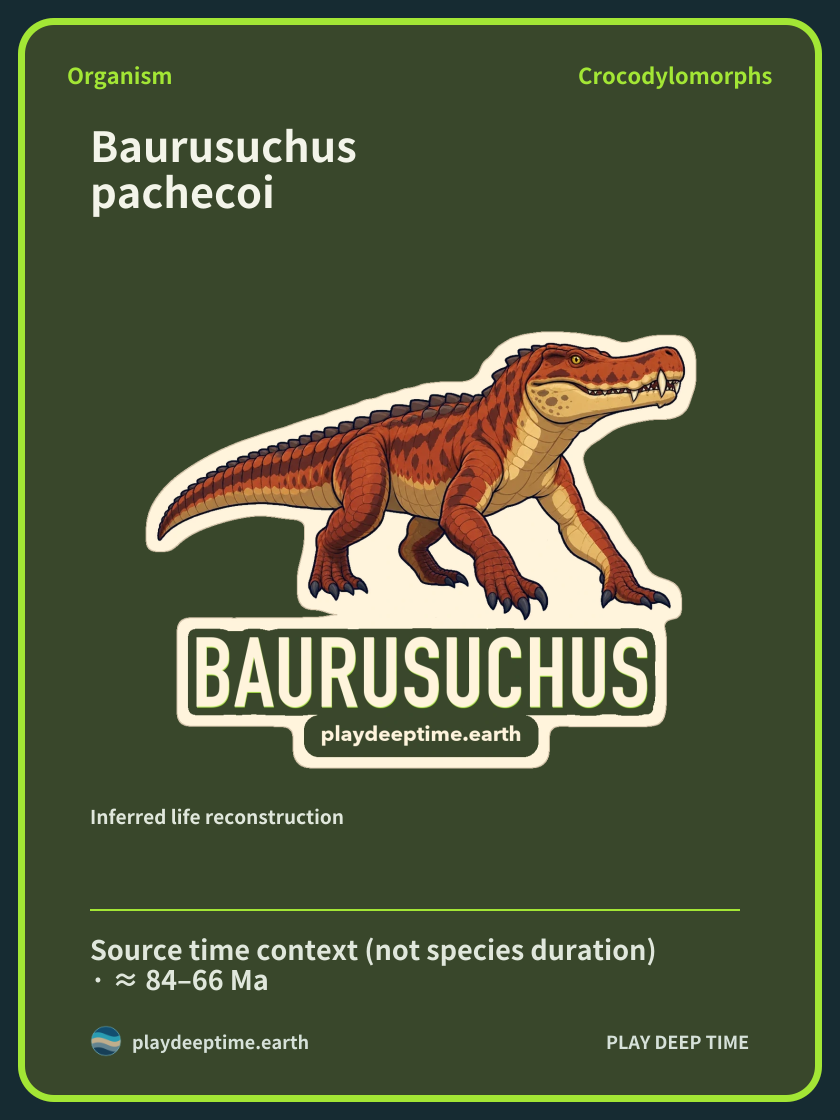
Inferred life reconstruction
Baurusuchus pachecoi
Overview
Baurusuchus pachecoi is a crocodile relative from Late Cretaceous Brazil. It gave its name to Baurusuchidae, a family with strikingly deep heads and large teeth. It evokes a terrestrial life different from that of today’s waterside crocodiles.[1][3]
Loading illustration…
Key facts
Not all crocodile relatives lived in water in the same way. Members of this family are studied for their tall snouts and strongly developed canine-like teeth. Their limbs also show features linked to moving on land.[3]
Time and place
It is associated with records from Late Cretaceous strata spanning roughly 84–66 million years ago. Fossils are known from the Bauru Basin in present-day Brazil. The basin’s diverse crocodyliforms offer a view of terrestrial ecosystems in South America during the age of dinosaurs.[2][1][3]
The time range describes source context, not the complete duration of this species.
Size, form and skeleton
The type specimen of this species, DGM229-R, preserves a skull and teeth. Baurusuchid heads are tall and laterally compressed, with prominent large teeth. Articulated skeletons of other members of the family are used to compare the relationship between the head and limbs.[1][3]
Baurusuchus pachecoi is a crocodile relative adapted to life on land. A 2026 study calculated a total body length of about 1.6m using a model with a skull length of 34.3cm as input. The result varies with the reconstructed proportions of the head and body, so it should be viewed as this study’s estimate.[4]
Loading illustration…
Habitat and reproduction
Baurusuchids are studied as crocodile relatives adapted to terrestrial predation. Their tall, narrow heads, strongly developed teeth, and limbs used for movement on land are compared together. This diversity is difficult to imagine from modern crocodiles lying by the water alone.[3]
Fossil discovery
Price named Baurusuchus pachecoi in 1945. A 2004 study reviewed related fossils from the Bauru Basin. Subsequent discoveries of new crocodyliforms allowed broader comparisons of the heads and bodies of this family.[1][3]
References
- Arruda, Carvalho & Vasconcellos2004 — Crocodylomorph fossils of the Bauru Basin
- Paleobiology Database — Fossil occurrence records for Baurusuchus
- Montefeltro, Larsson & Langer2011 — New fossils and evolution of Baurusuchidae
- Paiva et al. (2026) — Body-length estimates for crocodile relatives
- Buffetaut (1975) — Anatomy and classification of Bernissartia
Research questions
Do similarities seen in the head also extend to the body skeleton? Researchers compare the heads and articulated skeletons of different species to analyze relationships and locomotion. New specimens reveal the varied lives of terrestrial crocodile relatives.[1][3]
Observation
After looking at the tall snout and large teeth, move your gaze to the four legs supporting the body. Viewing the head and limbs together helps you understand the unfamiliar form of a terrestrial crocodile relative.[1][3]
Related organisms
 Bernissartia fagesiiCrocodylomorphsSource time context (not species duration) · ≈ 143–66 Ma
Different bodies among crocodyliforms
Explore the bodies of Baurusuchus pachecoi and Bernissartia fagesii together. Baurusuchus pachecoi: Baurusuchus pachecoi is a crocodile relative from Late Cretaceous Brazil. Bernissartia fagesii: Bernissartia fagesii is an Early Cretaceous crocodyliform known for a short snout and large eye sockets.