Organism · Crocodylomorphs
Bernissartia fagesii
Source time context (not species duration) · ≈ 143–66 Ma
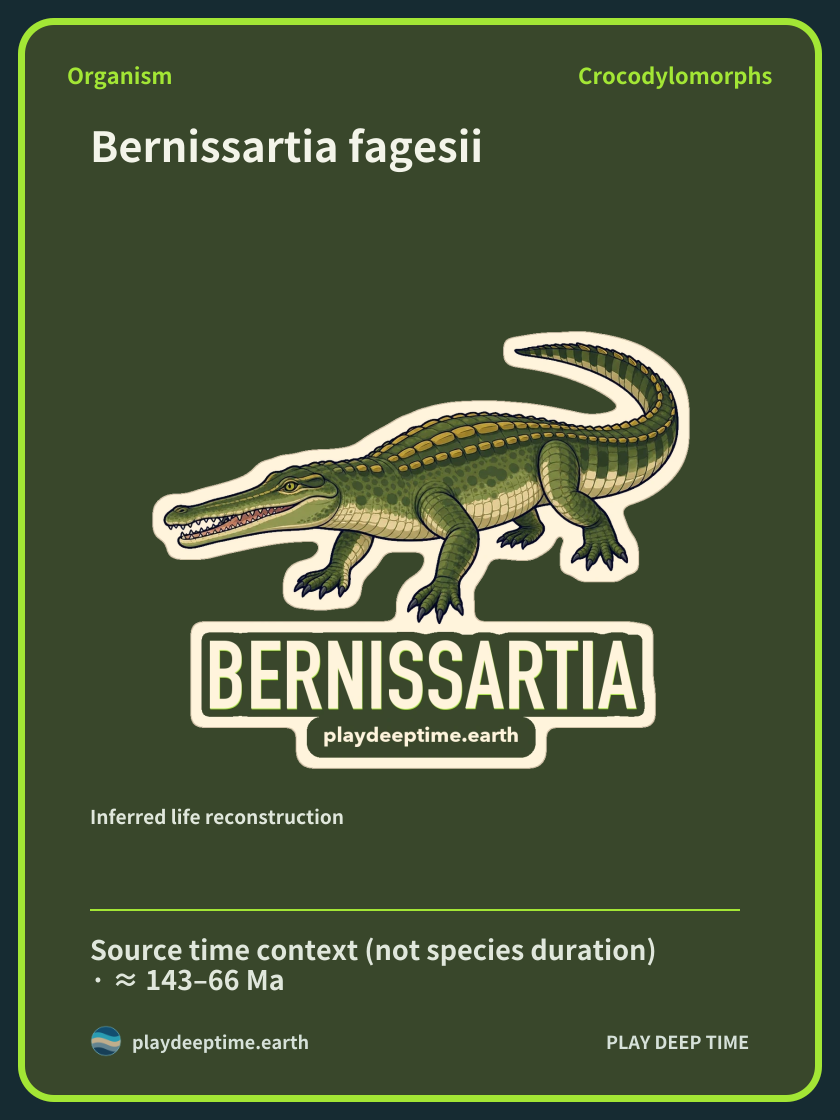
Inferred life reconstruction
Bernissartia fagesii
Overview
Bernissartia fagesii is an Early Cretaceous crocodyliform known for a short snout and large eye sockets. The nearly complete articulated skeleton R46 is reference material for studying the species. Within a familiar crocodile-like face and body, you can look for small curves and arrangements of dorsal osteoderms.[1]
Loading illustration…
Key facts
The snout has a distinct curve between the premaxilla and maxilla. Even a short snout is not a simple straight outline. Its overall length can be compared alongside the small bend where bones meet.[1]
Time and place
The literature addresses the skeleton from Bernissart, Belgium, and material from Galve in present-day Teruel, Spain. The Early Cretaceous was roughly 140–100 million years ago. Specimens from different regions are compared to study this crocodyliform’s features.[1][2][3]
The time range describes source context, not the complete duration of this species.
Size, form and skeleton
A short, curved snout, relatively large eye sockets, and a short anterior mandibular symphysis are described. The rectangular osteoderms on the back form more than two longitudinal rows. Alternating between head and back reveals different morphological features.[1]
Bernissartia fagesii was a small crocodyliform reptile about 60cm long from head to tail tip. Paleontologist Darren Naish introduced this size based on the nearly complete skeleton and other specimens.[4]
Loading illustration…
Habitat and reproduction
The osteoderms covering the back are arranged in several rows rather than forming a single smooth shell. A skeleton connecting the head and body axis allows the positions of each region to be examined. Observation can broaden from the short facial outline to the dorsal osteoderms.[1]
Fossil discovery
A 1975 study addressed the anatomy and classification of Bernissartia, and Spanish material was studied in 1990. Reference specimen R46 and other specimens were distinguished in comparisons. Later material meets earlier descriptions in a process of reexamining species features.[1][2]
References
- Buffetaut (1975) — Anatomy and classification of Bernissartia
- Buscalioni·Sanz (1990) — A small Bernissartia from Spain
- International Commission on Stratigraphy (2024) — Geological time chart
- Darren Naish — Early Cretaceous European crocodylomorph reptiles
- Sereno et al.2001 — Sarcosuchus, a giant African crocodyliform
Research questions
Does a nearly complete skeleton make every structure in the head clearly visible too? The skull of R46 is laterally compressed, and its palate is damaged. This material encourages reading the connections of a large skeleton together with the preservation of small regions.[1]
Observation
Move your gaze from the curve in the short snout and the large eye sockets to the back. Examining the longitudinal arrangement of rectangular osteoderms reveals different features of the head and body.[1]
Related organisms
 Sarcosuchus imperatorCrocodylomorphsSource time context (not species duration) · ≈ 143–66 Ma
Different bodies among crocodyliforms
Explore the bodies of Bernissartia fagesii and Sarcosuchus imperator together. Bernissartia fagesii: Bernissartia fagesii is an Early Cretaceous crocodyliform known for a short snout and large eye sockets. Sarcosuchus imperator: Sarcosuchus imperator is a giant crocodyliform with a long, broad snout.