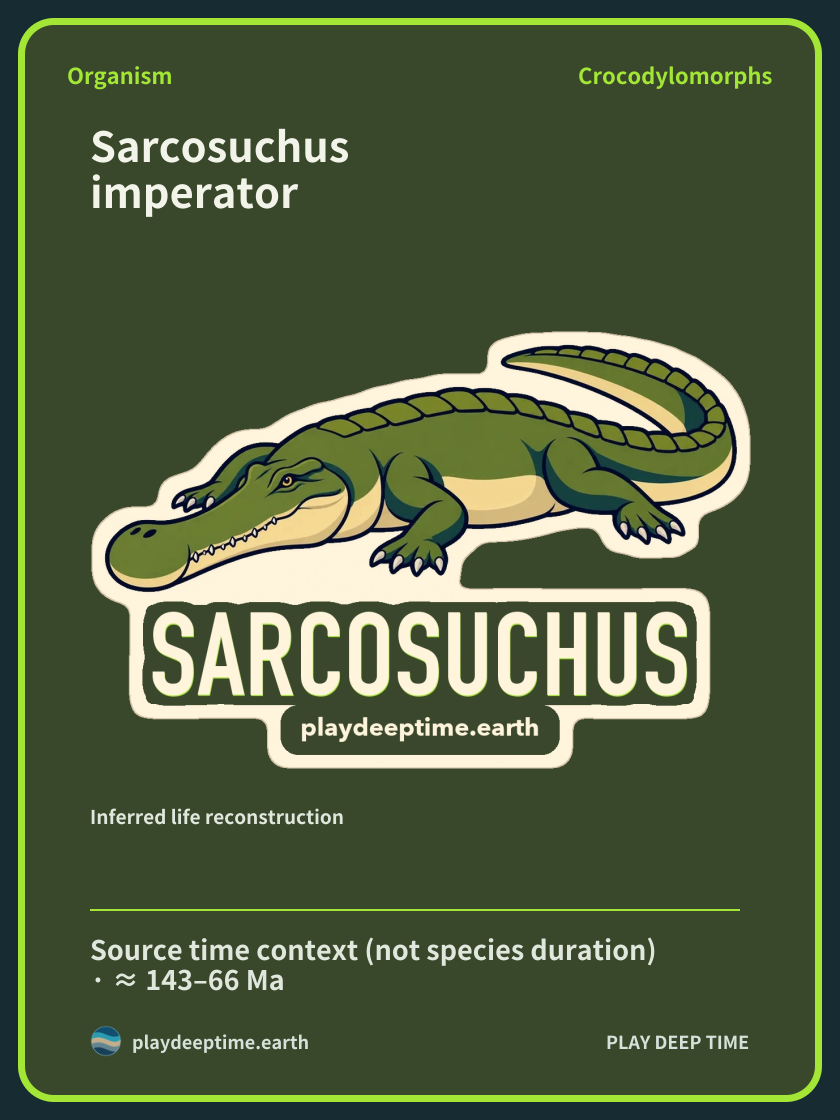
Organism · Crocodylomorphs
Sarcosuchus imperator
Source time context (not species duration) · ≈ 143–66 Ma
Inferred life reconstruction
Sarcosuchus imperator
Overview
Sarcosuchus imperator was an enormous crocodyliform with a long, broad snout. In adults, the snout widens further at its tip. Its low armor and elongated body reveal an unfamiliar crocodile relative of Cretaceous Africa.[1]
Loading illustration…
Key facts
How long did it grow to achieve such an enormous body? Researchers cut thin sections of body armor to examine growth lines. A 2001 study interpreted a prolonged period of rapid growth as contributing to its large size.[1]
Time and place
It is associated with Aptian–Albian material of the Early Cretaceous, around 110 million years ago. Skulls and partial skeletons are known from the Elrhaz Formation in present-day Niger. River sediments reveal an ancient river environment in what is now desert.[1]
The time range describes source context, not the complete duration of this species.
Size, form and skeleton
The adult snout is long and broad, expanding at its front end. Vertebrae, shoulder and pelvic bones, femora, and other skeletal material have been studied. Low armor extending from the neck to the middle of the tail helps reveal the long body’s outline.[1]
A 2019 study estimated a body length of about 9 m for large specimen MNN 604 by comparing its head width with living long-snouted crocodilians. This fossil reconstruction varies according to the crocodilians used for comparison.[2]
In the same study, a model correcting for body-mass differences between captive and wild crocodilians estimated about 2.4 tonnes. This is calculated from head width, not directly measured weight.[2]
Loading illustration…
Habitat and reproduction
In 2001, researchers interpreted it as a predator of river environments. Thick, smooth teeth and a broad snout were linked to a diet including large terrestrial vertebrates as well as fish. Skull, teeth, and sediments together reveal a river predator.[1]
Fossil discovery
In 1964, geologists surveying the Ténéré Desert in Niger found a partial skull of an enormous crocodyliform. It was named in 1966, and more specimens accumulated. A 2001 study expanded the story of body form and growth using new skulls and partial skeletons.[1]
References
Research questions
Why was the expanded snout tip shaped this way? Head proportions, teeth, and growth-related changes can be compared together. Including armor and the skeleton reveals more questions beneath its outward appearance.[1]
Observation
Follow the length of the snout to its expanded front tip. Then trace the low armor from neck through back to tail to see the body’s connections.[1]
Related organisms
 Simosuchus clarkiCrocodylomorphsSource time context (not species duration) · ≈ 143–66 Ma
Different bodies among crocodyliforms
Compare the bodies of Sarcosuchus imperator and Simosuchus. Sarcosuchus imperator: an enormous crocodyliform with a long, broad snout. Simosuchus: Simosuchus clarki is known for a blunt snout, short broad body, and short tail.