Organism · Vascular plants
Botryopteris forensis
Fossil record age bounds · ≈ 359–299 Ma
Inferred life reconstruction
Botryopteris forensis
Overview
Botryopteris forensis has been studied as a small fern that grew on tree trunks. In 1991, Rothwell reconstructed it spreading its fronds on another tree, based on stems entangled among roots and petioles extending outward.[1]
Loading illustration…
Key facts
The 1991 reconstruction shows small new plantlets near the bases of petioles and major frond divisions. Instead of viewing the complex frond only as a broad outline, look for the small points where new plants begin within it. Understanding leaves and stems leads to questions about how the plant multiplied.[1]
Time and place
The fossils in this study came from the Duquesne coal seam west of Steubenville in present-day Ohio, USA. The paper presented them as part of a Late Pennsylvanian, or late Carboniferous, fossil flora of the Appalachian Basin. Follow the time and place of this particular occurrence to encounter the small fern.[1]
The time range describes source context, not the complete duration of this species.
Size, form and skeleton
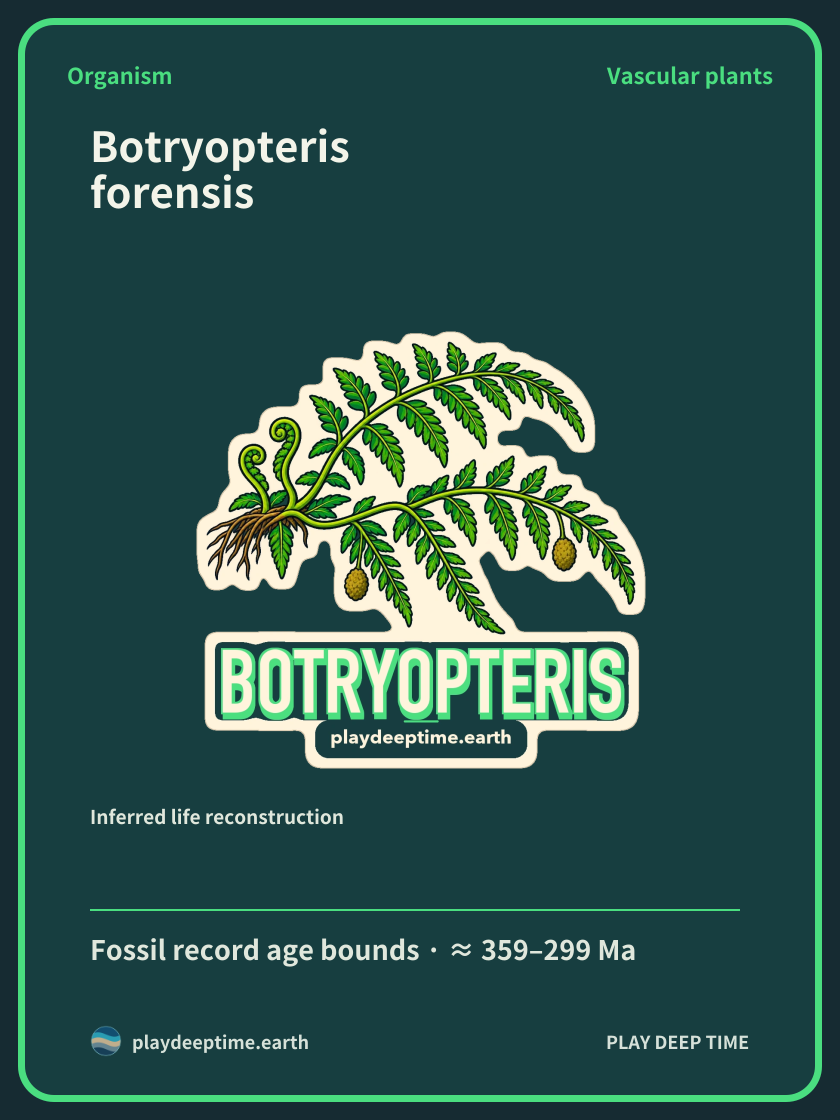
Petioles extended from a repeatedly branching base, and complex, several-times-pinnate fronds were reconstructed as spreading at their ends. Rather than standing straight upward, the fronds arched out nearly horizontally. Examine the contrast between small stems and widely spreading fronds.[1]
Botryopteris forensis was a fern that grew attached around the trunk of the large tree fern Psaronius. A 1991 reconstruction study suggested that large fronds could have reached approximately 30–40 cm. Spore-producing structures were reconstructed hanging downward among the repeatedly divided fronds.[4]
Loading illustration…
Habitat and reproduction
Stems and adventitious roots were found entangled in the root mantle of the tree fern Psaronius. Rothwell interpreted this connection as evidence of an epiphytic life growing on tree trunks. The reconstruction also showed rounded reproductive organs hanging downward in place of some frond divisions.[1]
Fossil discovery
Plant cell structures were preserved by minerals inside coal balls. The researchers examined them using the peel technique, lifting structures from rock surfaces onto thin cellulose acetate films. Rock pieces, peels, and slides numbered OUPH9518–9527 were listed as paleobotanical material at Ohio University.[1]
References
Research questions
Other studies have separated fossils with similar stems and leaves into different species using microscopic structures on spore surfaces. Rothwell treated the Duquesne material, which lacked preserved spores, as Botryopteris forensis. It is intriguing that tiny spore patterns connect with the name of an entire plant.[1]
Observation
The illustration focuses on the aboveground parts of the small fern, based on Rothwell’s 1991 reconstruction. Complex frond divisions have been simplified for clarity. The positions of the hanging, rounded reproductive organs are depicted as an arrangement inferred from fossil form.[1]
Related organisms
 Sphenopteris pottsvilleaSeed plantsFossil record age bounds · ≈ 319–307 Ma
Different clues preserving Carboniferous plants
Sphenopteris from Alabama was studied in the early Pennsylvanian Pottsville Formation, while Botryopteris from Ohio came from the later Duquesne coal seam. Comparing feather-like frond fragments with stems entangled among roots shows how questions about plants differ with the parts preserved as fossils.