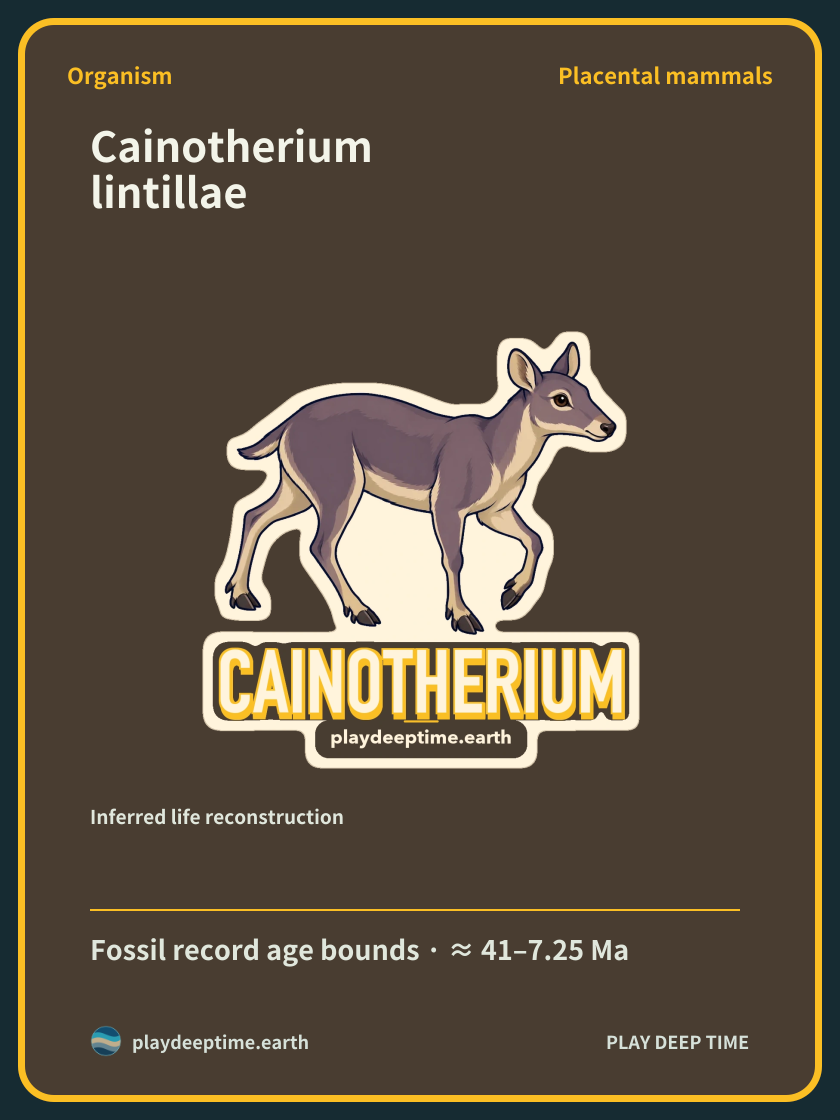
Organism · Placental mammals
Cainotherium lintillae
Fossil record age bounds · ≈ 41–7.25 Ma
Inferred life reconstruction
Cainotherium lintillae
Overview
Cainotherium lintillae is a small artiodactyl from Miocene Europe. It is studied through comparisons of jaw and tooth proportions. Small differences in similar-looking teeth have sometimes changed the name and history of a species.[1][2]
Loading illustration…
Key facts
It was not originally named as a separate species. In 1974, it was introduced as a subspecies of another species. Later comparisons of tooth size and proportions prompted repeated discussion of its taxonomic placement and rank.[1]
Time and place
It connects with Early Miocene material from present-day France, around 20 million years ago. Localities including Espira-du-Conflent, Estrepouy, and several in the Loire region have been studied. A partial lower jaw preserving teeth was also presented from Mauvières.[1][2]
The time range describes source context, not the complete duration of this species.
Size, form and skeleton
Mauvières specimen ULB-MAUV-22 preserves the fourth premolar through the second molar. Relative premolar and molar sizes are central to comparisons. Placing it alongside other species of the genus reveals differences in tooth arrangement and proportions.[2][1]
For the subspecies lintillae of Cainotherium lintillae, the combined length of the first through third upper molars is estimated in the literature at approximately 14.5 mm. This is a small jaw with three molars arranged within approximately 1.5 cm.[8]
Loading illustration…
Habitat and reproduction
Teeth arranged along a jaw provide evidence for investigating food-processing structures. Researchers compared premolar-to-molar proportions across several species of the same genus. Questions about lifestyle can begin in small regions such as jaws and teeth.[1]
Fossil discovery
Baudelot and Crouzel introduced material from Espira-du-Conflent, France, as a new subspecies in 1974. Later researchers compared teeth from other localities, and in 1995 it was treated as a separate species. New localities and measurements have continued to change the story of its name.[1]
References
- Berthet2003 — Classification and teeth of Cainotherium
- Gagnaison et al.2023 — Fossil mammals from Mauvières
- Berthet2003 — Classification and teeth of Cainotherium
- Gagnaison et al.2023 — Fossil mammals from Mauvières
- Gardner (1999) — Redescription of Albanerpeton from France
- International Commission on Stratigraphy (2024) — Geological time chart
- McGowan (2002) — Bodies and classification of albanerpetontids
- Berthet (2003), Le genre Cainotherium (Mammalia, Artiodactyla), Documents des Laboratoires de Géologie de Lyon 159
Research questions
Does a small size difference indicate a separate species? Later research considered tooth shape and proportions alongside locality and age. This is taxonomic research assessing small differences in connection with several kinds of evidence.[1]
Observation
Distinguish the front premolars from the rear molars within the jaw. Proportions among teeth, as well as overall body size, provide clues to ancient animals.[2][1]
Related organisms
 Albanerpeton inexpectatumLiving amphibian lineageSource time context (not species duration) · ≈ 23–5.33 Ma
Mammals and amphibians of Miocene France
Examine the jaws and teeth of Cainotherium separately from the jaws and frontal bones of Albanerpeton. Miocene material from different localities in present-day France reveals distinct faces of a small artiodactyl and an amphibian.