Organism · Ciliophora
Calpionella alpina
Fossil record age bounds · ≈ 149–133 Ma
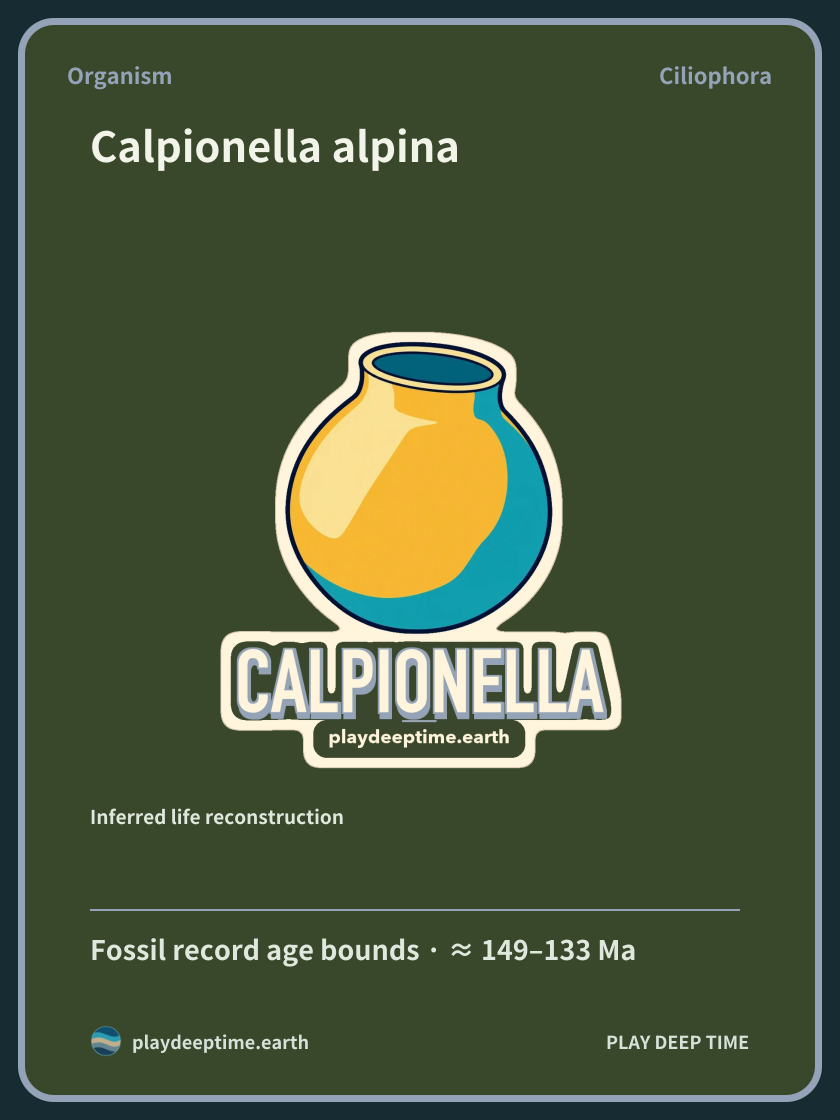
Inferred life reconstruction
Calpionella alpina
Overview
Calpionella alpina is a protist studied through a small fossil shell called a lorica. Its rounded body and short neck-like region stand out. This tiny outline connects with comparisons of the ages of rock layers.[1]
Loading illustration…
Key facts
Calpionellids are important fossils for correlating the ages of distant rock layers. Changes in their small body forms and their wide distributions help connect rock records across regions.[1]
Time and place
The material in this study came from the Early Cretaceous Padhi section in present-day Hidalgo, Mexico. It is recorded in limestone at horizon CEP-1.005, allowing tiny fossils to be traced within a specific rock layer.[1]
The time range describes source context, not the complete duration of this species.
Size, form and skeleton
The lorica is spherical to nearly spherical, with a short cylindrical collar distinct from the body. The opposite end is slightly angular and lacks a long, tail-like projection.[1]
The shell described in this study is approximately 60 µm long. This is approximately 0.06 mm, a size examined under a microscope.[2]
The shell width reported in the same study is approximately 50 µm.[2]
Loading illustration…
Habitat and reproduction
The studied strata are associated with a deep-marine basin depositional environment. Calpionellids, small bivalve fragments, and occasional sponge spicules in limestone are examined together to understand the ancient sea.[1]
Fossil discovery
Lorenz described Calpionella alpina in 1902. Research on the Padhi section in Mexico compared several calpionellids and reassessed this species’ form and fossil-bearing horizons.[1]
References
- Study of the Padi section — Morphology and strata of Calpionella alpina
- Calpionélidos de la transición Berriasiano-Valanginiano en la Sección Padhi, centro-este de Hidalgo, México: sistemática y bioestratigrafía
- Nakkady (1950) — Transcription of the original description of Globotruncana aegyptiaca
- Mikrotax — Stratigraphic distribution of Globotruncana
Research questions
The same fossil can look different in an oblique section. To distinguish forms resembling Calpionella elliptica, researchers compare both outlines and the rock layers in which they occur.[1]
Observation
In the illustration, examine the connection between the rounded lorica and the short collar. Follow the difference between the collar end and the opposite end to read the orientation of this small form.[1]
Related organisms
 Globotruncana aegyptiacaGlobothalameaFossil record age bounds · ≈ 83.6–3.6 Ma
Records of the sea in tiny shells
Explore different records of bodies and time in these two organisms. Calpionella alpina: a protist studied through a small fossil shell called a lorica, with a rounded body and short neck-like region. The material in this study came from the Early Cretaceous Padhi section in present-day Hidalgo, Mexico, recorded in limestone at horizon CEP-1.005. Globotruncana aegyptiaca: a foraminifer that formed chambers spreading like petals; one cell produced a small shell divided into several chambers. It is associated with seas of the Late Cretaceous Campanian and Maastrichtian stages, with a microfossil catalogue occurrence range spanning roughly 74–68 million years ago.