Organism · Flowering plants
Ceratophyllum demersum
Present
Living species illustration
Ceratophyllum demersum
Overview
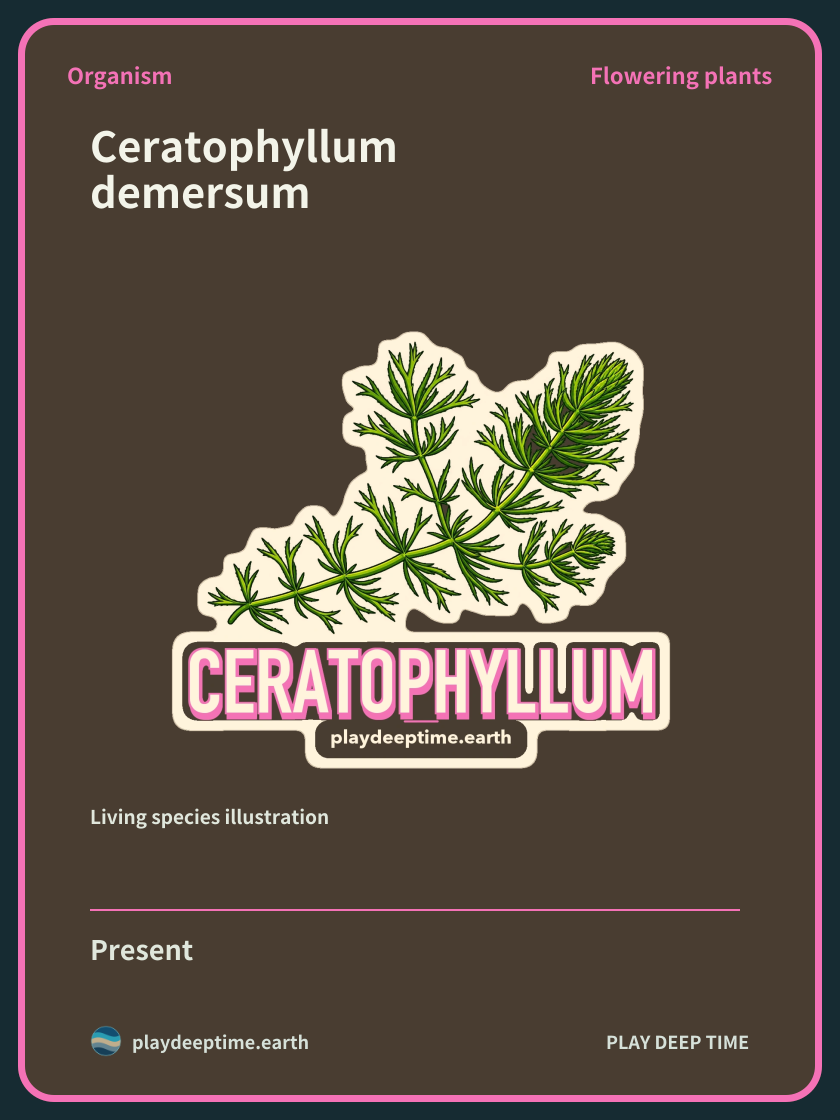
Ceratophyllum demersum, or rigid hornwort, is an aquatic plant that grows submerged or floating in water. Slender leaves gather around its stem and fork again toward their tips. Its rootless body, small flowers, and spiny fruits make it an intriguing plant.[1][3]
Loading illustration…
Key facts
The parts anchoring it like roots are actually specialized branches. The family description explains that the rootless body can be secured by these branches. Looking at an aquatic plant invites consideration of both shape and organ identity.[3]
Time and place
It is a living submerged plant native to many parts of the world. Kew’s plant checklist gives a cosmopolitan native range and separately classifies New Zealand’s North Island as an introduced area. Its living distribution can be explored alongside regional floras.[4]
The time range describes source context, not the complete duration of this species.
Size, form and skeleton
The flora reports stem lengths of approximately 30–150 cm. Stiff, dark green leaves gather around the stem and fork once or twice. Small teeth on the slender leaf segments and pointed tips are also characteristic.[1]
Loading illustration…
Habitat and reproduction
It grows underwater with long, slender, branching stems. The genus description states that small unisexual flowers occur singly in the leaf axils. The black nut is described as having two basal spines and a terminal spine, revealing reproductive structures different from the leaves.[1][2][3]
Fossil discovery
The 1988 New Zealand flora described the body at species, genus, and family levels. It connects the species’ branching leaves and spiny fruits with the rootless body of the broader group. One small aquatic plant illustrates several levels of botanical classification.[1][2][3]
References
- Ceratophyllum demersum — Species description
- Flora of New Zealand — Ceratophyllum
- Flora of New Zealand — Ceratophyllaceae
- Kew — Present-day distribution of Ceratophyllum demersum
- Gomez et al. (2015) — Montsechia, an ancient aquatic angiosperm
- Webb et al. (1988) — Species description of Ceratophyllum demersum
- Flora of New Zealand — Ceratophyllaceae
- Kew — Present-day distribution of Ceratophyllum demersum
- Flora of New Zealand — Ceratophyllum
Research questions
Are slender underwater structures leaves, roots, or branches? Examine their attachment positions, branching shapes, and the locations of flowers and fruits together. Distinguishing similar-looking parts is a way to understand a plant’s body.[1]
Observation
Follow the stem to find positions where leaves gather in whorls. Examining how a leaf forks once or twice and narrows to slender tips gradually reveals the aquatic plant’s complex outline.[1]
Related organisms
 Montsechia vidaliiMontsechiaSource time context (not species duration) · ≈ 130–125 Ma
An ancient aquatic plant and living rigid hornwort
The Montsechia researchers examined many fossil stems but found no roots. Living rigid hornwort is a rootless aquatic plant. Comparing stems and leaves of two plants from different times invites us to consider possible body arrangements for life underwater.